Developers of the massive SpaceX data center proposed near Willcox will rely mostly, if not completely, on renewable sources such as solar and wind energy for electric power and not fossil fuel-burning coal and natural gas plants, said the head of a Southeast Arizona power company that will supply electricity to the center.
New research shows that large data centers nationally that operate at or near the scale of the one proposed for Cochise County are currently emitting copious amounts of greenhouse gases from fossil fuel-burning power plants.
But for SpaceX's Arizona project, “We understand their focus is on renewable projects,” said Patrick Ledger, CEO and executive vice president of the Arizona Electric Power Cooperative Inc..
People are also reading…

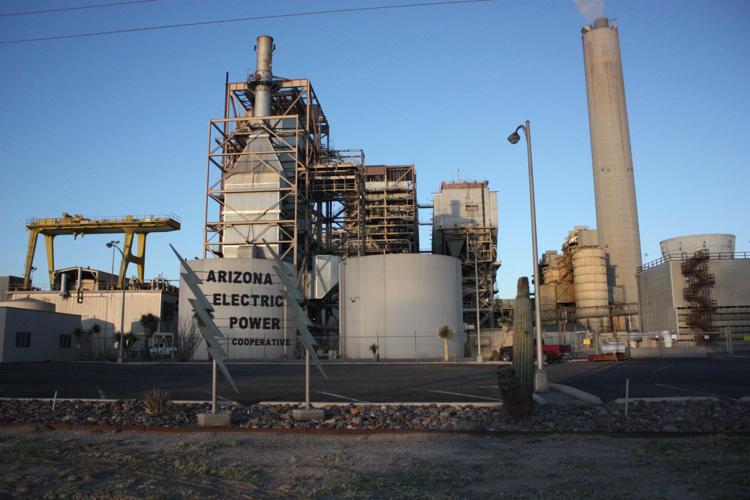
Arizona Electric Power Cooperative runs the Apache Generating Station, shown in this photo, which is near the proposed SpaceX data center near Willcox. The cooperative's power generation won’t directly supply the data center with locally produced power, but will buy electric power — mostly renewables such as solar and wind energy — from outside sources to be sold in Southeast Arizona for the data center's use, says Patrick Ledger, CEO of the cooperative.
That's a nonprofit company that runs various power-generating plants at Apache Generating Station, which adjoins the proposed SpaceX operation. They include facilities powered by coal, natural gas and solar energy.
The cooperative's power generation won’t directly supply the data center with locally produced power, but the cooperative will buy electric power from outside sources to be sold in Southeast Arizona for the data center’s use, Ledger said.
“They’ve told us they don’t want the project to have impacts on local water supplies and there will be no industrial water use, and they want to pull from solar and wind facilities to provide power,” said Ledger, whose company runs the Apache Generating Station that lies about 80 miles east of Tucson.
Will eventually need power lines built
The SpaceX project, to be built in four phases, will require nine buildings, each about 493,000 square feet in size, on a 747-acre site. The aerospace company led by Elon Musk says it will invest $50 billion in the facility, including $3.6 billion in upgrades to the region’s electric grid, and to create 5,000 construction jobs and 1,000 permanent jobs. The center would lie on the edge of Willcox Playa, east of U.S. Highway 191.

SpaceX CEO Elon Musk
But while the SpaceX project will rely on existing electric power transmission lines for energy during its first of four phases of operations, eventually the data center will require construction of new power lines, Ledger said.
The co-op’s power plants won’t be serving the SpaceX project, but its transmission lines will deliver the power to the center, and the Arizona Electric Power Cooperative will sell electricity wholesale to another provider that will sell it to the data center.
Just last June, the 550-mile-long SunZia power line was finished across lands in the San Pedro River Valley lying north and east of the proposed data center site, but the wind energy it carries from Arizona and New Mexico is already subscribed, so it can’t be used for this new facility, Ledger said.
SunZia's history, which includes unsuccessful environmental and tribal lawsuits, and a prolonged dispute over its height and location near the San Pedro River, shows that power transmission projects can be as controversial as power plants or data centers. The SunZia project took two decades to get permitted and built before it started to deliver energy.
Opponents seek delay
The SpaceX project has stirred widespread public interest and considerable opposition since backers announced it at the end of October. Opponents have raised concerns about its water and power uses, potential fire hazards from on-site battery storage, potentially harmful effects from lighting and noise, and its possible impacts on sandhill cranes and other migratory birds that habituate the nearby Willcox Playa.
The project is scheduled to go before the Cochise County Planning and Zoning Commission for a Dec. 9 vote on a special use permit. But opponents are seeking a delay because of the project's enormous scale and scope, and on Thursday, Arizona Attorney General Kris Mayes joined them, saying she wants a county decision delayed “until it has been thoroughly vetted by the relevant state and federal regulatory authorities.”
Opponents of the SpaceX data center are skeptical of any verbal commitment from developers to use renewable energy. That’s not least because the company’s application to Cochise County for the special use permit to build the center says nothing about where its power will come from beyond saying, “the electric grid.”
Ledger said that before Cochise County officials make a final decision on this project, the company will agree to make legally enforceable commitments to use renewable energy. He also cited the project’s plans to build an extensive network of batteries to store electricity for use in case of disturbances and interruptions of outside electrical services.
It would be one of the largest such battery networks in the U.S., and such battery complexes typically are associated with the use of solar and wind energy. Those energy sources must rely on batteries to provide backup power because they operate only intermittently — when the sun shines and the wind blows.
Michael Gregory, a longtime Southeast Arizona environmentalist who opposes the data center, said the current uncertainty about the project’s willingness to use renewable energy is one more reason why the project’s approval should be delayed.
“One of my main concerns is all of the increases in generation that will be required at the Apache Generating Station to power the data center,” said Gregory. “I do not trust this process. I do not trust SpaceX at all. Any agreement, any statement of that sort about the use of renewable energy has to be put into whatever agreement that the county makes with them, and guaranteed ahead of time before any agreement is signed.”
The information about the need for future transmission lines “is just one more piece of information that the public and the Planning and Zoning Commission will not have had time to examine before the (Dec. 9th) vote,” said Gregory, who lives in McNeal, a small community lying about 45 miles south of the proposed data center site and 15 miles northeast of Bisbee.
While SpaceX’s reported plan to rely on imported renewable power is better than increasing power output from Apache Generating Station, Gregory said, he added, “Again, that is brand new information, another change ... another reason to delay.”
‘Commitments will be enforceable’
This past week, Harvard University researchers released a widely reported study of 403 very large data centers across the U.S., commonly called hyperscale data centers because of their size and scope of operations. Researchers found that over 11 months through April 2025, they produced about 28 million tons of carbon dioxide — more than produced by the entire country of Denmark — and that roughly 54% of their electric generation was supplied by fossil fuel sources, the Associated Press reported. Their findings were published in the scientific journal Nature Sustainability.
The Star has tried, unsuccessfully so far, to reach SpaceX officials for comments on the Arizona data center project.
But Ledger said he thinks SpaceX should and will make explicit commitments to use renewable energy.
He said this will happen as part of an agreement still under negotiation between the data center company, the Arizona Electric Power Cooperative and the Sulphur Springs Valley Electric Cooperative. Arizona Electric Power Cooperative will buy power from the grid and sell it to the Sulphur Springs Valley cooperative, which in turn will sell it on a retail basis to homes and businesses across Southeast Arizona.
“Those commitments will be enforceable,” Ledger said. “Presumably, certain conditions will be required by the county as part of this permit, and those will also be enforceable.”
The first step will be for SpaceX to obtain the necessary planning and zoning approvals from Cochise County, he said — including the special use permit. The next step will be for the Arizona and Sulphur Springs power cooperatives and SpaceX to negotiate the service agreement — an agreement that will require Arizona Corporation Commission approval.
The reason SpaceX is interested in Apache Generating Station is that besides its energy generating plants, which include a coal-fired plant, natural gas generating stations and a new solar energy generating plant, “We have a very flexible service arrangement, and we can provide all the services a large facility has, and all the services that the Sulphur Springs cooperative will need to properly serve SpaceX,” Ledger said.
“We are not taking a position to advocate for the project, we’re simply doing a technical evaluation of their system’s impacts,” he said.
Contact Tony Davis at 520-349-0350 or tdavis@tucson.com. Follow Davis on Twitter@tonydavis987.

Tony Davis
Reporter