The teens behind me were boisterous, trying out insults on each other, but not even distracting me from reading the newspaper until the driver stopped the bus and started walking back.
I turned around and realized that one of the teens in a group of five apparent friends was hitting the other, sort of playfully but sort of not. The driver, a woman, told all five they had to get off. They did.
Standing-room passengers in the packed No. 8 bus squeezed into their vacated seats, and the ride went on down Broadway.
Things worked the way they’re supposed to, at least on my Monday afternoon ride home.
It came on a day city officials were publicly pushing new policies to ensure things go much more as they’re supposed to on Tucson’s transit system than they have.

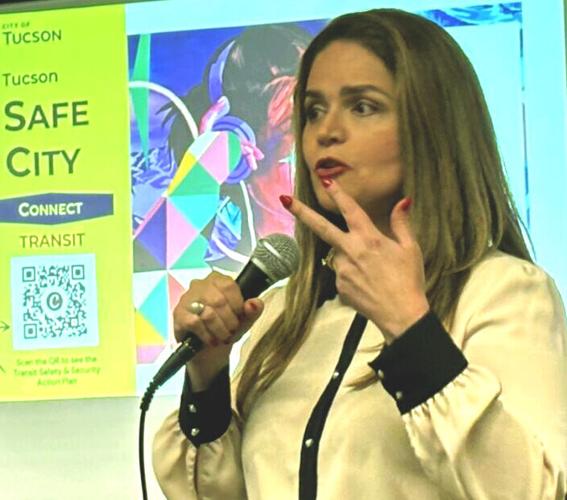
Mayor Regina Romero speaks at a public meeting on the city’s transit safety earlier this month at the Ward 2 City Council office.
Earlier Monday, after I had traveled downtown on an uneventful Sun Tran ride, I heard the mayor, assistant city manager, police chief, transportation director and other officials explain how they are trying to ensure the city’s transit system is safe, along with other aspects of Tucson’s transportation network.
People are also reading…
Police officers, security guards, community volunteers and, soon, transit ambassadors are all being mobilized to monitor especially the most troublesome routes and stops. They call the effort the Transit Safety and Security Action Plan, and the mayor’s office has made it part of her broader Safe City Initiative, which launched in October last year.
This effort comes in the wake of building frustration about safety on buses, streetcars and at stops and transit centers. There was a series of stabbings among passengers and attacks on bus operators in 2025 and 2026. Sun Tran operators even authorized a strike over safety issues this summer before agreeing to a new contract that includes safety improvements for them.
It took a long time for the city leadership to respond to transit safety issues, especially after Jacob Couch was killed at a downtown stop in April 2025. It also took a long time for the city leadership to confront our public-safety crisis in general. They finally kicked into gear after Enrique "Kix” Mercado was killed during a group ride on The Loop in September 2025.
The next month, Mayor Regina Romero launched the Safe City Initiative. And now, safety is a regular part of her public comments.

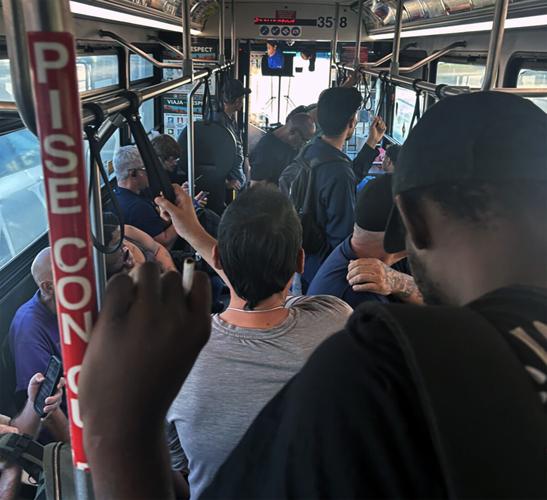
Passengers fill a SunTran bus Monday as it travels along East Broadway. Tucson is building up a transit-safety program.
“As mayor, my biggest responsibility is to have a safe city for all, no matter the zip code you live in, and no matter your salary at the end of the year,” she said Monday, echoing comments she made during recent meetings on transit safety. “ We all deserve safe spaces in our neighborhoods, and in our transit system and schools.”
The week of Aug. 10-14, the city held four meetings that they labeled, because everything needs branding, Safe City Connect. These were public meetings on the city’s Transit Safety and Security Action Plan, and I attended the last one, at the Ward 2 office.
The upshot of that and the roundtable I attended Monday, as it pertains to transit, is this.
• During the first two weeks of school, about 100 volunteers went to Sun Tran bus stops used by school children to help them and ensure things went well. It was a short-term project but potentially replicable.
• The police department has all the information on safety incidents from the city and Sun Tran and will deploy officers to buses and stops on the most troubled routes. Those tend to be on North Oracle Road, South Sixth Avenue, East Fort Lowell Road and East Speedway.
• The city will soon hire six full-time transit ambassadors, who ride buses, go to transit centers and help newcomers use the bus, a concept pioneered in Albuquerque.
• The city will continue reengineering stops so that they are well lit, have good sightlines and have fewer spaces for people to hang out and do drugs around them.
“If a bus stop looks unclean, it is perceived as being unsafe,” said Sam Credio, director of Tucson’s Department of Transportation and Mobility.
That’s a simple insight, maybe even obvious, but acting on it could have a solid impact for those on the fence about riding the bus.
What the city officials aren’t talking about for now is the controversial policy of continuing to subsidize fares completely. They decided earlier this year to extend the free-fare policy that began in 2020 for another year, despite its approximately $10 million cost. They’ll revisit that for the budget year that begins July 1, 2027.
This new transit safety plan is being paid for in large measure by $2.15 million from the Regional Transportation Authority plan and was approved in June by the City Council.
It won’t eliminate problems on buses or at stops and transit centers. These are reflections of the society we live in. But if the plan encourages more people to ride, that could on its own create a better sense of security.
“When you have more people on the bus, there’s less likely to be problems because there are more people around to be a witness and potentially intervene,” Ward 6 Council Member Miranda Schubert told me.
That’s something I felt in the moment between when the driver asked the teens to get off the bus Monday and when they actually started moving. There were more than 30 adults on board waiting for them who would not have tolerated dawdling as we went home, to work or otherwise got on with our lives.
Contact columnist Tim Steller at tsteller@tucson.com or 520-807-7789. On Bluesky: @timsteller.bsky.social

Tim Steller
Columnist

 Tim Steller’s column: Contract dispute shows Tucson politics changing