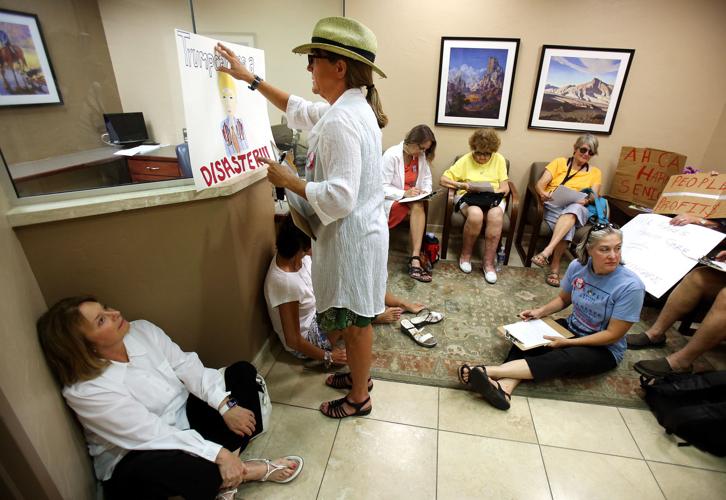
An AARP television advertisement airing in Arizona again this week takes aim at federal health reform and is targeted to U.S. Sen. Jeff Flake.
Republicans have a slim 52-48 majority in the Senate, and opponents of the American Health Care Act of 2017 (AHCA) are heavily lobbying Republican senators like Flake who are viewed as possible “no” votes.
The AARP ad features a couple visiting a financial-services company not-so-subtly called “Ryan and Associates” (House Speaker Paul Ryan has been one of the bill’s most-vocal proponents).
People are also reading…
One of the first things the financial adviser tells the couple in the ad is that since they are over 50, their health insurance is about to get more expensive due to a so-called “age tax” in the bill.
And also, the man’s asthma means insurers can charge consumers “thousands more,” the adviser tells the bewildered couple.
Flake responds
Reactions to the ad from health-care experts contacted by the Star last week were mixed, with some critics pointing out that the health-care bill that passed the House 217-213 on May 4 will be changed before the Senate votes on it.
When asked for a response to the ad, that’s what Flake, an Arizona Republican, said, too.
“The AHCA isn’t expected to come up for a vote in the Senate, so the Senate is drafting its own legislation,” Flake spokesman Jason Samuels wrote in an email. “Once that bill is written, released, reviewed, and scored we’ll have more clarity on its impacts.”
The ad started airing May 23 on Tucson and Phoenix television stations and will run until June 11.
It targets five U.S. senators, including Flake, say AARP officials. The other senators are Lisa Murkowski and Dan Sullivan of Alaska, Cory Gardner of Colorado and Dean Heller of Nevada. “Tell your senator: Vote ‘no’ on the healthcare bill,” the ad says.
AARP, the nation’s largest seniors group, made a “six-figure buy” for the ad in Arizona, as it did in each of the other three states targeted, said Alez Juarez, communications director for AARP Arizona.
Support for the ad’s claims
The language of the AHCA does not include the term “age tax” that’s used in the ad. But the ad does give consumers accurate information about the bill passed by the House, said health-policy expert Dr. Dan Derksen, who is director of the Arizona Center for Rural Health at the University of Arizona.
“The AARP isn’t referring to some possible legislation, whatever ends up being introduced by the Senate. It’s absolutely accurate on the AHCA,” Derksen said.
The House version of the AHCA does allow insurers in 2018 to charge older enrollees five times more than younger enrollees, Derksen said. Under the current Affordable Care Act law, which was passed under President Obama, insurers are allowed to charge older enrollees up to three times more than younger people.
“So the AARP ad is correct,” Derksen said.
The AHCA also allows states to waive many of the Affordable Care Act’s most popular consumer protections and thereby stop requiring insurers to include essential health benefits such as preventive services, newborn care and maternity coverage, Derksen said. It would also enable states to go back to charging more for pre-existing conditions if a person had not maintained continuous coverage, he said.
Criticism
And therein lies one of the problems that critics have with the ad. Most people with a pre-existing conditions aren’t going to allow their coverage to lapse, said Ray Magnuson, a Tucson health-insurance broker and owner of Magnuson & Associates. He calls the ad “disingenuous” and “misleading.”
“All these ads are in that gray area where you can’t say it’s an outright lie,” he said. “But it’s making assumptions.”
States will indeed be allowed to apply for waivers under the AHCA, and they will be able to apply to charge more for pre-existing conditions. However, in order to get a waiver the states “have to jump through five different steps,” said Maguson, an incoming regional vice president of the National Association of Health Underwriters.
“I think the ad is a lot of political posturing,” said Naomi Lopez Bauman, director of health-care policy for the conservative-leaning Goldwater Institute in Phoenix.
“We already know the House bill is completely independent of what the Senate is working on. ... The Senate has signaled quite clearly they are working on their own legislation,” she said.
Lopez Bauman thinks the Senate bill will address the so-called “age tax” and look more at income rather than age when structuring premium subsidies.
“There is a lot to be sorted out and we’re still early in the process,” she said. “The ad is not particularly educational. It’s political.”
The purpose of the ad is to make sure folks in Arizona “know we’re watching,” said AARP’s Juarez.
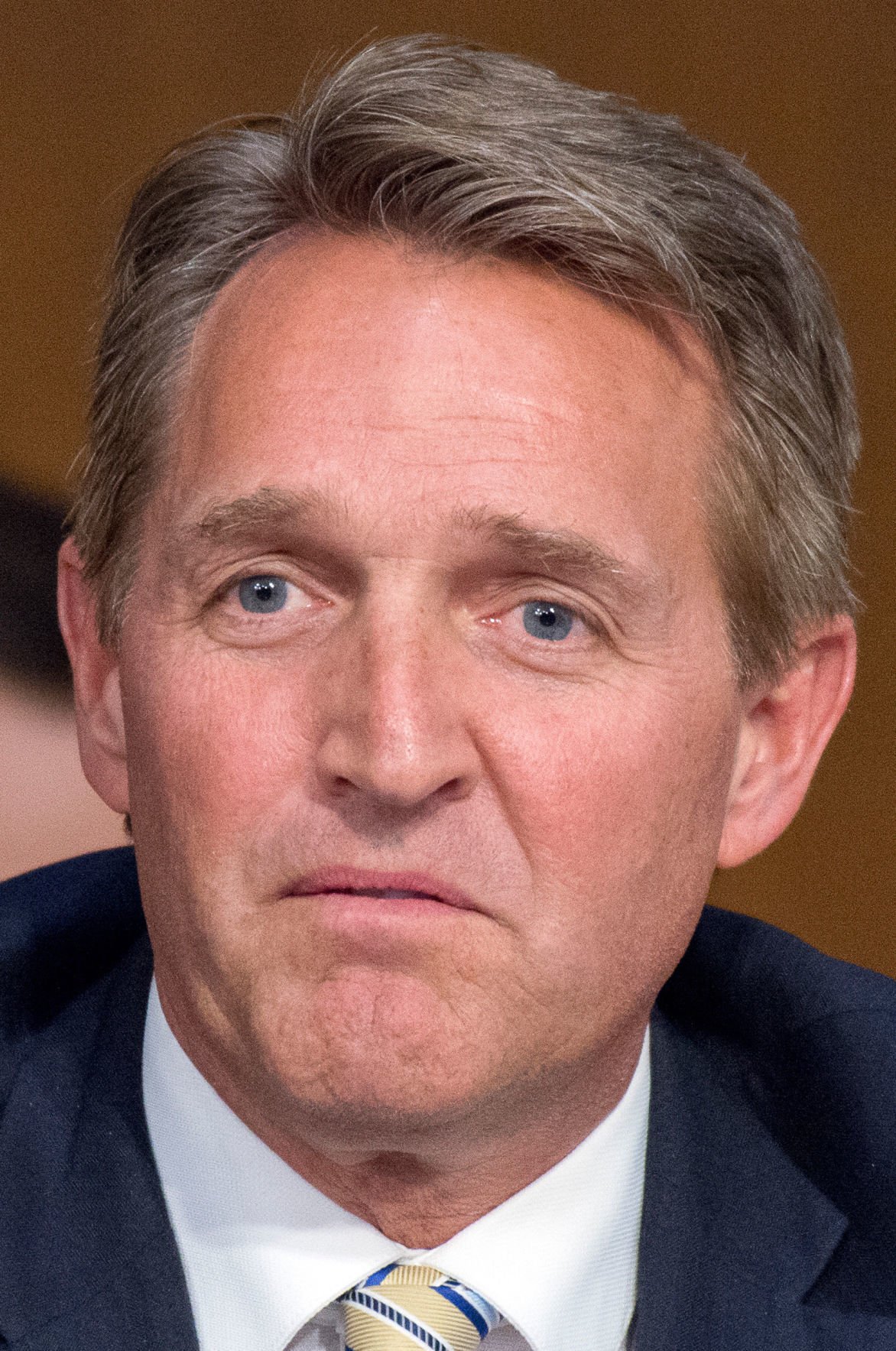
Jeff
Flake
Contact health reporter Stephanie Innes at 573-4134 or email sinnes@tucson.com. On Twitter:
@stephanieinnes