
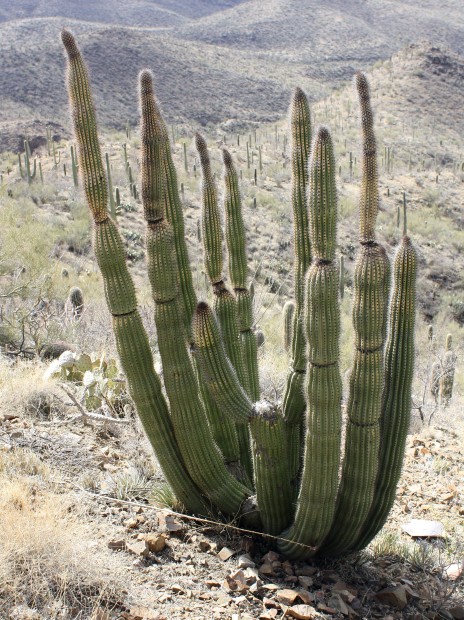
A crew surveying plants at Saguaro National Park west of Tucson has made a "shocking" discovery: a mature organ-pipe cactus growing among the saguaros.
"It was a very exciting find - very unexpected," said Andy Hubbard, network program manager with the Sonoran Desert Inventory & Monitoring Network.
"It's the only organ pipe known to be growing in the park," Hubbard said. "This was a fairly shocking discovery for members of the crew."
The find is significant because the big cacti - with arms somewhat resembling organ pipes - are almost completely limited in this country to warm, low-elevation deserts at Organ Pipe Cactus National Monument south of Ajo. A few lone plants have taken root elsewhere in Southern Arizona, but cold winter weather keeps the species from flourishing in the wild here.
Organ pipes thrive in parts of northern Mexico.
People are also reading…
Hubbard said a crew from the monitoring network, which is a part of the National Park Service, found the Saguaro Park specimen in February in a "sort of protected micro-site."
"It's on a west-facing slope that's probably warmer" than other sites in the area, he said. That might be why it has survived at a higher, colder elevation than its normal range.
Hubbard said the site is miles from park roads and well away from popular trails.
The remote location might explain why no one apparently has found the cactus during its 10 or more years of life.
"It's not open for general public access. It's an area where people should stay on trails," Hubbard said.
He said botanists and ecologists have two theories as to how organ-pipe cactus seeds found their way to Saguaro Park.
"One is that the seeds, which are very small, could have been transported quite a distance by a bird or other animals" from Organ Pipe Cactus Monument or Mexico, Hubbard said.
A second possibility has to do with the fact that organ pipes are on display at the Arizona-Sonora Desert Museum near the park.
"Seeds from there could have been transported by a bird or another animal," Hubbard said.
It's possible that a gradual migration of a species such as the organ pipe could be a result of climate change.
But Hubbard emphasized that the concept of "micro-climates" probably plays an important role.
"There can be a very small area that's protected and has a specific climate," he said. "Species respond to these micro-climates."
Hubbard said plans call for monitoring the condition of the organ pipe, which appears to be in good health.
Contact reporter Doug Kreutz at dkreutz@azstarnet.com or at 573-4192.