PHOENIX — For months after George Floyd was killed by police in May 2020, people from around the world traveled to the site of his murder in Minneapolis and left signs, paintings and poems to memorialize the man whose death reignited a movement against systemic racism.
Hundreds of those artifacts are on display for the first time outside of Minnesota, giving viewers elsewhere the chance to engage with the emotionally raw protest art and mourn Floyd, as well as other Black Americans killed by police.
"It's different than seeing it on TV," said Leah Hall of Phoenix, who brought her two young children to the exhibit that opened this month at the Arizona State University Art Museum. "It's an important part of history that they are not learning in school," said Hall, adding that she wasn't able to fly to Minneapolis to honor Floyd's life.

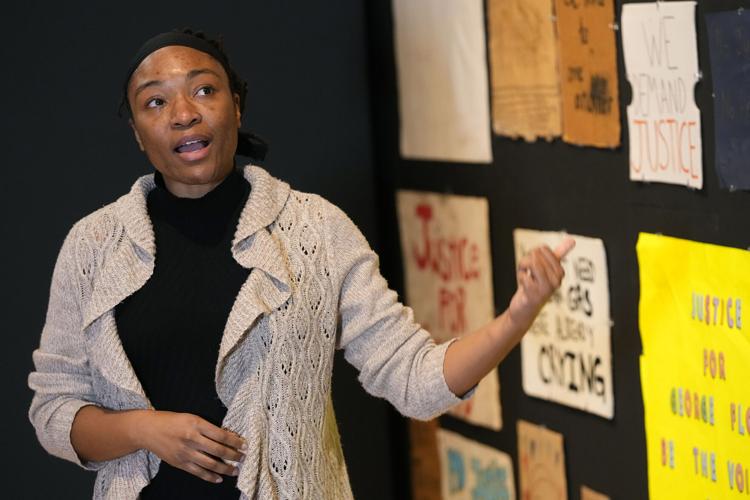
Jeanelle Austin, director of the George Floyd Global Memorial, talks Jan. 12 about "Twin Flames: The George Floyd Uprising from Minneapolis to Phoenix," at Arizona State University Art Museum in Tempe, Ariz.
"Twin Flames: The George Floyd Uprising from Minneapolis to Phoenix" features about 500 artifacts that protesters and mourners left at the intersection of 38th Street and Chicago Avenue where police killed Floyd. It is the largest collection of work from the intersection that has been on public display.
People are also reading…
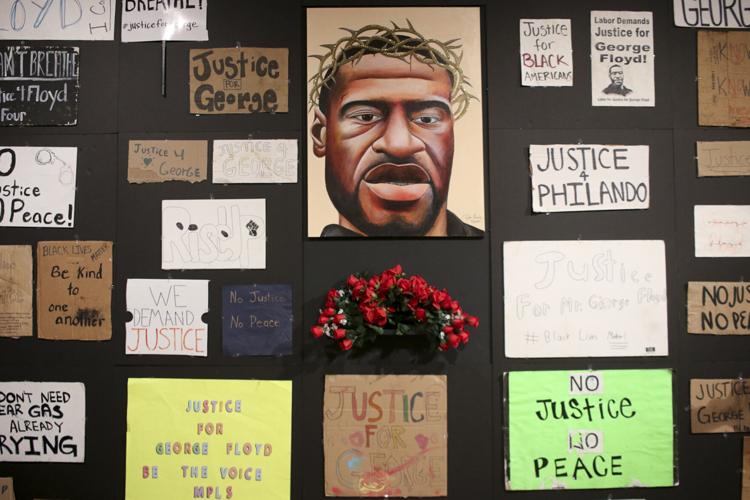
Paintings of Floyd and poems about him written on poster boards stand on easels throughout the exhibit. Signs made with paper plates and reused cardboard that say "Justice 4 Floyd" and "Enough is Enough" cover the walls.
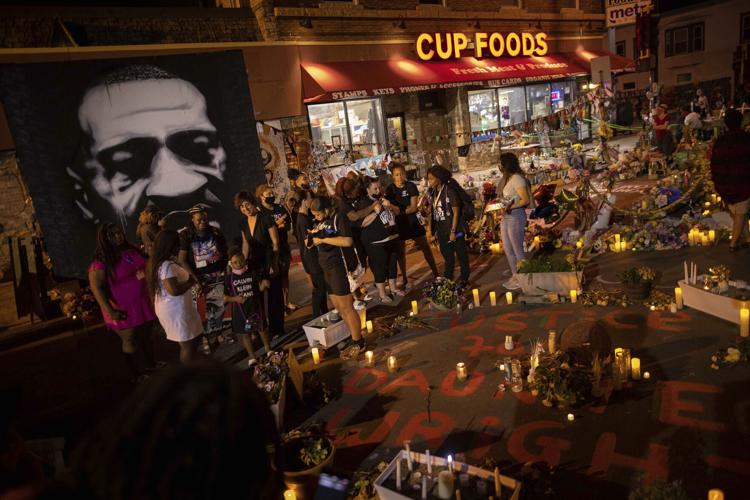
The heavy themes of the words and images on display are contrasted by arrangements of fake flowers and flickering, battery-powered, white candles evoking the vigil held in Minneapolis after his death.

The family of Daunte Wright, who was also killed by police, gathers May 25, 2021, on the one-year anniversary of George Floyd's death in Minneapolis.
What's on display in Phoenix is just a fraction of the thousands of artifacts under the care of the George Floyd Global Memorial, an organization that also tends to the living memorial at the intersection where he died and which remains closed off to traffic.
Many of the artifacts appear to have been written or drawn in a hurry. This conveys the urgency with which people felt the need to express their anger and grief after watching eyewitness video that captured the moment before he died, said Jeanelle Austin, director of the George Floyd Global Memorial.
Some recent visitors to the exhibit were moved to tears.
The organizers of the exhibit say their goal was to create a space for understanding and civil discourse, and potentially stimulate collective action against police violence and other systemic inequities in the U.S.
"We have always engaged with social and political work at the museum. Throughout time, art and protest have been side by side, and this (exhibit) really aligns with our mission to center creativity in art in the service of social good," said Brittany Corrales, a curator at the museum who helped facilitate those organizing the exhibit.
The organizers also see the exhibit as an opportunity to examine the history of museums in America overlooking the inequities faced by Black Americans and other marginalized communities.

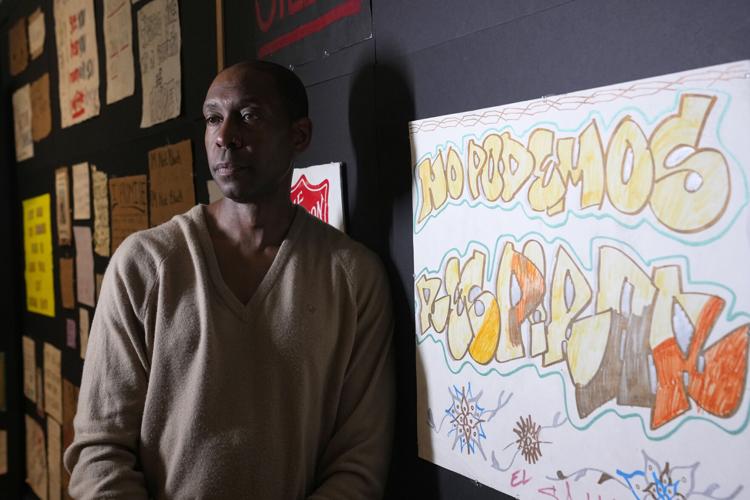
Rashad Shabazz, an Arizona State University professor, pauses Jan. 12 at the exhibit "Twin Flames: The George Floyd Uprising from Minneapolis to Phoenix," in Tempe, Ariz.
"To bring this here to the Phoenix metropolitan area, to Arizona State University, is significant because there is a history of police violence that is here that dates back to the early part of the 20th century," said Rashad Shabazz, a university professor and board member at ASU's Center for Work and Democracy, which funded the exhibit and brought the artifacts to Arizona.
The exhibit draws direct parallels between Minneapolis and Phoenix, where an Arizona state trooper shot and killed a Black man named Dion Johnson the same day Floyd was murdered. The George Floyd Global Memorial is hopeful of bringing the exhibit to other cities after it leaves Phoenix in July, but there are no plans yet.
One Phoenix resident who visited the exhibit last week said it would resonate far beyond the United States.
"This is not just an American problem," said Charm Abella, who was living in Spain in 2020 and remembers protests reaching around the world.
Other museums around the country are also delving into themes explored at the ASU Art Museum.

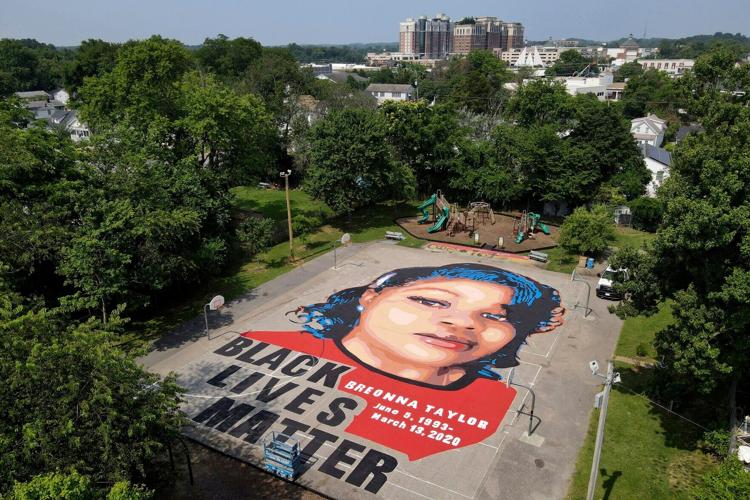
A ground mural depicting a portrait of Breonna Taylor is seen July 6, 2020, at Chambers Park in Annapolis, Md.
In Louisville, Kentucky, the Speed Art Museum last year honored the life of Breonna Taylor, who police killed after they illegally entered her apartment in March 2020.
The exhibit, the second at the museum to focus on Taylor's life, prominently displayed a portrait of Taylor created by Amy Sherald, the artist who painted the portrait of Michelle Obama for the National Portrait Gallery in Washington, D.C.
The exhibit spoke to the idea that Black artists could use portraits to spark conversation and potentially action, said Raphaela Platow, the museum's director.
"What's important for us is that we continue having ongoing conversations about the issues that we are facing as a community, from police violence to racial segregation to systemic oppression," Platow said.

Signs and a portrait are displayed Feb. 2 at a new exhibit, "Twin Flames: The George Floyd Uprising from Minneapolis to Phoenix," at Arizona State University Art Museum, in Tempe, Ariz.
Family members of Floyd who visited the exhibit were deeply moved.
Floyd's aunt, Angela Harrelson, who traveled from Minneapolis, said that upon entering the museum she felt "overwhelmed, but in a good way."
"I saw all the art that people meticulously cared for and took the time to place," she said. "It was concentrated with so much love and passion."
Photos: Remembering George Floyd

Tributes are displayed on the three-year anniversary of George Floyd's death at George Floyd Square on May 25 in Minneapolis.

A stone for George Floyd is pictured on the three-year anniversary of George Floyd's death at the Say Their Names Cemetery on May 25 in Minneapolis.

People gather along the steps of the Philadelphia Art Museum during a Justice for George Floyd protest May 30, 2020, in Philadelphia. The third anniversary of Floyd’s murder is May 25, 2023.

Demonstrators gather outside Cup Foods to celebrate the murder conviction of former Minneapolis police officer Derek Chauvin in the killing of George Floyd, April 20, 2021, in Minneapolis. The third anniversary of Floyd’s murder is May 25.

Demonstrators rally at Lincoln Memorial on June 4, 2020, in Washington, during a protest over the death of George Floyd, an unarmed black man, who died after a police officer kneeled on his neck for several minutes.

In this image from surveillance video, Minneapolis police officers from left, Tou Thao, Derek Chauvin, J. Alexander Kueng, and Thomas Lane attempt to take George Floyd into custody in Minneapolis, Minn., on May 25, 2020.

Police use chemical irritants and crowd control munitions to disperse protesters during a demonstration against police violence and racial injustice in Portland, Ore., Sept. 5, 2020, sparked by the killing of George Floyd. The third anniversary of Floyd’s murder is May 25.

President Joe Biden greets Gianna Floyd, the daughter of George Floyd, after he signed an executive order in the East Room of the White House, on May 25, 2022, in Washington.

A guard holds the door as Gianna Floyd, the daughter of George Floyd, walks out of the West Wing of the White House, on May 25, 2021, in Washington.

Protesters kneel in front of New York City Police Department officers before being arrested for violating curfew beside the iconic Plaza Hotel on 59th Street, June 3, 2020, in New York. Protests continued following the death of George Floyd, who died after being restrained by Minneapolis police officers on May 25.

Preschool children visit the site where George Floyd was murdered by then Minneapolis Police officer Derek Chauvin, as the kids took a field trip to the memorial, June 24, 2021, in Minneapolis.

A woman leaves roses along a tribute for George Floyd on the three-year anniversary of his death at George Floyd Square on May 25 in Minneapolis.

Tributes are displayed on the three-year anniversary of George Floyd's death at George Floyd Square on May 25 in Minneapolis.

Tributes are displayed on the three-year anniversary of George Floyd's death at George Floyd Square on May 25 in Minneapolis.

A stone for George Floyd is pictured on the three-year anniversary of George Floyd's death at the Say Their Names Cemetery on May 25 in Minneapolis.

People hold signs saying "Say Their Names" and pay tribute to George Floyd and other Black lives lost to police brutality on the three-year anniversary of George Floyd's death at the Say Their Names Cemetery on May 25 in Minneapolis. The murder of Floyd at the hands of Minneapolis police, and the fervent protests that erupted around the world in response, looked to many observers like the catalyst needed for a nationwide reckoning on racism in policing.

Minneapolis Police Chief Brian O'Hara, left, shakes hands with an activist on the three-year anniversary of George Floyd's death at George Floyd Square on May 25 in Minneapolis.

Minneapolis Police Chief Brian O'Hara raises his fist in solidarity on the three-year anniversary of George Floyd's death at George Floyd Square on May 25 in Minneapolis.

Minneapolis Police Chief Brian O'Hara raises his fist in solidarity on the three-year anniversary of George Floyd's death at George Floyd Square on May 25 in Minneapolis. The murder of Floyd at the hands of Minneapolis police, and the fervent protests that erupted around the world in response, looked to many observers like the catalyst needed for a nationwide reckoning on racism in policing. (AP Photo/Abbie Parr)