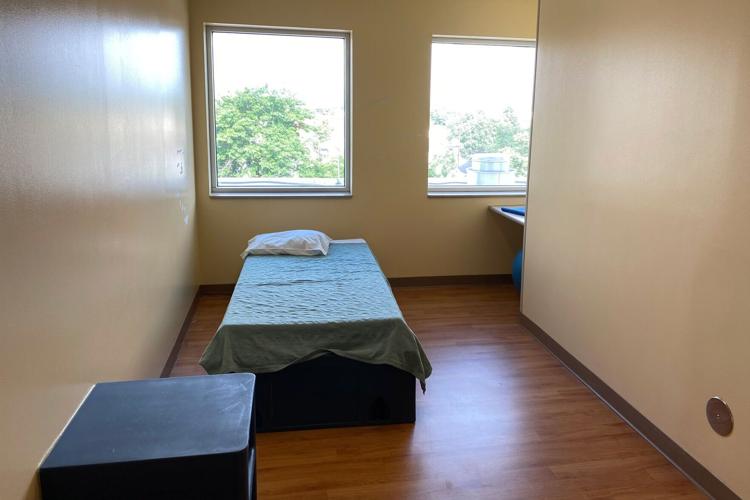
DENVER — When Denver Health wanted to open an inpatient opioid detox unit specifically for teens, doctors there searched high and low for a model to copy. They didn’t find one.
Teens who land in emergency rooms with an opioid overdose generally receive naloxone to reverse the effects of dangerous drugs in their system and are sent home with a list of places they can go for follow-up care. But too often, those teens never seek additional help. They are left to suffer through the agony of withdrawal with no medications to ease their cravings. As a result, many, seeking relief, go back to opioids, often with tragic consequences.

Denver Health's inpatient teen opioid detox facility has a common room, with views of the Front Range of the Rocky Mountains, providing an area where teens can get some physical activity while undergoing treatment.
Christian Thurstone, the director of behavioral health services at the Denver hospital, said six of his teen patients have died of fentanyl overdoses in the past two years. Denver Health has now opened what he believes to be the nation’s first adolescent inpatient detox unit.
People are also reading…
“I’ve been doing adolescent substance treatment here in Denver for 20 years,” Thurstone said. “I wouldn’t know where to send somebody for adolescent detox.”
New research has found that most areas of the U.S. lack facilities that offer medically managed withdrawal for patients under 18. With adolescent overdoses continuing to rise along with the rapid growth of intentional and unintentional fentanyl use, there is a stark lack of options for teens.
Researchers at Oregon Health & Science University posed as an aunt or uncle of a teen who recently overdosed. The researchers called every U.S. teen addiction treatment facility they could find to ask if their niece or nephew could go there to detox and whether the facility offered medications to help with the process.

Denver Health repurposed rooms in an adolescent psychiatric unit to serve as one of the first inpatient teen opioid detox facilities in the U.S.
Of the 160 adolescent residential treatment facilities they contacted, only 63 said they would allow adolescents to detox on-site. Of those 63, only 18 offered buprenorphine — the one medication that’s FDA-approved to treat opioid use disorder in kids as young as 16 — and some of those offered no additional medications to manage withdrawal symptoms.
“I’m not sure if inhumane is too strong of a word,” said Caroline King, an emergency medicine resident at Yale University, who graduated from OHSU in 2023 and led the research. “Offering nothing, offering no additional medication, even nausea medication or really basic things, is really a travesty.”
Staff members at one facility told the researchers they don’t offer medications because kids are resilient, implying they don’t suffer as much as adults, or perhaps that they deserve to suffer, King said. Workers at another told researchers they “try to push Gatorade down them and just lay them down in a cot,” she said.
King said multiple locations responded that they couldn’t think of a single place in their state where kids could go to detox.
“It’s just really terrible to hear that that’s the case,” King said.
The American Society of Addiction Medicine is revising its standards for treating opioid use disorder in adults this year and children in 2024. Sandra Gomez-Luna, the chief medical officer for psychiatry at the Yale School of Medicine, who is leading the pediatric effort, said most adolescents do not experience significant withdrawal symptoms and that, in general, withdrawal isn’t as intense for teens as it is for adults.
“That doesn’t mean that there isn’t a portion of teens with substance use disorders that will require medically monitored withdrawal management,” she said.
Because teens usually haven’t been using drugs for as long as adults, Gomez-Luna said, they may not suffer the consequences of chronic use or have as many accompanying health conditions that can make withdrawal more difficult, or more complex to treat.
But the rise in the more potent opioid fentanyl may be changing that thinking.
“As more and more teens will get involved in fentanyl use,” Gomez-Luna said, “there will be more adolescents that will require medically monitored withdrawal.”
Gomez-Luna said the addiction medicine group is also concerned there are too few facilities for teens and a lack of specialized personnel to treat them.
Scott Hadland, chief of adolescent and young adult medicine at Mass General for Children and Harvard Medical School, said there are fewer facilities for adolescents in part because many teens are never identified as needing help or connected to care, despite the growing number of overdoses.
When no dedicated detox units are available, teens sometimes get admitted to a hospital, often to the intensive care unit, where more monitoring is available than on regular inpatient floors. But that also means teens are less likely to be cared for by a team specializing in adolescent addiction medicine.
Addiction specialists stress that not all teens with opioid use disorder need inpatient detox. Withdrawal can be managed at home if teens have a stable family environment to support them and monitor their symptoms. Many adolescents with opioid use disorders, however, come from broken homes in which the parents may be struggling with addiction themselves. And coming out of the pandemic, specialists are also seeing more teens with opioid use disorders who have other psychiatric problems, such as depression, anxiety, attention-deficit/hyperactivity disorder, or eating disorders.
Thurstone said that nationwide about half of all adolescents drop out of treatment, but that it’s worse in marginalized communities. “We can do better than, you know, an ER visit and a list of resources to call.”