WASHINGTON — Active-service members and veterans provided firsthand testimony Wednesday about the chaotic U.S. withdrawal from Afghanistan, describing in harrowing detail the carnage and death they witnessed on the ground while imploring Congress to help the allies left behind.
Former Marine Sgt. Tyler Vargas-Andrews testified to Congress about the stench of human flesh under a large plume of smoke as the screams of children, women and men filled the space around Kabul's airport after two suicide bombers attacked.
"I see the faces of all of those we could not save, those we left behind," said Vargas-Andrews, who wore a prosthetic arm and scars of his own grave wounds from the bombing. "The withdrawal was a catastrophe in my opinion. And there was an inexcusable lack of accountability."

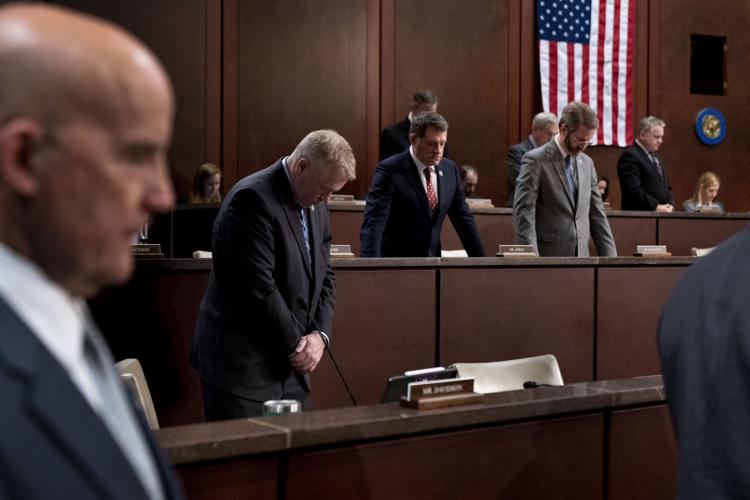
Congressmen stand Wednesday for a moment of silence for the service members who were killed during the United States evacuation from Afghanistan, during a House Committee on Foreign Affairs hearing on Capitol Hill in Washington.
The first of what is expected to be a series of Republican-led hearings examining the Biden administration's handling of the withdrawal displayed the open wounds from the end of America's longest war in August 2021, with witnesses recalling how they saw mothers carrying dead babies and the Taliban shooting and beating people.
People are also reading…
Taliban forces seized the Afghan capital, Kabul, far more rapidly than U.S. intelligence had foreseen. Kabul's fall turned the withdrawal into a rout, with Kabul's airport the center of a desperate air evacuation guarded by U.S. forces deployed for the task.
The majority of witnesses argued to Congress that the fall of Kabul was an American failure with blame touching every presidential administration from George W. Bush to Joe Biden. Testimony focused not on the decision to withdraw, but on what witnesses depicted as a desperate attempt to rescue American citizens and Afghan allies with little U.S. planning and inadequate U.S. support.
"America is building a nasty reputation for multigenerational systemic abandonment of our allies where we leave a smoldering human refuse from the Montagnards of Vietnam to the Kurds in Syria," retired Lt. Col. Scott Mann testified before the House Foreign Affairs Committee.
He added, "Our veterans know something else that this committee might do well to consider: We might be done with Afghanistan, but it's not done with us."

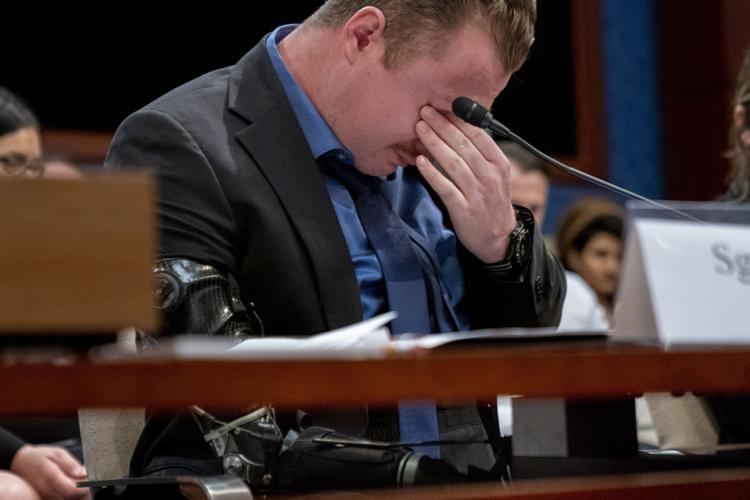
Former Marine Sgt. Tyler Vargas-Andrews, who was gravely injured, losing an arm and a leg in a suicide attack at Hamid Karzai International Airport in Kabul, becomes emotional Wednesday as he recounts his story during a House Committee on Foreign Affairs hearing on the U.S. evacuation from Afghanistan on Capitol Hill in Washington.
Vargas-Andrews sobbed as he told lawmakers of being thwarted in an attempt to stop the single deadliest moment in the U.S. evacuation: the suicide bombing that killed 170 Afghans and 13 U.S. servicemen and women.
He said Marines and others aiding in the evacuation operation were given descriptions of men believed to be plotting an attack before it occurred. He said he and others spotted two men matching the descriptions and behaving suspiciously, and had them in their rifle scopes but never received a response about whether to take action.
"No one was held accountable," Vargas-Andrews told Rep. Mike McCaul, R-Texas, chairman of the committee. "No one was, and no one is, to this day."
U.S. Central Command's investigation concluded in October 2021 that given the worsening security situation at Abbey Gate as Afghans became increasingly desperate to flee, "the attack was not preventable at the tactical level without degrading the mission to maximize the number of evacuees." However, that investigation did not look into whether the bomber could have been stopped or whether Marines on the ground had the appropriate authority to engage.
Defense Department spokesman Lt. Col. Rob Lodewick said Wednesday that the Pentagon's earlier review of the suicide attack had turned up neither any advance identification of a possible attacker nor any requests for “an escalation to existing rules of engagement” governing use of force by U.S. troops.
McCaul is deeply critical of the Biden administration's handling of the withdrawal. "What happened in Afghanistan was a systemic breakdown of the federal government at every level, and a stunning failure of leadership by the Biden administration," he said.
Last month, U.S. Inspector-General for Afghanistan John Sopko concluded again that actions taken by both the Trump and Biden administrations were key to the sudden collapse of the Afghan government and military, even before U.S. forces completed their withdrawal in August 2021.
That includes President Donald Trump's withdrawal deal with the Taliban, and the abruptness of Biden's withdrawal U.S. contractors and troops.
The report blamed each U.S. administration since American forces invaded in 2001 for inconsistent policies and a failure to build a capable, sustainable Afghan military.

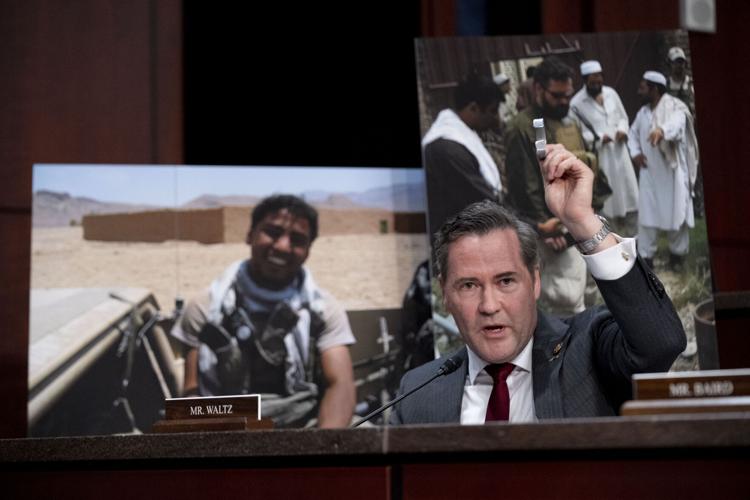
Images of two men who worked with Rep. Michael Waltz, R-Fla., while he was serving in the Army are visible Wednesday as he holds up a military bracelet while speaking during a House Committee on Foreign Affairs hearing on the U.S. evacuation from Afghanistan, on Capitol Hill in Washington.
The witnesses testifying Wednesday urged action to help the hundreds of thousands of Afghan allies who worked alongside U.S. soldiers and who are now in limbo in the U.S. and back in Afghanistan.
"If I leave this committee with only one thought it's this: It's not too late," said Peter Lucier, a Marine veteran who now works at Team America Relief, which has assisted thousands of Afghans in relocating. "We're going to talk a lot today about all the mistakes that were made, leading up to that day, but urgent action right now will save so many lives."
One of those solutions discussed Wednesday would be creating a pathway to citizenship for the nearly 76,000 Afghans who worked with American soldiers since 2001 as translators, interpreters and partners. The government admitted the refugees on a temporary parole status as part of Operation Allies Welcome with the promise of a path to a life in the U.S.
But that effort stalled in the Senate late last year due to opposition from Republicans.
Afghanistan by the numbers: The cost, in lives and dollars
Intro

At just short of 20 years, the now-ending U.S. combat mission in Afghanistan was America's longest war. Ordinary Americans tended to forget about it, and it received measurably less oversight from Congress than the Vietnam War did. But its death toll is in the many tens of thousands. And because the U.S. borrowed most of the money to pay for it, generations of Americans will be burdened by the cost of paying it off.
Here's a look at the U.S.-led war in Afghanistan, by the numbers, as the Taliban in a lightning offensive take over much of the country before the United States' Aug. 31 deadline for ending its combat role and as the U.S. speeds up American and Afghan evacuations.
Much of the data below is from Linda Bilmes of Harvard University's Kennedy School and from the Brown University Costs of War project. Because the United States between 2003 and 2011 fought the Afghanistan and Iraq wars simultaneously, and many American troops served tours in both wars, some figures as noted cover both post-9/11 U.S. wars.
The longest war

Percentage of U.S. population born since the 2001 attacks plotted by al-Qaida leaders who were sheltering in Afghanistan: Roughly one out of every four.
The human cost

American service members killed in Afghanistan through April: 2,448.
U.S. contractors: 3,846.
Afghan national military and police: 66,000.
Other allied service members, including from other NATO member states: 1,144.
Afghan civilians: 47,245.
Taliban and other opposition fighters: 51,191.
Aid workers: 444.
Journalists: 72.
Afghanistan after nearly 20 years of U.S. occupation

Percentage drop in infant mortality rate since U.S., Afghan and other allied forces overthrew the Taliban government, which had sought to restrict women and girls to the home: About 50.
Percentage of Afghan teenage girls able to read today: 37.
Oversight by Congress

Date Congress authorized U.S. forces to go after culprits in Sept. 11, 2001, attacks: Sept. 18, 2001.
Number of times U.S. lawmakers have voted to declare war in Afghanistan: 0.
Number of times lawmakers on Senate Appropriations defense subcommittee addressed costs of Vietnam War, during that conflict: 42
Number of times lawmakers in same subcommittee have mentioned costs of Afghanistan and Iraq wars, through mid-summer 2021: 5.
Number of times lawmakers on Senate Finance Committee have mentioned costs of Afghanistan and Iraq wars since Sept. 11, 2001, through mid-summer 2021: 1.
Paying for a war on credit, not in cash

Amount President Harry Truman temporarily raised top tax rates to pay for Korean War: 92%.
Amount President Lyndon Johnson temporarily raised top tax rates to pay for Vietnam War: 77%.
Amount President George W. Bush (pictured) cut tax rates for the wealthiest, rather than raise them, at outset of Afghanistan and Iraq wars: At least 8%.
Estimated amount of direct Afghanistan and Iraq war costs that the United States has debt-financed as of 2020: $2 trillion.
Estimated interest costs by 2050: Up to $6.5 trillion.
The wars end. The costs don't.

Amount Bilmes estimates the United States has committed to pay in health care, disability, burial and other costs for roughly 4 million Afghanistan and Iraq veterans: more than $2 trillion.
Period those costs will peak: after 2048.