Under the cover of darkness, Michelle slipped out of her car to squat down in the middle of the street. With her vehicle as her home, she had no other option for immediate relief.
Content warning: This article contains graphic descriptions of domestic violence. If you are experiencing violence and need help, go to www.thehotline.org, call (800) 799-7233 or text “start” to 88788.
She was pregnant and not very much in control of her bladder’s whims. Even if she could hold it long enough to make it elsewhere, there weren’t any free public restrooms for someone like her — homeless, unshowered and not able to spend the little money she had to buy a snack in exchange for a cafe bathroom code.
She looked up as she hiked her pants back up. Amid the urgency, she failed to see she wasn’t alone. Passersby and onlookers gawked at her, some grimaced. She was humiliated, she said.
People are also reading…

The Lee Enterprises Public Service Journalism Team surveyed 150 women from July through October 2024 across eleven women’s daytime and overnight shelters throughout the Pacific Northwest.
But every time she had to let her pants slink to her feet and unsteadily crouch down, humiliation was not what made her cower. Instead, she feared the worst — a man taking advantage of her vulnerable position to rape her.
Her anxiety is shared by others in her situation.
The Lee Enterprises Public Service Journalism Team surveyed 150 women at daytime and overnight homeless shelters across the Pacific Northwest. A majority — 65% — said lack of access to secure bathrooms made them feel unsafe or put them in a dangerous situation. And 45% said they believe that predicament led to health issues like urinary tract or bladder infections.

In this report, Lee Enterprises omits full names of domestic violence victims to protect their safety and identity.
Michelle, 45, often tried to ignore her body’s demand as long as she could. She had already experienced decades of violence. The risk wasn’t worth it to her.
Of the women surveyed, 57% said they had been physically or sexually assaulted at some point while experiencing unsheltered homelessness — often after they already fled an abusive partner.
But most cities, such as Portland where Michelle now lives, do not offer many safe, clean, accessible or free restrooms despite public health experts acknowledging the very real, very ordinary need.
Portland reduced its unmanned portable restrooms from 120 during the pandemic to just 10, which cost $78,000 annually to operate, said Cody Bowman, city spokesperson. A city employee in March submitted a proposal to create supervised restrooms, but city leaders did not follow through because of budget constraints.
“There is a tremendous amount of shame and embarrassment and dehumanization that stems from not having access to a restroom,” said Corinne Feldman, a physician assistant for the University of Southern California Street Medicine team, which provides care for unhoused people. “There is also a mental health toll from that. It is a signal from society that we don’t want you in our restroom or even near us.”
A simple solution
Before Michelle resided in her car, she said, she lived in a beautiful 3,400-square-foot home in southern Washington. In the walls of that home, away from the eyes of police or neighbors, her husband fostered fear. Once, he slammed her head into the ground until she stopped moving, she said.

To break free from the domestic abuse and to protect her children, Rachel experienced homelessness in hopes of something safer on the other side.
He set up cameras to monitor her in their home and car. He wrapped her purse strap around her neck and told her to watch herself die in the mirror, she said. When she fled to domestic violence shelters, he found her by pinging her phone.
If the police did show up, his personality changed, she said. He was charming. He talked about his time in law enforcement. He joked and made small talk until the officers left.
“The first two years of our relationship, he was my best friend,” Michelle recalled. “The next four were absolute hell. He was abusive in every single way. I went to the hospital many times. Police showed up many times. Everyone believed him. He had tried to kill me. It was simply a gift from God when I got away.”
She thought nothing would feel less dignified than what she experienced at home.
But finally escaping to another city and perfecting her ability to hide from him came with an onslaught of new indignities related to her lack of housing that ate away at her self-worth.
“I can remember walking around in pain because I couldn’t find a bathroom,” Michelle said. “I have peed myself because of not wanting to get out of the safety of my car and having no place to go.”
Forcing her body to resist the urge led to kidney stones three times, she believes. One lodged in her ureter, causing sepsis. It landed her in the hospital for five days in 2022 as she waited for antibiotics to course through her body.
“My kidneys were working overtime since I was pregnant and holding my urine in,” she said.

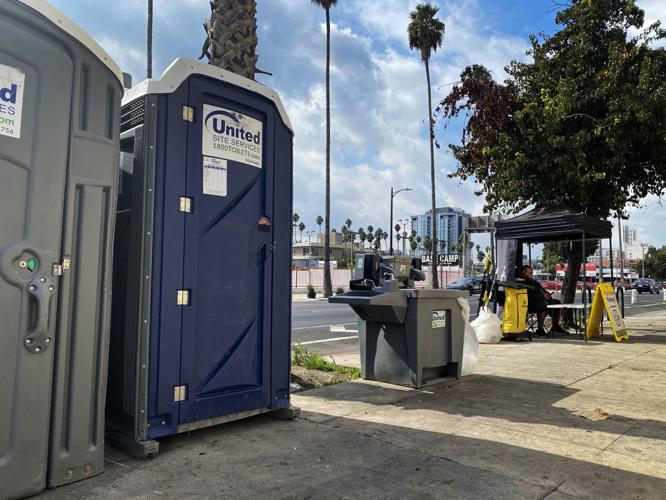
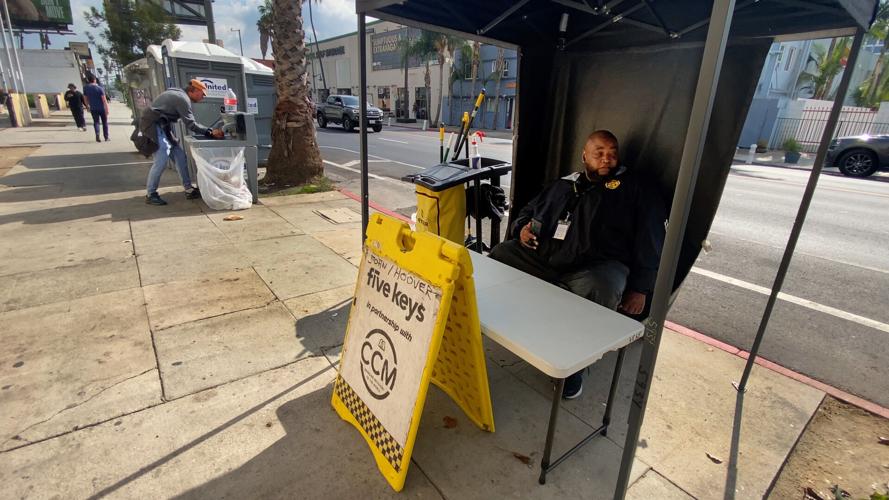
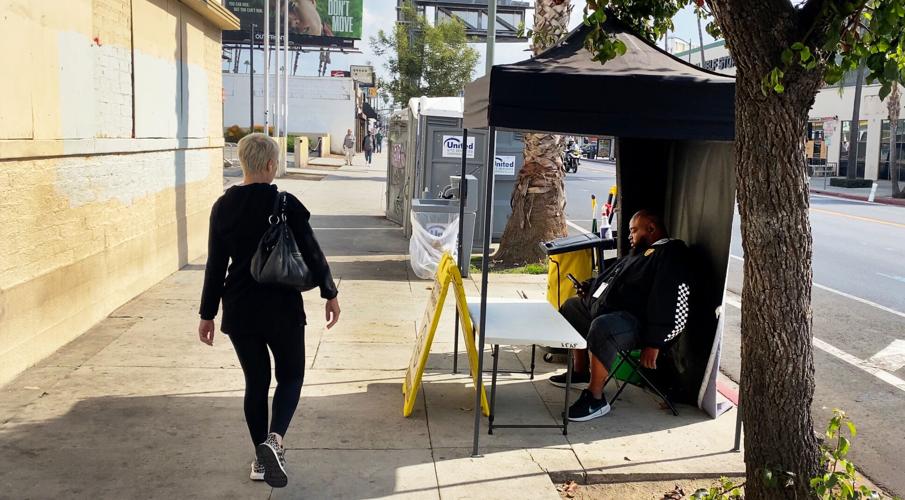
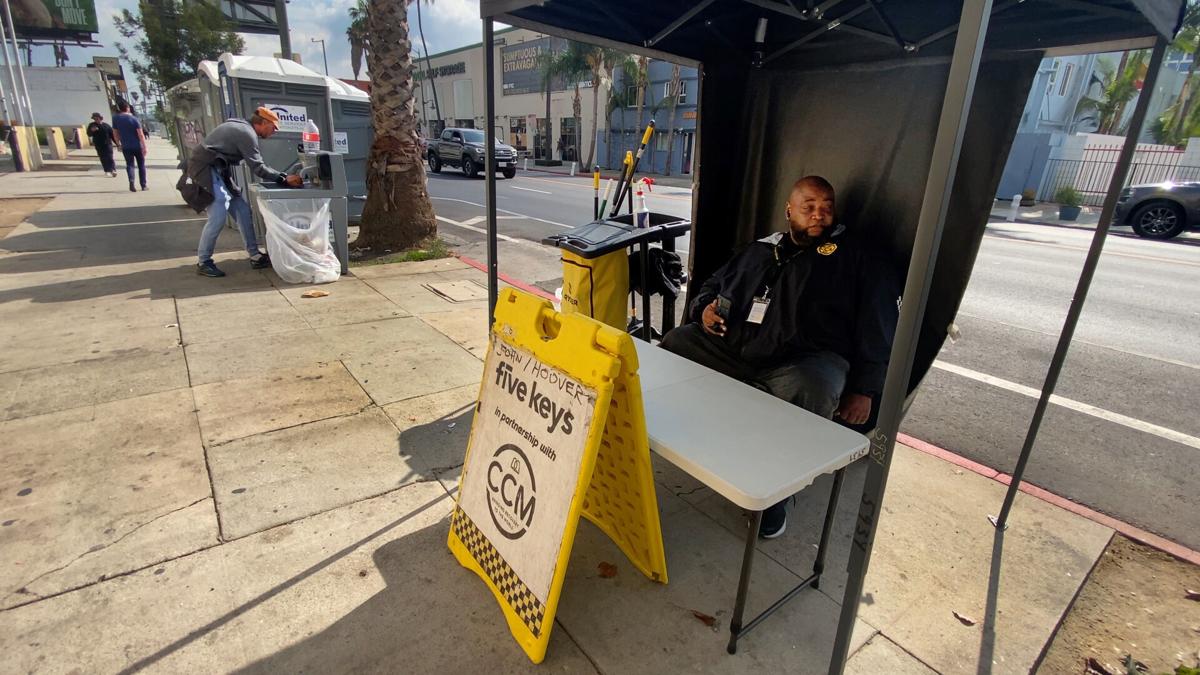
A worker at a Pit Stop Program site mans a public restroom facility in Los Angeles on Nov. 2, 2024. The site offers handwashing stations, hygiene products, information about local support services and staff to monitor for safety and cleanliness.
Feldman said access to restrooms, particularly to toilet paper or other hygiene products, can reduce the chance of health issues such as urinary tract infections.
And for those experiencing homelessness who do become ill, lack of medical access compounds those symptoms.
While someone with health care access might immediately get a prescription to treat the infection, unsheltered women are less likely to because they often lack transportation and access to primary care doctors. They also often feel judged by emergency room staff for experiencing homelessness.
“Addressing women’s health needs with street medicine is far more effective than hoping unhoused women are all going to come into the clinic,” Feldman said. “And the only way to overcome their hesitancy to come in is developing relationships with people on the street.”
Forcing women who need to urine to expose themselves in public creates a constant reminder of their vulnerability, and risk of sexual assault — another traumatic experience unhoused women often fear seeking care for in hospitals, Feldman said.
Without immediate treatment after a sexual assault, which those who are unhoused are far more likely to suffer, victims can miss the opportunity for medications that could reduce the chance of HIV, gonorrhea or chlamydia developing, Feldman said.
“Women who have just experienced sexual assault have a lot of hesitancy for many reasons to seek care,” Feldman said. “The compounding layer of discrimination related to homelessness further decreases their desire to want to go in.”
Without a stable life and access to regular health care, Michelle opted for an abortion soon after her hospital stay. She recovered in her car after the procedure without the comfort of a private, clean restroom.
“Even a lot of (Portland) parks have closed and locked their public restrooms because people were sleeping in them or overdosing in them. It seems like the city would need to have the bathrooms manned to ensure they are properly used,” she said. “I don’t think the city has the money for that.”
But other city leaders across the West Coast have prioritized safe restrooms, including San Francisco and Los Angeles.

A worker at a Pit Stop Program site mans a public restroom facility in Los Angeles on Nov. 2, 2024. The site offers handwashing stations, hygiene products, information about local support services and staff to monitor for safety and cleanliness.
The city of angels, struggling to wrangle the sprawling trauma of homelessness in its own right, dug up the funds for secure restrooms aimed at the unhoused population. In the current fiscal year, the city spent $4.6 million on 16 Pit Stop Program locations, which offer toilets, handwashing stations, hygiene products, information about local support services and staff to monitor for safety and cleanliness.
The facilities offer 51 toilets and 71 full-time staff members at the 16 sites throughout Los Angeles, largely situated in non-coastal neighborhoods stretching from Hollywood to Chinatown and down to South Los Angeles, with just one site in Long Beach. The sites receive nearly 1.1 million visits per year, said Paul Gomez, a spokesperson for the city.
The program is a start, though it still hasn’t fully addressed the need for abundant, secure 24-hour sites. While most of the locations are open 12 hours, just three are open around the clock in a city that can take a day to cross on foot.
The program is managed by the city and contracts with Five Keys and Christ Centered Ministries, who staff locations. The nonprofits hire local residents, especially those in economically disadvantaged neighborhoods, to manage the sites as part of the city’s workforce development opportunities.
“By providing a safe place for people to take care of their bathroom needs with dignity, privacy and safety, we were able to help in improving community livability while reducing human waste from the sidewalks, doorways and streets,” the program’s description says.
Christ Centered Ministries says staff is their key to success. Without eyes on the facilities, the toilets would very likely spiral into the chaos that caused many cities to nix their portable toilet programs, namely, becoming sites of hazardous waste, substance use, prostitution and rape.
The workers not only clean the toilets but clean the sidewalks and spaces around the sites, hoping to offer neighbors little to complain about.
Feldman said she and her team have often utilized the Pit Stop Program bathrooms while doing medical outreach work on the streets of Los Angeles.
“For women, those monitored bathrooms are a reassurance they will be safe or safer using it,” she said. “And they really do a phenomenal job of keeping them clean and making sure no one is bothering you. It is a very tenable solution.”
Michelle wishes similar programs had existed in the Pacific Northwest when she was still experiencing homelessness. The Pit Stop program offers toothbrushes, toothpaste, deodorant, wipes, soap, razors and feminine hygiene products.
It’s the tampons and pads she wished she had access to at the time.
“I am not a thief, but women do steal pads and tampons if they can’t afford them,” Michelle said. “But I couldn’t break my own moral code, so I would go dumpster diving in hopes of finding new clothes to wear when my pants got soaked in blood.”
Portland nonprofits serving women hand out feminine hygiene products, but it was not always practical for Michelle to get across town to fetch them when needed.
“I did notice you can get tampons and pads for free in places that homeless people don’t typically go,” she said. “New Seasons Market leaves them in their bathrooms for free, and places where people with a lot of money go like the Broadway theater, those bathrooms have them.”
Experiences innate to being a woman become harder when homeless, Feldman said.
Michelle now has a bathroom of her own in a one-bedroom apartment subsidized by Portland housing nonprofit, Do Good Multnomah. While homeless, she saved money by working for DoorDash delivering meals out of her car. Now, she works at a nonprofit that helps others experiencing homelessness.
She said she was forced to quit her nursing job when she saw the sliver of a chance to flee her husband years ago. She hopes to one day regain her expired nursing license.
Michelle knows firsthand that housing is the key to success, but providing resources to address safety and health concerns for other women while they slug through the housing process could allow them to live long enough in safety to finally access those coveted apartments.
Nicole Hayden is an investigative journalist on the Lee Enterprises Public Service Journalism Team. Do you have a domestic violence, restraining order, housing or related legal story you believe needs to be investigated? Contact Nicole at Nicole.Hayden@lee.net.

A worker at a Pit Stop Program site mans a public restroom facility in Los Angeles on Nov. 2, 2024. The site offers handwashing stations, hygiene products, information about local support services and staff to monitor for safety and cleanliness.
Nicole Hayden can be reached at nicole.hayden@lee.net or at (810) 210-1561.