The day after an emergency cesarean section to deliver her premature twins, Rachel came back from the neonatal intensive care unit to find her now ex-husband napping in her hospital bed.
Content warning: This article contains graphic descriptions of domestic violence. If you are experiencing violence and need help, go to www.thehotline.org, call (800) 799-7233 or text “start” to 88788.
She was sore. Overtired. Could barely walk. She needed to rest her body, if even for a moment.
“I said I really needed to lay down, and his mom started yelling at me, saying he had a really hard day,” recalled Rachel, 43.
That moment felt dark, but she didn’t yet know domestic violence would push her into darker territory leading to a substance use disorder and then homelessness.
People are also reading…
The abuse started when she became pregnant. She assumed the stress of twins weighed on her now ex-partner. Perhaps once her babies arrived, the joy would quell the worry. But the brutality got worse as the years went by. The day in the hospital was just the start of the deep exhaustion that would warp her life.
In addition to newborn twins and a healing body, she had two other children to take care of. Her partner didn’t allow her to work or have her own bank account, so she stayed home to raise her kids, though she struggled to be focused and alert. Her nights stretched into hours of violence, robbing her of sleep. She feared the fatigue made her a bad mother.
“I thought meth would make me a better mom,” Rachel said. “It gave me more energy to keep up with the kids, and I was just so exhausted from the abuse. I told myself that lie, that it was making me better, but drugs never make us better people.”

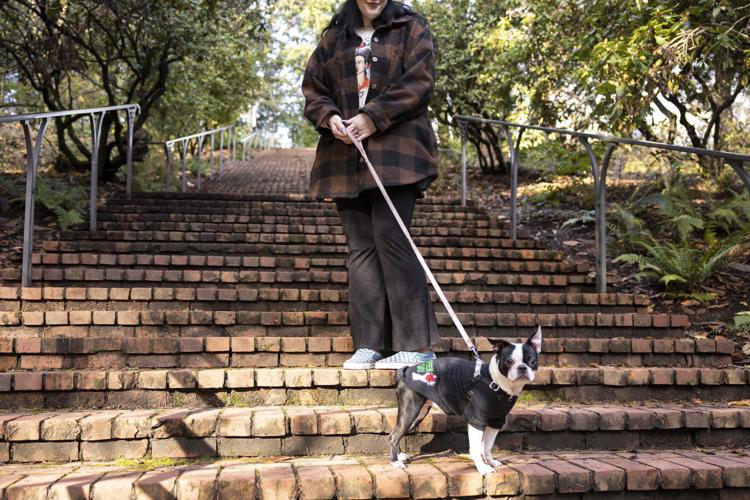
Rachel stands on a staircase with her dog Punkin in Laurelhurst Park on a sunny autumn day in Portland. Rachel, a survivor of domestic violence who experienced substance abuse and homelessness, said her mission is to help others with similar experiences.
To break free from the domestic abuse, the substance use and to protect her children, Rachel plunged herself into an equally dire place — experiencing homelessness with four children in tow — in hopes of something safer on the other side.
The Lee Enterprises Public Service Journalism Team surveyed 150 women at daytime and overnight homeless shelters across the Pacific Northwest about the connection between domestic violence and homelessness.
The surveys were conducted at women's shelters in Salem, Oregon, about 25 miles north of Albany and Corvallis, as well as nine other shelters located throughout the Pacific Northwest. In 2024, Oregon ranked fourth in the nation for the rate of people experiencing homelessness per 10,000 people and it had the sixth-highest rate of female homelessness in the country, according to the National Alliance to End Homelessness.
In this report, Lee Enterprises omits full names of violence victims to protect their safety and identity.
Of those surveyed, 67% said domestic violence caused homelessness at some point in their lives, and 49% said it caused their current bout of homelessness. Of those, 16% said substance use also contributed to their homelessness while just 10% reported to still be struggling with a substance use disorder.
Rachel, who is more than 12 years sober, has custody of her children and now works as a domestic violence mentor, said it is not unusual to see a domestic violence victim stop using substances to cope as soon as they leave their abuser. But to prepare a survivor, particularly women with children, for long term success, recovery programs need to be built for mothers.
A strong recovery
“Once in recovery, I never relapsed,” Rachel said.
Without taxpayer-funded services, she knows the stress of raising four children while staying sober would have pushed her back into her abuser’s home.
“I don’t know if I would have been so strong in my recovery if after I left him, I had to immediately find work, go to outpatient services every day and pay for child care,” she said. “Maybe I would have fallen back into thinking I needed a man to help me afford to live.”
Anita Hargrave, a physician and intimate partner violence researcher at University of California San Francisco and Benioff Homelessness and Housing Initiative, said cash subsidies for survivors to provide stabilization is one solution her research strongly suggests.
“When interviewing survivors, while there were many ways they said their abuse led to homelessness, the economic reality pushed them further into a downward spiral,” Hargrave said. “Financial abuse is often part of an abusive relationship — not having access to their own funds, so it makes people extremely vulnerable when they leave the relationship.”
Rachel qualified for cash benefits of about $721 a month and the Oregon Health Plan paid for her recovery services. While still unhoused, she began going to outpatient recovery services for medication-assisted treatment to receive suboxone, which treats opioid dependence. While the methamphetamine allowed her to stay awake during the day to take care of her kids, the opioids allowed her to block out the nightly pain of the violence. She was first prescribed opioids following her C-section.
The recovery center allowed Rachel to bring her kids with her every day, something typically against the rules. Without that support, she knows she wouldn’t have been able to prioritize her health needs.

“Once in recovery, I never relapsed,” said Rachel, now 12 years sober. But she said her story may have turned out differently without taxpayer-funded support, including cash subsidies, that allowed her to focus on her recovery.
She squatted in empty stores with her children to hide from her abuser while she waited for a domestic violence shelter to have enough room for her family of five. Rachel was tenacious in accessing services — often shelter beds and recovery services are scarce, but she called until there was an opening.
Hargrave said only 5% of unhoused women reported spending most of their nights in a domestic violence shelter, according to her research in California.
Eventually, Rachel moved into a subsidized apartment.
“I had a lifetime of abuse and addiction to work on,” Rachel said. “That 10 years of housing assistance and cash assistance allowed me to raise my own kids, allowed us all to go to counseling and it helped me be strong in my recovery. When women don’t have enough resources to survive, they end up going from one abuser to another, thinking the next is just a good man who wants to help you.”
More than a decade later, Rachel is no longer receiving cash assistance but making her way on nonprofit wages which “aren’t quite a living wage, but (she is) stubborn and determined not to go back” to her former life, she said.
Before she fled her ex-partner, she insisted she needed recovery services but he told her she was “ridiculous” and didn’t allow her to access them. Advocates say pushing substances on victims is a way abusers try to strengthen their control.
Rachel didn’t learn healthy coping skills until she entered outpatient recovery services. For her whole childhood, she watched her father abuse her mother and stepmother, and watched him deal and use meth. While she never used substances while pregnant or breastfeeding, Rachel said her first exposure to the stimulant was when her father gave them to her when she was 12.
“When I was in sixth grade, I found out my dad had AIDS,” Rachel said. “I was terrified to lose him and he was terrified to die. So, I started using to be closer to him and he used to not fall asleep or miss anything.”
Coping with substances and abuse in relationships seemed normal to her. To heal from her substance use disorder, Rachel needed to heal from decades of pain, too.
Once, her abuser threw a lit firework at her face, leaving a hundred tiny scars dancing across her forehead. Another time, he slammed her hand in a drawer over and over until bones splintered out. He’d become angry if she left the house without his permission — even to buy formula and diapers. He tracked her phone and monitored her purchases. She once woke from a deep sleep to police in her home, guns pointed at her, because he called 911 to falsely report she had a gun. Police simply told each of them to stay on separate floors of the house that night.
But her most heartbreaking memory was witnessed by one of her youngest children.
“My ex was trying to push me down the stairs to the basement and the bigger of my twins was in the kitchen close enough to see,” Rachel said. “I caught myself somehow, but he kept pushing me again and again as I just held on. Soon after that incident, we were finally in a domestic violence shelter and there were a set of stairs there, and one of my twins said, ‘Don’t worry mama, I won’t push you down the stairs.’”
She couldn’t do an intensive in-patient recovery program because she couldn't leave her children, though she is thankful for the services she did access. Now as an advocate, though, Rachel sees a deep need for recovery services that allow mothers to bring their children — to stop abusers from getting custody of kids, to stop kids from falling into the foster care system and to offer survivors a confidential place to recover.
Across Oregon there are about 100 of those beds, though they largely are centered in Portland, far from Albany and Corvallis, or any community not within an easy commute to the city.
The Letty Owings Center, operated by one of Portland’s largest homeless and supportive services providers, Central City Concern, houses 28 of those beds. Some of the clients Rachel works with now have had success walking through their doors.
Tina Bialas, the program’s director, said it takes about $4.6 million, largely funded by Medicaid, to operate annually — a seemingly large expense to taxpayers, but necessary to stop the generational cycle of violence and substance use.
“I struggle to think of any woman I have worked with that has come here and hasn’t suffered physical, sexual or emotional abuse through the years, oftentimes stretching back to their childhood,” Bialas said. “Many of our women don’t recognize at first that what was happening to them is considered abuse. So that is a big part of the work, helping them reset their understanding of what should be normal.”
Without first establishing a truly safe environment, which the center offers, a survivor’s brain cannot move out of the fight or flight response to start healing, Bialas said. To address much of the substance use disorder that Bialas sees, the women have to address their trauma while concurrently addressing their addiction.
Women are allowed to bring one child under the age of 6 with them to the residential program. Some exceptions are made if a woman gives birth to her second child while there or she has twins. The challenge is for mothers like Rachel who have multiple children or older children.
“It is much harder for a mother to focus on her recovery if she is caring for more than one child,” Bialas said. “And when you get to school-age children, you run into the logistics of who watches the kids on school vacations and not wanting the older children to attend therapy sessions with their moms because it would be inappropriate for children to hear that … this is definitely an area of improvement, to figure out how we as a society and service delivery system can create ways for older children to be with a parent who is going through treatment.”
While the conversation often hovers around the mother’s responsibility as she struggles to access housing or treatment, Bialas asks, “Where are the (fathers)? We should be expecting so much more of them.”
Nicole Hayden is an investigative journalist on the Lee Enterprises Public Service Journalism Team. Do you have a domestic violence, restraining order, housing or related legal story you believe needs to be investigated? Contact Nicole at Nicole.Hayden@lee.net.


Rachel plays with her dog Punkin in a carpet of yellow ginkgo leaves at Laurelhurst Park in Portland. Now 12 years sober, she said she once used drugs to cope with domestic abuse that she suffered while raising young children.
Nicole Hayden can be reached at nicole.hayden@lee.net or at (810) 210-1561.
"I thought meth would make me a better mom. It gave me more energy to keep up with the kids, and I was just so exhausted from the abuse."
— Rachel, domestic violence survivor
"Financial abuse is often part of an abusive relationship — not having access to their own funds, so it makes people extremely vulnerable when they leave the relationship."
— Dr. Anita Hargrave, intimate partner violence researcher
"Many of our women don’t recognize at first that what was happening to them is considered abuse. So that is a big part of the work, helping them reset their understanding of what should be normal.”
— Tina Bialas, director, The Letty Owings Center