People are also reading…
STEPHAN, S.D. — Nestled amongst miles of prairie on the northern part of the Crow Creek Reservation in central South Dakota sits a remnant of a dark period in American history.
Disheveled, abandoned buildings — dormitories and churches — that once housed hundreds of children each year now lie crumbling, awaiting demolition.

The federal government has begun to reckon with the ugly history of its system for educating Native American children, but that system never e…
In mid-November 2023, Crow Creek Sioux Tribe Chairman Peter Lengkeek and several others stood at the site of a former Catholic boarding school, the Immaculate Conception Mission, digging around in the earth searching for the location of a main water line break, trying to find the shut-off point.
Lengkeek had the idea to try and find the original blueprint for the nearly 74-year-old waterline. Searching through the blueprint records, a small piece of paper sticking out of a pile caught their attention. The paper, a hand-drawn schematic of the waterline and street, identified something strange — a gravesite.
The map was from the early 1900s, during the early years of the school, and on the left-hand corner, ever so lightly, someone had written the word “graveyard.” In 1900, the school received utilities identified as “water works” and a gasoline engine, which may be when the map was created.

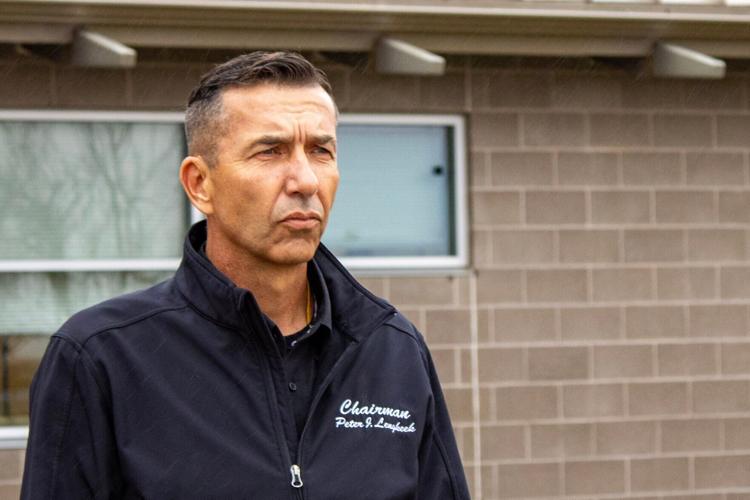
Peter Lengkeek, chairman of the Crow Creek Sioux Tribe, stands outside of the Crow Creek Tribal School, next door to the former Catholic mission where remains were recently discovered.
“No one had noticed it before,” Lengkeek said. “At first we thought these must be the wrong plans because our cemetery is across campus… but it all lined up.”
Later, a member of the tribe’s historic preservation office visited the site and walked around in a clockwise circle. Odell “Muggs” St. John, Lengkeeks first cousin, told Lengkeek to grab some utility flags lying around from the waterline break and whenever St. John would stop, Lengkeek was to place a flag where he stood.
“Muggs has a gift,” Lengkeek said. “He’s able to heal children and we rely on him to fix things for us. We rely on him to find sacred places like graves, altars, those kinds of things.”

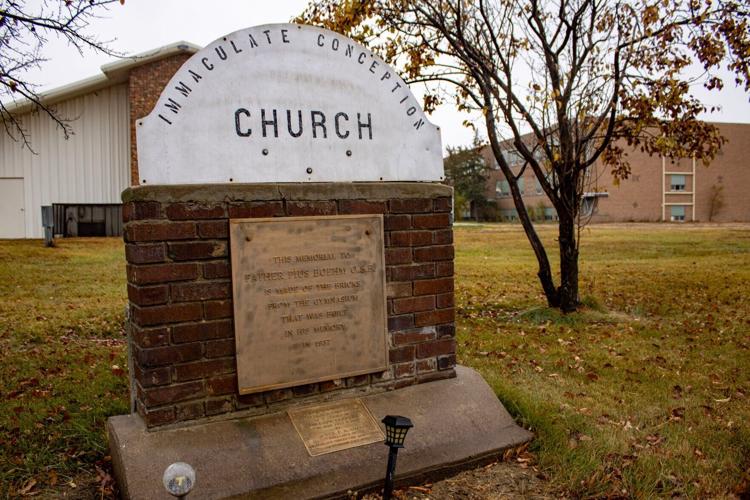
A memorial for Father Pius, one of the mission's first priests, sits outside of the former boarding school where more than 38 hidden children's graves were recently discovered by the tribe.
When they finished the two men stepped back and looked at the site. The flags were lined up perfectly, 6-foot rows, 8 feet apart.
“We knew right then and there that these were graves,” Lengkeek said.
Tribe members later found a photo depicting 38 little white crosses, matching what Lenkeek’s cousin had found and confirming suspicions of a hidden gravesite separate from the school cemetery.
Indigenous children from across the United States came to the school, like other boarding schools, seeking an education. But many faced abuse and neglect, and all were forced to give up their culture and heritage in favor of an education guided by the partnership between the Catholic Church and Bureau of Indian Affairs.
These 38 graves are likely those of children who attended the school during its nearly 100-year run in the Stephan community on the Crow Creek Reservation in central South Dakota, Tribe members said.
From 1887 to 1975, more than 1,000 children were taken, many by force, to the Immaculate Conception Boarding School. While many students came from the Crow Creek and Lower Brule Sioux Tribes, children were taken from tribes across South Dakota and even as far as Wisconsin, Montana, Idaho, Oregon, North Dakota, Nebraska and Iowa.

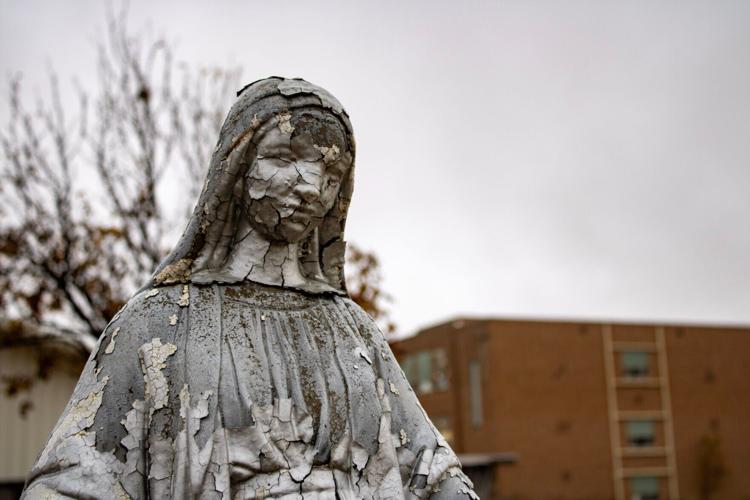
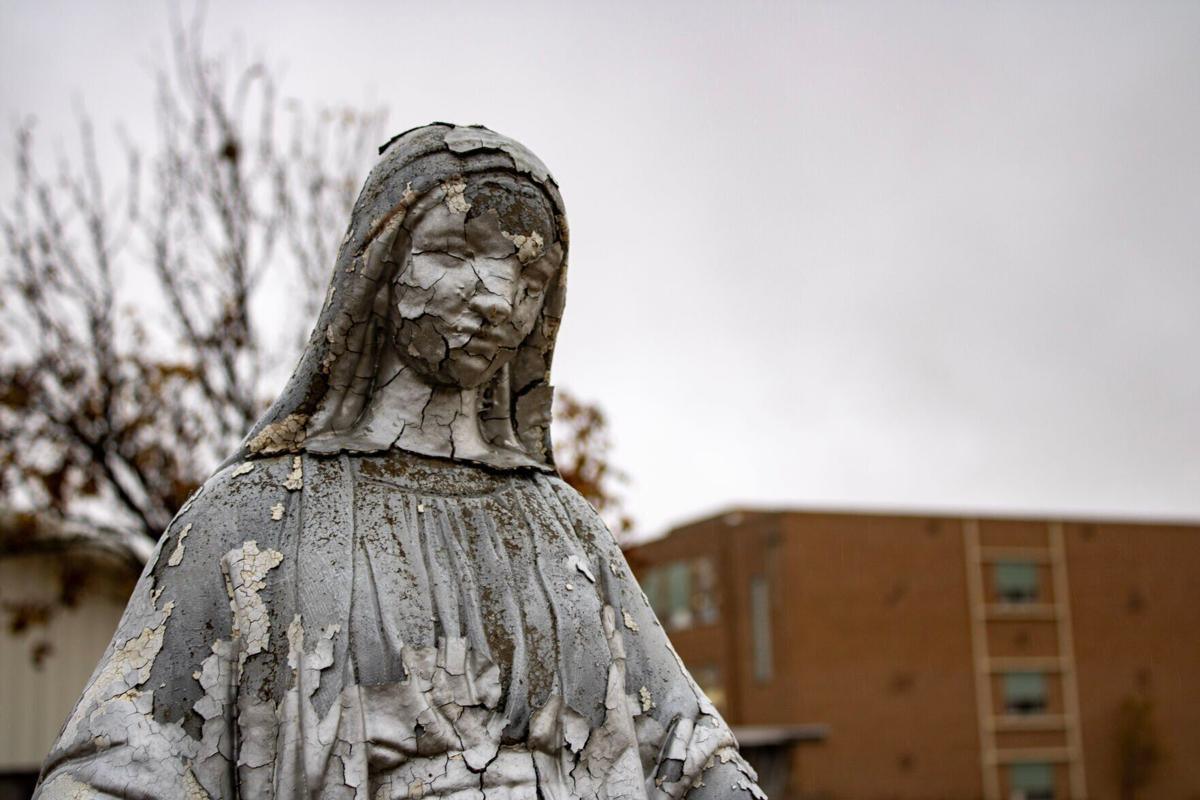
A statue of the Virgin Mary sits outside the site of a former Roman Catholic boarding school in Stephan on the Crow Creek Reservation.
This was part of a larger initiative to assimilate Indigenous children into white, American culture. The Bureau of Indian Affairs allowed Christian missionaries to help spread efforts out into the United States, establishing the Bureau of Catholic Indian Missions.
A time of turmoil and expansion
Around 1880, Chief Drifting Goose, leader of a band of lower Yanktoni Dakota people, reached out to the “black robe” missionaries to try and establish a school on the Crow Creek Reservation, much like Chief Red Cloud did in creating the Holy Rosary Mission on Pine Ridge.

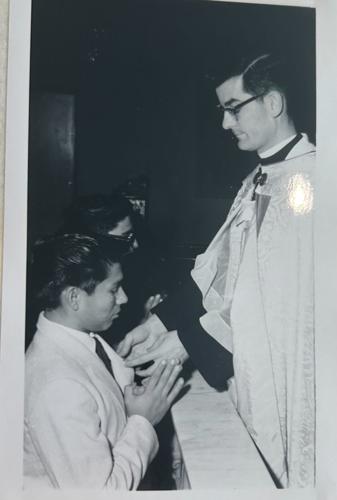
A student is received into the sodality at the Immaculate Conception Mission around 1960.
Drifting Goose and famous missionary Father Pierre-Jean De Smet met along the banks of the Missouri River and formulated a plan to create a Catholic Mission School on some of Drifting Goose’s land in the northern part of the reservation.
Thus, Immaculate Conception was born — the name was chosen by a wealthy donor named Katherine Drexel who supplied $20,000, roughly equivalent toy $660,000 today, in memory of her mother.
Initially, Immaculate Conception was to receive the equivalent of about $850 in today’s money per Lower Burle child boarding at the school and $1,600 per Crow Creek child from the government. With time, the school began accepting children from other tribes in the United States, despite not receiving additional compensation for it. The amount grew over time, as did the school’s attendance, beyond maximum capacity.
In 1929, financial records indicate the school was ordered to build an addition as constant overcrowding was causing health and safety concerns for children. In some school records, children are noted as having to share single beds with each other due to overcrowding.
What originally began as an elementary school in 1887 soon grew into a full K-12 facility, with two students, Aurelia LaRoche and Martina LaFraomboise, graduating in 1938 after spending their entire education careers at the school.
Throughout the school's history, illness spread rapidly in the school’s overcrowded conditions — in 1957, nearly all of the student and staff populations were infected with the flu.
The school frequently ran out of food and needed to supplement from wherever workers could find supplies. The clothing sent by the government for students, brown heavy suits and brown brogan shoes, was usually too small.
Everything at the mission was “exceedingly primitive,” a book on the school’s history by former nun Sister Marmion Maiers said.
Aside from illness, the school was set on fire six different times (only burning down twice) and was destroyed by a tornado twice. The second tornado in 1938 is noted to have “torn up the cemetery” but it isn’t clear which one, and injured 29 people. Extreme cold led to the deaths of some staff members, most notably one nun in the early years of the school who was unable to find her way back inside during a blizzard.

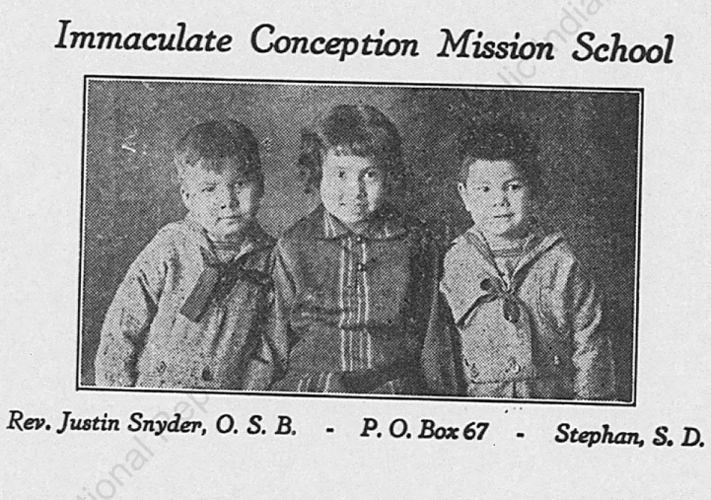
Students at the Immaculate Conception Mission school in the 1930s.
Marquette University in Milwaukee hosts a majority of records pertaining to the Bureau of Catholic Indian Missions. Amy Cooper Cary, head of the Marquette Archival Collections and Institutional Repository, said the university could not provide enrollment information that would contain private information such as student names and blood quantum, but was able to provide microfilm from the school.
The Marquette website contains digitized correspondence letters between the mission and the Bureau of Indian Affairs from 1926-1932, excluding 1929, which was recently removed. These documents provide a glimpse into life at the school, including multiple strange incidents.

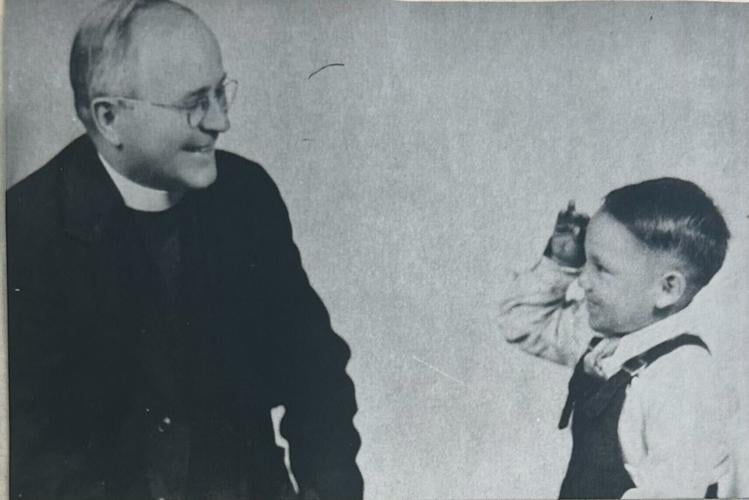
A photo from the "History of Immaculate Conception Mission." The caption reads: "Reverend Justin Snyder O.S.B. 1931-1943 entertained by Alex Thunder Horse."
Records from 1928 feature correspondence regarding a 4-year-old Hunkpati Dakota boy named Clarence Little Eagle who was seemingly taken by the mission from his mother to a Sioux Falls orphanage, following a request for help his mother made with the mission. The child’s mother and a mission priest fought for his return, but subsequent financial records make no mention of Little Eagle’s whereabouts.
In later years, financial documents contained letters from multiple community members calling for a mission doctor to be removed from the reservation over concerns of racism and malpractice, specifically that the doctor “treated Indians like dogs.”
The mission also seemingly took in children under the age of 7 at random. Per its contract with the Bureau of Indian Affairs, the school was only meant to house children ages 7 and up.
Life in Stephan

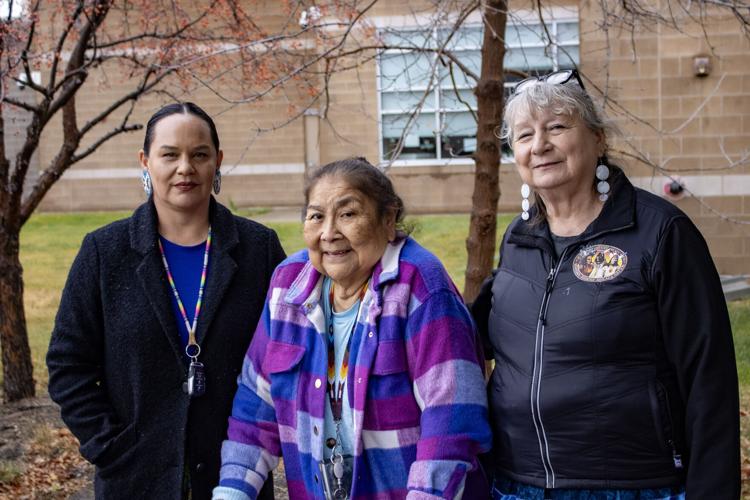
Jennifer YoungBear, Roberta "Kay Bird" Crows Breast and Susan Paulson pose for a photo together at the site of the former Immaculate Conception Mission School. Paulson and Crows Breast attended the school in the 1960s.
The 1950s were a turbulent time for the Mandan Hidatsa Arikara Nation in North Dakota. The creation of the Garrison Dam led to a major flood in 1953, consuming a quarter of the reservation and ruining homes, the tribal office and the hospital.
Susan Paulson’s family, like many other MHA families, made the tough decision to send their children off to boarding schools in South Dakota along the Missouri River.
“They (the U.S. government) made life so difficult that people thought, ‘Well, this way they’ll be going to a place where they’ll be fed,’” Paulson said.

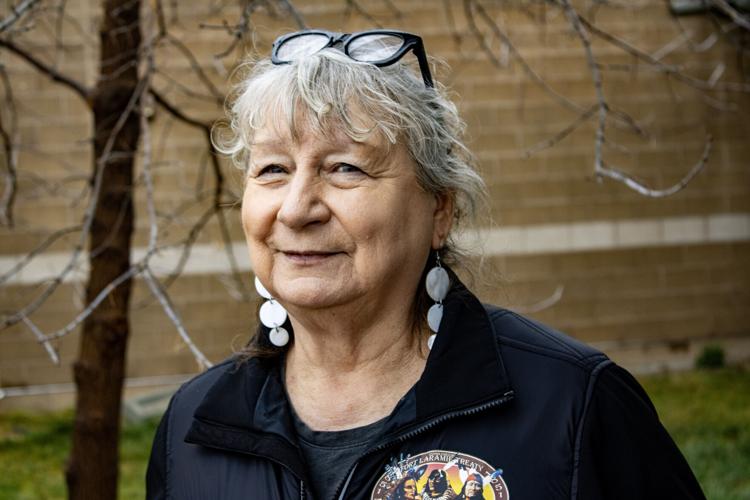
Susan Paulson of Bismarck stands at the former Immaculate Conception Boarding School in Stephan, S.D., where she was enrolled as a child.
In 1957, Paulson and her cousins traveled over 400 miles south to South Dakota. Her cousins enrolled at St. Joseph’s Indian School in Chamberlain and Paulson enrolled 35 miles north at Immaculate Conception.
For many students, life at the school was completely different than life in the dormitories. While the school provided a good education, the dorms were a place of work, fear and physical abuse.
“I learned a lot, and I had good grades, we had good teachers, and nuns were over there, you know. But it was dorm life that was terrible,” said Roberta “Kay Bird” Crows Breast, a Mandan Hidatsa Arikara elder who attended the school starting in 1963. “When we went back to the dorm, all we did was work, all we did was work.”
Zachary King, of the Turtle Mountain Band of Chippewa Indians, said the manual labor and abuse at the schools led to his mother Alta Marie Bruce experiencing lifelong back problems.

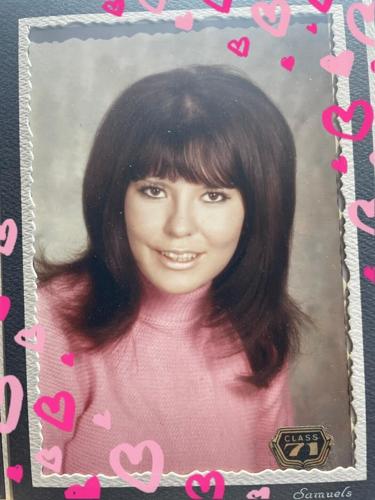
Alta Marie Bruce attended the Immaculate Conception Mission from 1967-1971 from Belcourt, N.D., on the Turtle Mountain Reservation. Bruce died in 2020.
Bruce, also a citizen of the Turtle Mountain Band of Chippewa Indians, was sent 400 miles from her reservation in northern North Dakota to Stephan, where she attended high school until her graduation in 1971.
“When I was a kid I remember her talking about having to clean the bathrooms, scrubbing the floors down on her hands and knees, and one time she was kicked in the back (by a nun) really hard,” King said. “That lingered on and in her old age she really struggled with arthritis in her hands from being hit with rulers so much.”
Paulson, now 72, was around 7 years old when she enrolled in 1958. At the school, she and around 100 girls her age lived in the dorms with one nun, called a matron, responsible for their care.
A free spirit, Paulson has always moved to the beat of her own drum, something she said may have bothered the nuns.
One of the nuns, Sister Damien, began locking Paulson in a storage room alone during mealtime, occasionally leaving her there until 2 or 3 in the morning.
“When they punished her they really went overboard,” Crows Breast, 71, said.
Crows Breast, an elder from the three affiliated tribes, came to Immaculate Conception in 1963 seeking reprieve from the rampant racism she’d experienced at the public schools in Parshall, N.D., a town on Fort Berthold Reservation with a significant non-Native population.

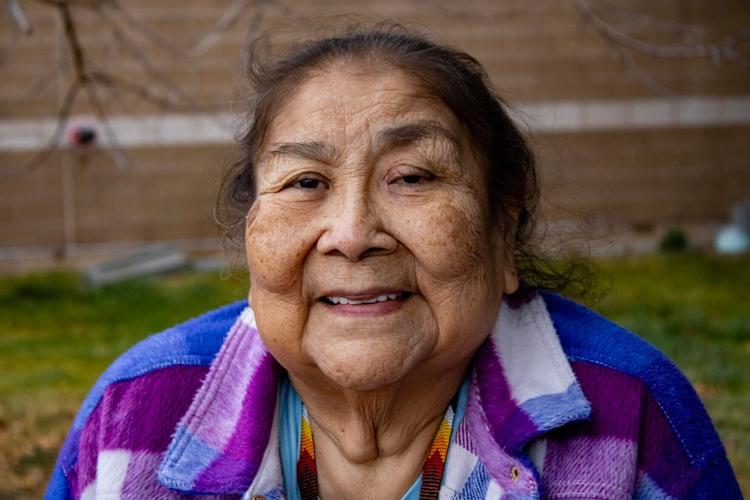
Roberta "Kay Bird" Crows Breast of the Mandan, Hidatsa and Arikara Nation, stands on the grounds of the former Immaculate Conception Boarding School in Stephan. She attended the school as a child.
“The racism was horrible, they made fun of Indians, and if they brushed past us they’d have to ‘wipe’ us off of them,” Crows Breast said.
But at Immaculate Conception, Crows Breast witnessed abuse and neglect perpetrated on Indigenous children, including Paulson, by mission nuns.
Paulson and Crows Breast would go on to form a lifelong friendship.
“A lot of people have no memories (of the school), but Kay Bird, she helps me to remember the details,” Paulson said.
The two women recounted hearing stories of “the belt line,” where male students were forced to punish each other. Boys would be lined up in rows of two and the boy being punished would run through the line as both sides hit him with belts.
“I never witnessed it but I heard of it,” Paulson said. “They would talk about it in whispers.”
Paulson remembered seeing a little boy from Mandaree, a community on her home Fort Berthold Reservation, who was bullied for sores on his face.
A nun's treatment of Paulson eventually escalated into physical violence.
When she was 9, Paulson and a few other students decided to try to run away from the school. It was winter, bitterly cold on the Great Plains, but the girls were determined to escape the abuse they’d been living in.
Dressed in brown denim dresses with big clunky shoes and brown stockings, the girls made a break for it, but it wouldn’t be long before they realized their goal was unattainable.
Paulson was over 400 miles away from home and one of her fellow runaways was 740 miles away from Chicago, from where she’d been sent. With no hats, gloves or winter clothes and no way out, the girls turned back.
“We were so far away from home it wasn’t even funny,” Paulson said. “If we didn’t turn back, we’d probably have been frozen kids lying on the prairie somewhere; they wouldn’t have found us until spring.”
When they came back, the girls were beaten and reprimanded for trying to escape.
For a while, life went back to the way it had been. Paulson was responsible for laundering student bedding, and had several other chores around the school.
One day in 1964, when Paulson was 13, she was walking down the stairs when Damien jumped on top of her in front of Paulson’s friend, Crows Breast. Damien attacked Paulson, and Paulson fought back.
Following the fight, Paulson was expelled from the school after standing up to Damien, who had been abusing her for seven years. After Paulson left, Crows Breast remained at the school, coming back every year for the friends she’d made.
“My mom asked me why I didn’t say anything to her about how bad it was, but I went back for my friends,” she said. “We became like family.”
Many students never came home, and their stories and names are yet to be revealed to tribal leaders who’ve begun the search for students.
A broader struggle to identify graves
From 1872 until the present day, over 32 Indian Boarding Schools have operated across South Dakota, bringing students from across the country for an assimilative education. Most are closed, but a mix of tribal, religious and federal-controlled Indian boarding school facilities remain around South Dakota including Maȟpíya Lúta (formerly Holy Rosary Mission), Flandreau Indian School, St. Joseph’s Indian School, Crow Creek Tribal Schools and the Pierre Learning Center.
So far only roughly 50 graves have been identified in the state, though this number is expected to change as more past and present schools begin their searches.
In 2008, Canada established the Truth and Reconciliation Commission, which operated until 2015, and was organized by the parties of the Indian Residential Schools Settlement Agreement.
The search for truth and healing picked up steam in 2021 when more than 215 children’s graves were discovered in Canada at the Kamloops Indian School, sparking an international trend of grave searches and wider education on the existence of boarding schools in Canada and the United States.
Around this time, Zachary King said his mother, Alta Marie Bruce, began speaking to him and his siblings about what she’d experienced at Immaculate Conception.
“People just didn’t talk about it,” King said. “There were people around here that had a good experience, and I think that’s why maybe my mom didn’t talk about it as much.”
King said he felt his mom, who passed away in 2020, was afraid to speak about what happened to her because of the positive experiences she heard from others.
“Some of the people that live around here, they’ve got big families, around 13 kids, and sometimes they weren’t able to feed them. So going to a place (like a boarding school) with three meals a day was huge,” King said.
The search for graves continued to spread, reaching South Dakota. Schools such as Maȟpíya Lúta and the former Rapid City Indian School have begun searching for and identifying graves. And while the Rapid City search has made great progress, work at the Immaculate Conception school is just starting.
For tribal leaders, the search for answers is complicated. The Immaculate Conception church is no longer in operation and the Sioux Falls Diocese and Bureau of Indian Affairs have provided little to no answers as to who the children are or how they died. With the church and mission gone, death records have become even harder to find. According to the Bureau of Catholic Indian Missions, in a situation like this, death records should be housed in the diocese.
Someone, somewhere, has these records, said Lengkeek, the Crow Creek Sioux Tribe chairman.
“We were told that half of the archives went to the University of South Dakota in Vermillion and half went to Augustana in Sioux Falls,” Lengkeek said. “But they won’t let us in there to look.”
The University of South Dakota was able to provide “The History of Immaculate Conception” by Sister Marmion Maiers to ICT and The Journal through an interlibrary loan. The dissertation contains a detailed timeline of the mission but does not contain any information on student deaths.
The Sioux Falls Catholic Diocese, which oversaw the church, did not respond to numerous requests for information.
Working to heal a nation
One year after the discovery on the Immaculate Conception grounds, on Nov. 9, survivors from North Dakota and South Dakota gathered in Stephan — about 227 miles east of Rapid City — to honor the children who died at the school and share their own stories. In near-freezing temperatures and drizzling rain, elders and youth gathered at the newly discovered gravesite fenced off near the intersection of BIA-23 and Crow Creek Loop.
For decades, community members and former boarding school students had traversed this land unaware of the secrets lying beneath.
Paulson, Crows Breast and Paulson’s daughter, Jennifer YoungBear, traveled four hours from Bismarck, North Dakota to Stephan for the ceremony, joining a handful of other survivors who made the journey. It was an emotional reunion — many hadn’t seen each other for decades since their time at the school.
“I think that everybody that was supposed to be here was here,” Lengkeek said. “This is a step closer for my people to heal, and that’s what I’m really excited about.”
Excavating the site will be difficult, Lengkeek said. Much of the land is now private property with trees overgrown on the site, but the tribe and the people haven’t forgotten about the children.
On Oct. 25, President Joe Biden delivered the first formal presidential apology for the federal boarding school era while visiting the Gila River Indian Community just south of Phoenix.
In his apology, Biden referred to the period as a “sin on our soul.”
“After 150 years, the government eventually stopped the program (of boarding schools) but never formally apologized,” Biden told the crowd. “I formally apologize today as President of the United States of America for what we did. I apologize, apologize, apologize!”

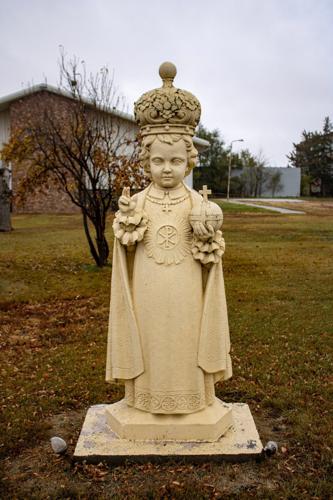
A statue of the Infant of Prague stands outside of the former Immaculate Conception Mission in Stephan on the Crow Creek Sioux Tribe reservation in central South Dakota.
In July, a final investigative report from the Department of the Interior on Indian Boarding Schools called for the formal apology from the United States, among other recommendations, including Congressional approval of a proposed Truth and Healing Commission to further investigate boarding schools, a national memorial to acknowledge the painful history and financial support for tribal programs that include repatriation, education, mental health support and community rebuilding.
Bruce, King said, coped with her trauma through her Anishinaabe culture.
“She led a really remarkable life,” King said. “The culture was her outlet. She attended sweats, she sundanced. The culture is what got her through it.”
In addition to providing avenues for healing, the Truth and Healing Commission bill would grant the authority to subpoena records from church-run schools, ICT reported in October. The bill is currently pending in Congress.
This would greatly aid the Crow Creek Sioux Tribe in their years-long struggle to obtain death records from the school and work towards identifying graves.
“These children are ready now, they’re going to start showing up all over the United States because they want to go home,” Lengkeek said. “They’ve been here long enough and if they’re here any longer they won’t be able to make it home, at least that’s what we believe.”
The most recent 38 graves aren’t the first time the school has discovered unmarked graves, Lengkeek said.
In 2011, during the construction of the Crow Creek Tribal School, Lengkeek said three child-size caskets and bone fragments were found under the grounds which formerly belonged to Immaculate Conception.
“(The children) they’re ready now, they’re ready to go home,” Lengkeek said. “We need to help them, we need to reunite them with their moms and dads, their siblings and their people.”
Special Report: Problems persist within federal schools for Native Americans
The federal government has begun to reckon with the ugly history of its system for educating Native American children, but that system never entirely went away. Nor have its problems entirely been resolved. In a series of stories, Lee Enterprises Public Service Journalism reporter Ted McDermott has investigated the use of psychotropic medications at one of the nation’s few remaining Indian boarding schools, Flandreau Indian School in South Dakota, as well as allegations of abuse, neglect and even death within the BIE system more broadly.

The Department of the Interior’s Office of Inspector General is calling out the Bureau of Indian Education for allowing problems to persist at Havasupai Elementary School in Arizona.

The BIE has known about concerns involving the Flandreau Indian School since fall 2023. But attempts to access public records and get answers about the bureau's response have been unsuccessful.

A lack of training and a disorganized system contributed to “med errors,” including some students being “given the wrong medication," said one long-time teacher at the BIE-operated Flandreau Indian School.

"Why are they doping up our children like this?" one parent said. "Why do they deserve to do this?"

The Flandreau Indian School Student and Parent handbook explicitly states, "Failure to take prescribed medication is a Health and Safety issue and can result in FIS disciplinary action.”

As Native American students face what one BIE superintendent called "extreme challenges," Circle of Nations School welcomed a reporter and photographer inside. "We want the exposure," an administrator said.

Within the federal government's sprawling Bureau of Indian Education school system, allegations of abuse, neglect and even death at BIE schools have emerged over the past two decades.

Thousands of reports designated for recording abuse, neglect, injuries, life-threatening incidents and death have been filed since 2008 at the 55 schools the BIE operates directly.
This story is co-published by the Rapid City Journal and ICT, a news partnership that covers Indigenous communities in the South Dakota area.
Amelia Schafer is the Indigenous Affairs reporter for ICT and the Rapid City Journal. She is of Wampanoag and Montauk-Brothertown Indian Nation descent. She is based in Rapid City. You can contact her at aschafer@rapidcityjournal.com.