NEW YORK — Low-value imports are losing their duty-free status in the United States this week as part of President Donald Trump's agenda for making the nation less dependent on foreign goods and resetting global trade with tariffs.
An executive order the Republican signed last month eliminates a customs exemption for international shipments worth $800 or less starting Friday, nearly two years earlier than the deadline set in the tax cuts and spending law approved by Congress.
People are also reading…
Though the president previously ended the de minimis rule for inexpensive items sent from China and Hong Kong, having to pay import taxes on small parcels from everywhere else likely will be a big change for some small businesses and online shoppers.

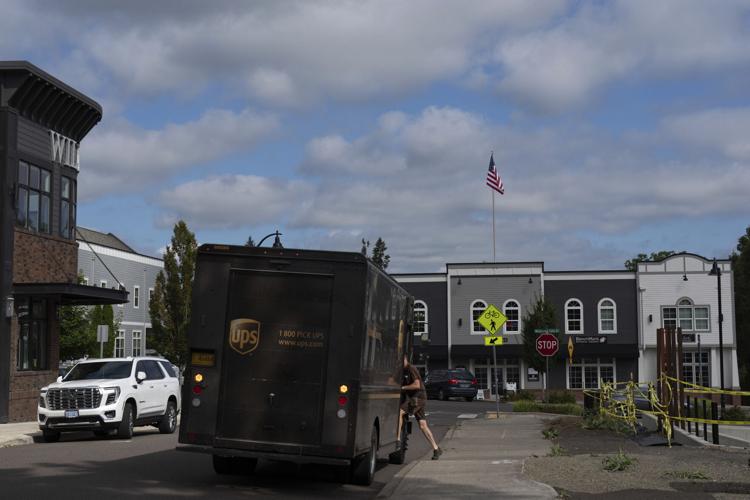
A UPS driver gets into their vehicle after delivering packages Aug. 20 at A Sight For Sport Eyes, a brick-and-mortar and e-commerce store for sport goggles in West Linn, Ore.
Purchases that previously entered the U.S. without needing to clear customs will require vetting and be subject to their origin country's applicable tariff rate, which can range from 10% to 50%. For the next six months, carriers handling orders sent through the global mail network also can choose a flat duty of $80 to $200 per package instead of the value-based rate.

In response, the national postal services of more than a dozen countries said they would temporarily suspend sending some or most U.S.-bound packages due to confusion over processing and payment requirements.

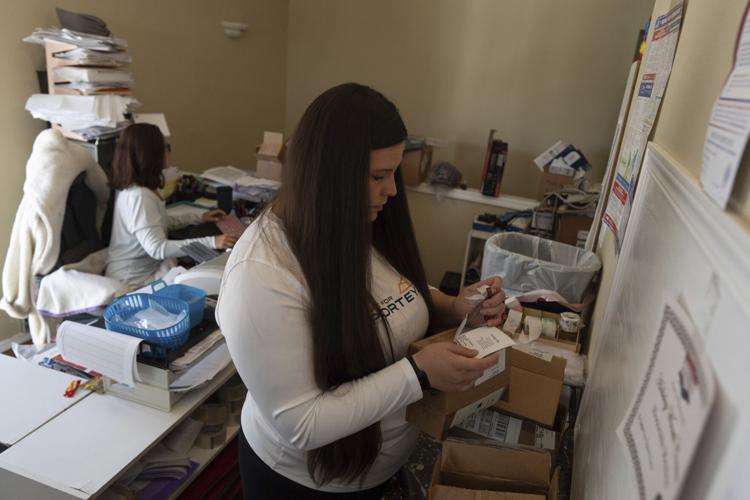
Amanda Follett works on packages Aug. 20 at A Sight For Sport Eyes, a brick-and-mortar and e-commerce store for sport goggles in West Linn, Ore.
Critics call de minimis rule a loophole
The Trump administration says the exemption became a loophole that foreign businesses exploit to evade tariffs and criminals use to get drugs, counterfeit products and other contraband into the U.S. Former President Joe Biden and members of Congress also discussed the issue.
Other countries have similar exemptions, but the threshold is usually lower. For example, $175 is the value limit in the 20 European Union countries that use the euro as their official currency. The U.K. allows foreign businesses to send parcels worth up to $182 without incurring tariff charges.

In the U.S., the de minimis — Latin for lacking significance or importance — exemption started in 1938 as a way to save the federal government the time and expense of collecting duties on imported goods with a retail value of $1 or less. U.S. lawmakers eventually increased the eligibility cutoff to $800 in 2015, according to the Congressional Research Service.
A total of 1.36 billion packages with a combined value of $64.6 billion reached the U.S. last year, compared to 134 million packages sent under the exemption in 2015, the U.S. Customs and Border Protection agency reported.
About 60% of the 2024 shipments came from China and Hong Kong, according to an analysis logistics firm Flexport prepared based on U.S. government data. Multiple countries and regions accounted for the remainder, including Canada, Mexico, the European Union, India and Vietnam.

Shannen Knight, owner of A Sight For Sport Eyes, looks on Aug. 20 while talking about the store in West Linn, Ore.
Business owners anticipate higher costs
Proponents of limiting the exemption argue that it served as a way for China-founded retail platforms like Temu and Shein to flood the U.S. with low-priced goods. The National Council of Textile Organizations said ending the exemption would help close a "backdoor pipeline for cheap, subsidized, and often illegal, toxic and unethical imports."
However, some smaller American companies that rely on imported products and materials benefited from the exemption too.
Shannen Knight imports hard-to-find sports goggles and glasses as the owner of A Sight For Sport Eyes, her online store and shop in West Linn, Oregon. She routinely received shipments from the U.K., the Netherlands and Italy that fell under the de minimis dollar cutoff.
Knight estimated that she would need to raise the retail price of the rugby goggles she gets from Italy, a specialty item without strong prospects for stateside production, by 50%.

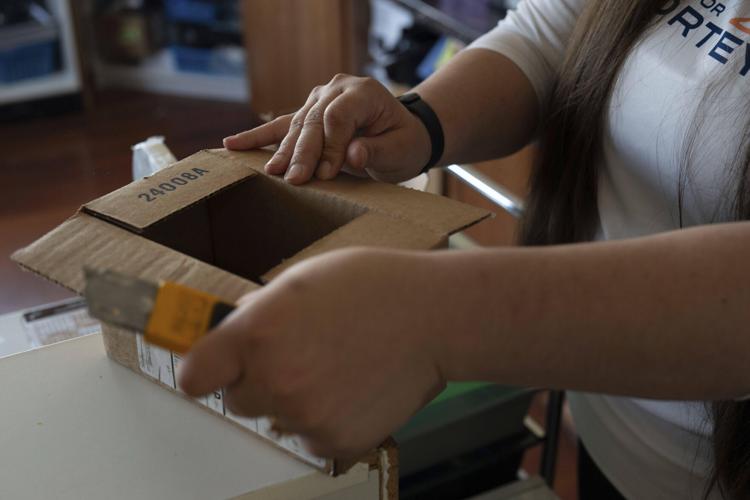
Amanda Follett opens packages Aug. 20 at A Sight For Sport Eyes, a brick-and-mortar and e-commerce store for sport goggles in West Linn, Ore.
Kristin Trainor is worried the end of de minimis will mean the end of Diesel and Lulu's, her 3-year-old boutique in Avon, Connecticut. More than 70% of the women's clothes and accessories she stocks comes from small fashion houses in France, Italy and Spain.
She estimates a simple Italian linen sundress that cost $30 wholesale at the beginning of the year will rise to $43 next month.
After a corporate career, Trainor opened the store to have more time with her 9-year-old son and her 91-year old father. Raising the boutique's prices to absorb part of the import charges would help offset higher shipping and logistics costs, but Trainor worries her customers will balk at higher prices.
"At this point," she said, "I am leaning more and more towards closing the boutique, sadly."

Rugby eye-ware made by the Italian brand Raleri is displayed Aug. 20 at A Sight For Sport Eyes in West Linn, Ore.
Ken Huening started CoverSeal, which makes and sells protective covers for cars, motorcycles, grills and patio furniture, in 2020. The company is based in Los Gatos, California, and the covers are manufactured in Mexico and China. When a customer places an order, it ships from Mexico.
Though a trade agreement that took effect in 2020 made most goods from Mexico and Canada exempt from country-specific U.S. tariffs, the withdrawal of the de minimis rule applies to all countries.
Huening said he'll have to raise prices or end free shipping now that his products will be taxed when they are sent from Mexico to U.S. customers. He's looked at setting up a U.S. production and logistics network but says domestic sewing facilities and textile manufacturers do not exist for the engineered fabric used in CoverSeal's products.
"We are often asked why we don't just establish a U.S. supply chain," he said. "It is not possible in the short term. By the time the infrastructure is established, many companies and small businesses will be out of business."
Photos: A look at global trade

FILE - Swiss chocolate bars from the brands Favarger, Villars, Cailler and Swiss-Dream are photographed in a souvenir shop window on Thursday, April 10, 2025, in Geneva. (Martial Trezzini/Keystone via AP)

FILE - Watches in the Omega shop window at the Bahnhofsstrasse in Zuerich, Switzerland, on Thursday, April 10, 2025. (Til Buergy/Keystone via AP)

FILE - A view of Gruy're AOP cheese wheels in the Gruy're AOP maturing cellars of Fromco, part of the Emmi Group, on Tuesday, May 6, 2025 in Moudon in the canton of Vaud. (Jean-Christophe Bott/Keystone via AP)

FILE - An employee at On tidies up sports shoes from the On sports brand in the On store on Wednesday, Jan. 22, 2025, at On's headquarters in Zurich. (Gaetan Bally/Keystone via AP)

A container is loaded on a truck at the Civitavecchia Harbour, Italy, Thursday, Aug. 7, 2025. (AP Photo/Gregorio Borgia)

A man works at a leather factory at Dharavi in Mumbai, India, Thursday, Aug. 7, 2025. (AP Photo/Rajanish Kakade)

Vehicles for export are parked at a port in Pyeongtaek, South Korea, Thursday, Aug. 7, 2025. (AP Photo/Ahn Young-joon)

An Indian customer, reflected on a mirror, tries a gold necklace at a jewelry shop in Lucknow, India, Thursday, Aug. 7, 2025. (AP Photo/Rajesh Kumar Singh)

An employee sorts medicines in a medicine wholesale shop in Guwahati, India, Thursday, Aug. 7, 2025. (AP Photo/Anupam Nath)

Trucks navigate along stacks of containers at the Manila North Harbour Port in Manila, Philippines on Thursday, Aug. 7, 2025. (AP Photo/Aaron Favila)

A truck navigates along stacks of containers at the Manila North Harbour Port in Manila, Philippines on Thursday, Aug. 7, 2025. (AP Photo/Aaron Favila)

An employee holds U.S. dollar notes at a money changer in Jakarta, Indonesia, Thursday, Aug. 7, 2025. (AP Photo/Tatan Syuflana)

A man watches stock prices displayed on an electronic board at the Indonesia Stock Exchange in Jakarta, Indonesia, Thursday, Aug. 7, 2025. (AP Photo/Tatan Syuflana)

A crane works on stacks of containers at the Bangkok Port in Bangkok, Thailand, Wednesday, Aug. 6, 2025. (AP Photo/Sakchai Lalit)

A crane unloads a shipping container from a truck at IPC Container Terminal at Tanjung Priok Port in Jakarta, Indonesia, Wednesday, Aug. 6, 2025. (AP Photo/Achmad Ibrahim)

A worker waits for customers at Roopam Sarees, which sells clothing imported from India, on Thursday, July 31, 2025, in Berkeley, Calif. (AP Photo/Noah Berger)

Sen. Minority Leader Chuck Schumer of N.Y., speaks during a news conference on tariffs on Capitol Hill, Thursday, July 31, 2025, in Washington. (AP Photo/Mariam Zuhaib)

Cargo containers line a shipping terminal at the Port of Oakland on Thursday, July 31, 2025, in Oakland, Calif. (AP Photo/Noah Berger)

A worker assembles steel decking in the construction of a housing project, Thursday, July 31, 2025, in Portland, Maine. (AP Photo/Robert F. Bukaty)

A welder works on steel decking during construction of a housing project, Thursday, July 31, 2025, in Portland, Maine. (AP Photo/Robert F. Bukaty)

New cars are parked in a lot at the International Car Operators terminal in the Port of Zeebrugge, Belgium, Thursday, July 31, 2025. (AP Photo/Virginia Mayo)

The Atlantic Navigator II departs from the Port of Baltimore, Thursday, July 31, 2025, in Baltimore. (AP Photo/Stephanie Scarbrough)

A South Korean protester holds up a banner during a rally against U.S. President Donald Trump's tariffs policy on South Korea, near the U.S. Embassy in Seoul, South Korea, Wednesday, July 30, 2025. The signs at bottom read "We can't give you a penny." (AP Photo/Ahn Young-joon)

Workers prep bulk bags of sugar to be loaded on a container ship at the port of Santos, Brazil, Tuesday, July 29, 2025. (AP Photo/Andre Penner)

Workers load a truck with the last boxes filled with clothes from the empty Tzicc clothing factory following the threat of U.S.-imposed tariffs in Maseru, Lesotho, Tuesday, July 22, 2025. (AP Photo/Bram Janssen)

A sewing machine is covered by a sheet inside the empty Tzicc clothing factory following the threat of U.S.-imposed tariffs in Maseru, Lesotho, Tuesday, July 22, 2025. (AP Photo/Bram Janssen)

A woman works in a Celine shop, Monday, July 28, 2025 in Paris. (AP Photo/Thomas Padilla)

Customers and influencers try on new Korean perfume during a workshop at Senti Senti in New York on Friday, July 25, 2025. (AP Photo/Yuki Iwamura)

A worker tends to plants inside a greenhouse at the Veggie Prime tomato farm, which exports to the United States, in Ajuchitlan, Mexico, Wednesday, July 23, 2025. (AP Photo/Marco Ugarte)

FILE - President Donald Trump speaks during an event to announce new tariffs in the Rose Garden at the White House, on April 2, 2025, in Washington. (AP Photo/Mark Schiefelbein, File)