Lindsay Clancy's murder trial is nearing its end, and USA TODAY's Melina Khan breaks down what happens after the jury decides her fate.
Lindsay Clancy's fate will soon be in the hands of a Massachusetts jury to deliberate a verdict in the highly-publicized triple murder trial.
Clancy, 36, faces three murder charges in the January 2023 strangulation deaths of her three children — Cora, 5; Dawson, 3; and Callan, 8 months — at the family's Duxbury, Massachusetts, home. She has pleaded not guilty to all three counts.
Prosecutors allege Clancy planned the killings by sending her husband to pick up takeout food and medicine, then, while he was gone, strangling the children to death with exercise bands. After, Clancy cut her wrists and neck and jumped out of a second-story window, which left her paralyzed.
While Clancy does not dispute that she killed the children, defense attorney Kevin Reddington says she is not guilty because she lacks criminal responsibility for her actions, more commonly known as an insanity defense. Reddington says Clancy was suffering from postpartum depression and psychosis at the time of the killings.
People are also reading…
The prosecution and defense both rested in the case after calling a slew of witnesses, including Clancy's family members and friends, first responders and medical providers. After rebuttal witnesses for the prosecution finish testimony, closing arguments will take place and the judge will instruct the jury and send them into deliberations.
Here's what could happen after the jury returns a decision in the case, which has put a spotlight on postpartum mental health.

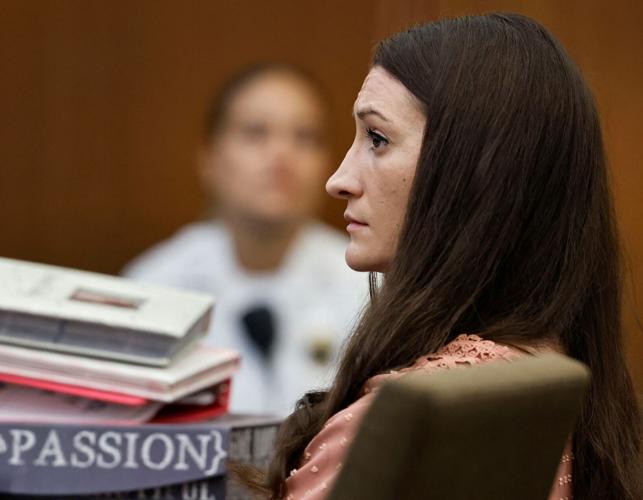
Defendant Lindsay Clancy, who is accused of killing her three young children in 2023, at the defense table Monday during her Plymouth Superior Court trial in Plymouth, Mass.
What charges does Clancy face?
Lindsay Clancy faces three counts of first-degree murder. She pleaded not guilty to all three counts.
She was initially also charged with three counts of strangulation, but prosecutors dropped them prior to the start of the trial in July.
In Massachusetts, first-degree murder carries a mandatory sentence of life in prison without parole.
What is the jury deciding on?
Jurors will soon be tasked with determining whether Clancy is criminally responsible for killing her children.
While known as lacking criminal responsibility under Massachusetts law, the defense is more commonly referred to as not guilty by reason of insanity.
A person is not criminally responsible for their conduct if they have "a mental disease or defect, and as a result of that mental disease or defect, lacks the substantial capacity either to appreciate the criminality or the wrongfulness of her conduct or to conform her conduct to the requirements of the law," according to a definition read in court by judge William Sullivan.

Supporters yell words of encouragement to Lindsay Clancy's lawyer, Kevin Reddington, as he arrives Thursday at the courthouse in Plymouth, Mass.
In most states, the defense has to prove a lack of criminal responsibility, but Massachusetts shifts that burden onto the prosecution.
According to legal experts, this essentially means that the jury has to answer one major question: did the prosecution prove, beyond a reasonable doubt, that Clancy understood the wrongfulness of her actions at the time of the killings?
"I think it's a very high burden for the prosecution in this case to meet, and I'm curious to see if the jury sees it the same way," said Seth J. Zuckerman, a celebrity criminal defense attorney, founder of Zuckerman Legal Group and former New York City prosecutor.

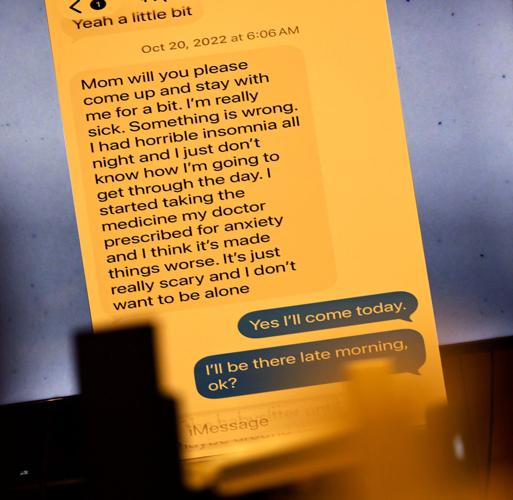
A copy of a text Lindsay Clancy sent her mother asking for help is seen Aug. 17 at her trial in Plymouth Superior Court in Plymouth, Mass.
What are the possible outcomes?
If the jury finds Lindsay Clancy guilty, it must also determine what degree of murder she should be convicted of.
The degree of the murder conviction would determine the length of a prison sentence; if she is convicted of first-degree murder, it carries a mandatory life sentence in Massachusetts. Individuals who are in prison custody in Massachusetts are assessed for both immediate and ongoing healthcare needs, according to the state's Department of Correction.
If the jury finds her not guilty or lacking criminal responsibility, under Massachusetts law, the sentence typically requires the defendant to undergo a mental evaluation and likely a commitment to a state hospital for treatment.
Clancy has been held at Tewksbury Hospital, a facility in Tewksbury, Massachusetts, for court-ordered mental health treatment since May 2023.
If the jury cannot come to a unanimous decision, the judge could declare a mistrial.
A mistrial is "certainly possible" in a case as contentious as this one, Zuckerman said.
"This case has brought out strong emotions on both sides and since there's strong emotions on both sides in the public, I'm assuming there will be strong emotions on both sides within the jury," he said.
Gary Galperin, an adjunct professor at Cardozo School of Law and former Manhattan assistant district attorney, said he doubts that the jury will return a verdict quickly.
"Jurors, especially in long trials and high-profile trials, they really take their obligations seriously and they know that if they don't come to an agreement, that would mean a retrial," he told USA TODAY.

Judge William Sullivan directs a prosecution witness to answer a question Monday at the Plymouth Superior Court trial of Lindsay Clancy in Plymouth, Mass.
What happens if she's found not guilty?
Clancy likely won't get off scot-free even if she is found not guilty, Galperin and Zuckerman said.
"One of the public misconceptions is that oh, someone is found insane, they get away with murder and walk out of the the courtroom. That is not the case," Galperin said.
A so-called insanity verdict would reflect Clancy's mental state at the time of the killings, not her mental state now. She would likely be ordered to undergo a mental health evaluation and may be committed to a state hospital for treatment under court order.
Generally speaking, defendants who are committed to a state hospital for long-term mental health treatment are reevaluated periodically. If they are deemed not a danger to themselves or others, they may have a chance to be released, though the process can take years, according to Galperin and Zuckerman.
"This periodic review, continued hospitalization and so forth can frequently enough result in hospitalization — a deprivation of liberty — longer than if the person were convicted and sentenced after a guilty verdict," Galperin said.