Public defenders across America regularly work triple the cases they can effectively handle, and some work upwards of 10 times too many cases, according to an analysis of Lee Enterprises data based on a milestone study of public defender workloads released Tuesday.

Across the West, public defense systems face crushing caseloads, historic underfunding, structural problems and staffing shortages, imperiling criminal defendants’ lives and denying them their constitutional right to counsel.
The new workload standards developed in the study are the first national, data-driven metrics that show “when a public defender has too much work — so much work, he or she can’t be competent for all their clients,” said longtime civil rights lawyer Stephen Hanlon. The study’s figures replace half-century-old caseload standards that are inaccurate and based on “nothing,” Hanlon said.
“This is a watershed event in public defense,” said Hanlon, a public defense reform leader and one of the study authors.
The "groundbreaking" study finds public defenders are "dangerously overworked" and seeks to reduce caseloads, the authors said in a press release.
People are also reading…
Lee Enterprises’ Public Service Journalism team requested caseload data from all 50 states to conduct the first-ever national analysis of public defender workloads using the new National Public Defense Workload Standards. The analysis proves public defenders are severely overworked — a problem that threatens the constitutional right to effective counsel.
The data show more than 9,000 public defenders in 33 states have average caseloads three times the maximum annual cases outlined in the standards, according to a conservative analysis that underestimated workloads. In another five states and one county, the 50 public defenders with the highest workloads each had four times the maximum cases on average, according to a similar analysis. The remaining 11 states did not have data that could be compared to the standards.
"Excessive caseloads ... inevitably cause harm," the study states. "Overloaded attorneys simply cannot give appropriate time and attention to each client. They cannot investigate fully or in a timely manner. They cannot file the motions they should. Cases are delayed, and evidence and witnesses are lost."
Attorney Malia Brink, one of the study authors, said a criminal justice system with overburdened public defenders "denies all people who rely on it — victims, witnesses, defendants, and their families and communities — equal justice."
Montana resident Joseph Jefferson-Dust, a public defender’s office former client, was in and out of jail for a year despite his accuser recanting her allegations. His exoneration case was delayed because the recantation sat unseen in an overwhelmed public defender office for 13 months. A judge vowed in July to overturn Jefferson-Dust’s 2016 conviction.
A Lee Enterprises investigation found the right to counsel is routinely violated across the West. Hundreds accused in Oregon — some of whom are in jail — are stuck in limbo each day without attorneys because of a public defender shortage. In other states, public defenders are so overworked they become ineffective. People lost homes, jobs and exonerating evidence while waiting for attorneys to help them.

Joseph Jefferson-Dust was released from probation requirements in July by Yellowstone County District Court Judge Brett Linneweber in light of his accuser recanting her allegations.
Nona Wiley, 55, met her public defender for the first time after her court hearing began in Matagorda County, Texas, last October.
“I called him, and he won’t even answer the phone,” Wiley said, sobbing in court, devastated at the possibility of losing time with her grandchildren. Her case was delayed to give the attorney more time to prepare, Wiley said.
The American Bar Association adopted in August new principles that state public defenders’ caseloads should “never” exceed national standards. Updated for the first time in more than 20 years, the principles are guidelines for policymakers to create effective public defense systems — something they have a constitutional obligation to do.
Hanlon created a new national organization, the Quality Defense Alliance, to fight for the enforcement of the standards across the U.S. through advocacy and legal action. The alliance is already assisting with a court battle in Oregon, where a state Supreme Court judge ordered a lower judge to stop assigning cases to overwhelmed public defenders in Marion County. A Oregon Supreme Court hearing on the case is scheduled for Sept. 19.
Reporter Emily Hamer explains problems with public defense and how a group of researchers and attorneys hope to fix them.
The principles cite both the new National Public Defense Workload Standards and the old standards, but state that the new standards are grounded in “rigorous” research and account for the changes in public defense practice over the last 50 years. The old standards don’t.
The old caseload standards, commonly referred to as the “NAC Standards,” don’t account for body cameras, smartphones and other new technologies that make today’s cases more complicated and time-consuming. Most public defense experts agree the old standards overestimate the number of cases attorneys can handle. Hanlon said there was “no methodology,” “no data” for the old figures. A few lawyers scribbled them on a cocktail napkin in the 70s, he said.
“It's truly astonishing that we relied on that for 50 years, and there's no excuse for having done that,” Hanlon said.
What are the new public defense workload standards?
The RAND Corporation, National Center for State Courts, American Bar Association Standing Committee on Legal Aid and Indigent Defense, and Hanlon’s firm, the Law Office of Lawyer Hanlon developed the new standards from a study of 17 state-level public defense workload studies and a research session that led to a 33-member expert panel consensus. The study was also supported by philanthropic organization Arnold Ventures.

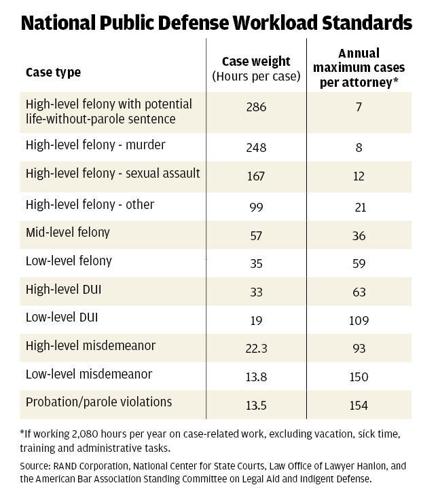
The standards are the hours attorneys should spend on 11 case types to ensure effective representation. Those hours can be used to show the maximum number of cases attorneys should handle in a year. They can also be used to calculate the number of attorneys an office needs to handle its cases.
A low-level felony should take about 35 hours to defend, so a public defender should work a maximum of 59 of them a year if working 2,080 hours on cases with no vacation, no sick time and no administrative tasks, according to the new standards. Public defenders should handle fewer more serious felonies: No more than 21 high-level felonies, 12 sexual assault cases or eight murders in a year.
The NAC standards recommended attorneys work a maximum of 400 annual misdemeanors or 150 annual felonies, and make no recommendations for more serious felonies.
In Illinois, public defenders in St. Clair County each handled more than 350 felonies in 2022. The old standards indicate that’s slightly more than double the recommended maximum while the updated standards suggest it’s at least six times too many cases, assuming the felonies were all low-level.
The National Legal and Defender Association, which helped create the old standards, said it hopes the updated standards “will provide a wake-up call to states and localities on the need to properly invest in public defense.”
The Montana state public defender office this year asked for 20 new staff attorney positions to help manage its workload, but lawmakers only included eight new positions in the final budget. State Sen. Ryan Lynch, D-Butte, said it will “absolutely” be helpful to have nationally recognized standards to assess Montana public defender workloads and argue for more staff in future budget sessions.

State Sen. Ryan Lynch, D-Butte.
Public defenders are overworked nationwide
Most states in the Lee Enterprises data analysis did not distinguish between low-level and high-level felony cases, so Lee counted all unspecified felonies as low-level to underestimate workloads.

People accused in more than 100,000 misdemeanors each year go to jail without talking to a lawyer, a Lee Enterprises investigation found. The practice threatens people's constitutional right to counsel.
Even with the conservative analysis, public defenders in recent years faced excessive workloads according to the new standards in at least Alabama, Alaska, one Arizona county, Arkansas, one California county, Colorado, Connecticut, Delaware, Florida, Georgia, Hawaii, Idaho, two Illinois counties, Indiana, Kansas, Kentucky, Maryland, Michigan, Minnesota, Missouri, two Nebraska counties, New Jersey, New Mexico, New York, North Dakota, Ohio, Oklahoma, Oregon, two Pennsylvania counties, Rhode Island, South Carolina, one South Dakota county, Tennessee, Texas, Washington, West Virginia, Wisconsin and Wyoming.
Of the 39 states that provided data comparable to the new standards, only Vermont had public defenders with caseloads below the maximum. But that’s under an analysis that misses juvenile cases, which makeup about 20% of the attorneys’ total cases but cannot be compared to the standards because the study only considered adult criminal cases.

Experts say Arizona's Pima County soon won’t have enough public defenders to handle the cases being filed. “We’re hitting a crisis point,” one public defender said.
The 50 lawyers with the highest public defense caseloads in Texas worked an average of six times as many cases as they should in 2021, according to Texas Indigent Defense Commission caseload data compared to the new standards. Two attorneys had 12 times too many cases.
In Idaho, the 50 attorneys with the most public defense cases in fiscal year 2021 had caseloads nearly five times higher than the standards, according to Idaho Public Defense Commission data. One attorney had 14 times too many cases, and another had seven times too many.
Full-time public defenders in a judicial circuit in Florida and a judicial district in Maryland worked 10 times too many cases on average in fiscal year 2022, according to data from the Florida Department of Law Enforcement and Maryland Office of the Public Defender.
Experts consider workloads 'really problematic'
When an American Bar Association study in 2022 showed Oregon attorneys were shouldering the weight of three times as many cases as they can effectively handle, Washington County district attorney Kevin Barton called those figures “fantastical.”
“The study suggested that Oregon needed roughly 1,300 more attorneys, which I think is a number that is not grounded in reality,” Barton said.

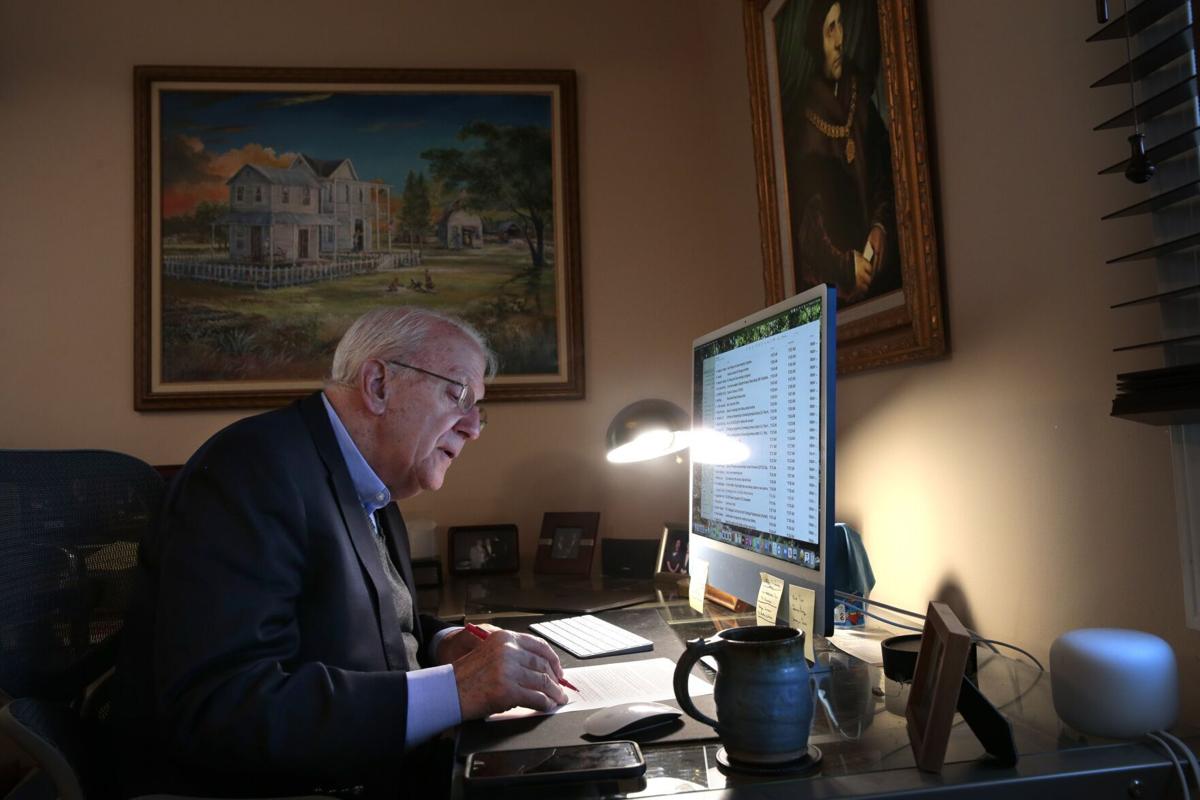
Hanlon
Hanlon agrees with Barton that the standards show public defender caseloads are extraordinarily high, but he said it’s reality.
“I don’t think we got it wrong,” Hanlon said. “Now is that number really problematic? Yes. In many cases, it means that if you just continue the system the way it is, a tripling, quadrupling (or) more of the amount of money that needs to go into indigent defense.”
Hanlon said part of the reason why caseloads are so high is “these cases, by and large, are not being investigated,” despite attorneys’ ethical obligation to complete case investigations before recommending plea deals. Judges and attorneys push defendants through the system as quickly as possible in what Hanlon calls a "criminal processing system."
The new standards give public defenders time to investigate every case to fulfill their constitutional obligations.
Longtime civil rights attorney and public defense reform advocate Stephen Hanlon addresses criticism of the standards.
Additional attorneys would ‘dramatically alter’ defense strategy
Eric Whitcher, Pennington County Public Defender director, said attorneys in his South Dakota office struggle to keep up with cases’ body camera footage because a minor traffic stop can amass hours of footage.

Whitcher
“There would be absolutely no way we could watch them all,” Whitcher said. “We make choices. You just hope you don’t make a mistake.”
Whitcher’s office in 2021 had nearly four times as many cases as the new standard calculations recommend. At least 54 more staff-attorney positions are needed to handle its cases, according to a Lee Enterprises analysis of its caseloads adjusted to the new standards. The office is currently short 2 of its 22 attorney positions, Whitcher said.
“[Tripling staff] would dramatically alter what our expectations would then be about how we approach each and every case from an investigation standpoint,” he said. “I would expect every lawyer to watch every minute of every video, to be in multiple communications with their client, and running down any possible defense, filing any possible motion. It would be a very different practice.
“I know that the lawyers would feel like they got to do everything possible in each and every case.”

The Public Service Journalism team focuses on producing in-depth and investigative stories on local, state and national issues with significan…
But Pennington County can’t afford to triple the public defender office’s budget, Whitcher said.
Decriminalizing cases could ease some of the burden on public defenders. Pennington County law enforcement most frequently charges drug possession. Removing laws that allow prosecution for drug residue presence, for example, could reduce the office’s workload by more than 600 cases, about 10%, Whitcher said.
Hanlon knows states and counties cannot triple or quadruple public defense budgets on their own. Hanlon, along with the Quality Defense Alliance, advocate for federal public defense grants for local governments. The alliance also works with states to develop five-year plans to improve public defense through funding increases and the decriminalization of some nonviolent charges.
Hanlon said transforming public defense over the next five years is a realistic goal.
“It took us 50 years to dig this hole,” Hanlon said. “We are not going to dig out of it overnight.”