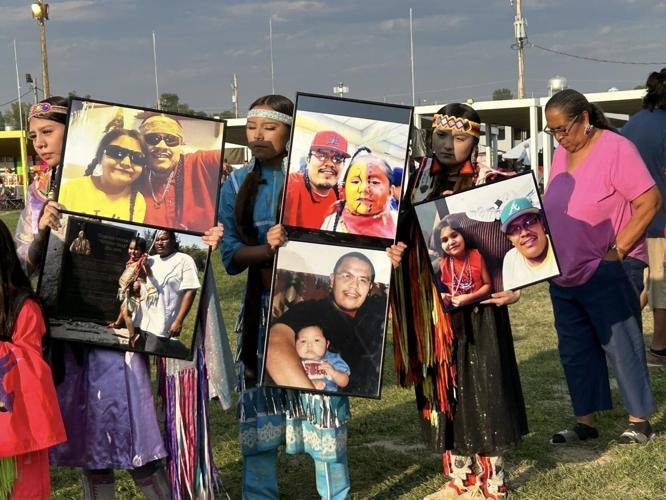
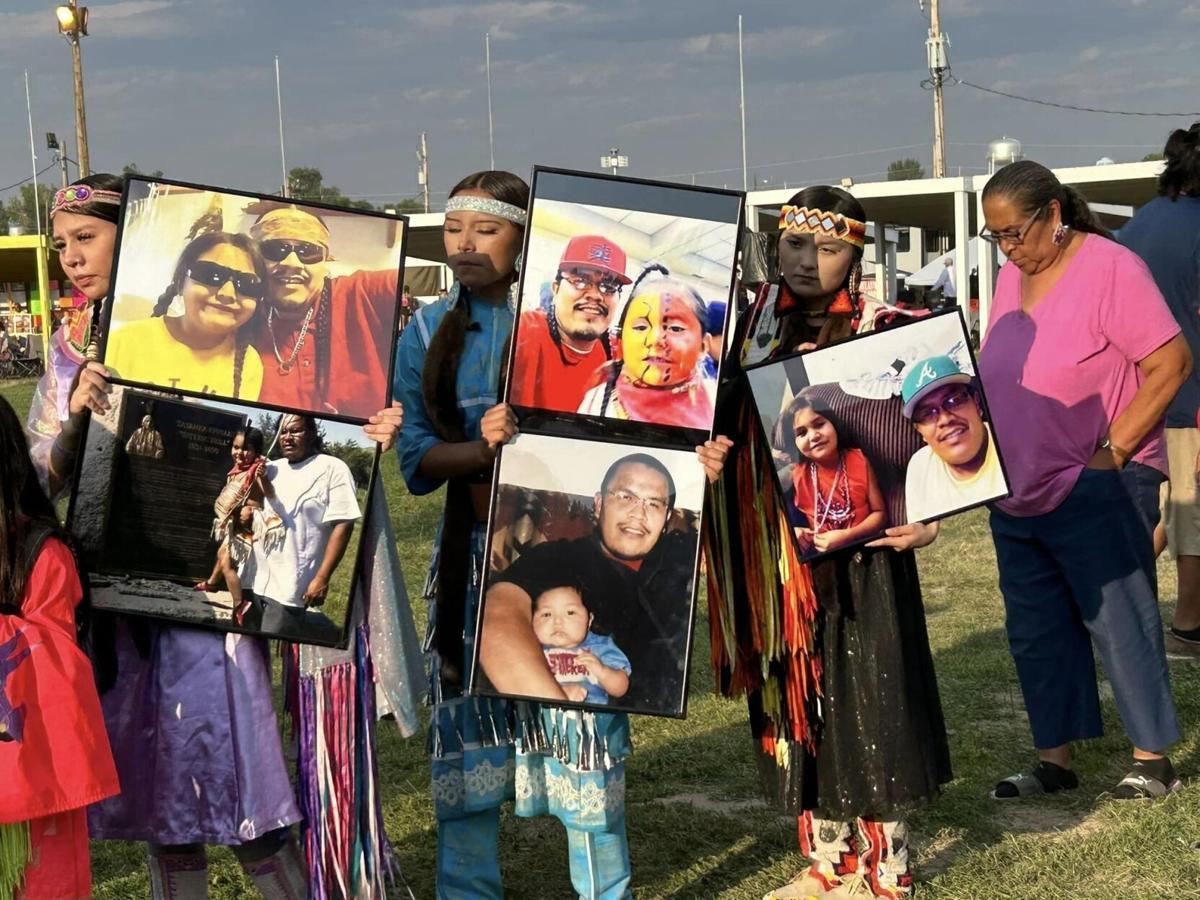
Brandon Brave Heart stood just outside the powwow arbor late on the night of Aug. 2.
It was after 10 p.m. and the Oglala Lakota Nation Wacipi and Fair was abuzz with people dancing, drumming and visiting with friends and relatives. It was the second night of the annual powwow in Pine Ridge, South Dakota, and Brave Heart was visiting with a friend when he heard several loud pops.
The 40-year-old Lakota man and his friend looked at each other. “Are those real shots?” he asked his friend. Like a scene in a movie, people began running in all directions — mothers grabbed their children’s arms, women’s traditional dancers competing inside the arbor began rushing away from the arbor.
Brave Heart ran toward his drum group to look for his family, but when he got there, his two brothers, nieces, nephews and other family members weren't there. Men, women, children and elders lay on the ground near the powwow drum. Mothers and grandmothers hovered over the children and grandchildren, many of whom were crying.
People are also reading…
Brave Heart thought of his five children and wife at home, but decided in that moment to run toward where he had heard the gunshots, hoping he could help somehow.
Elsewhere in the powwow arbor, Karin Eagle ran toward the west side of the arbor where her infant granddaughter, daughter and nephew had been sitting, not far from where the shooting had occurred.
Like so many others, the 51-year-old Oglala woman didn’t know what was going on. Was it a mass shooting? Was anyone injured? These questions ran through her mind.
The powwow arbor, a circular structure with four sections each in one of the colors of the medicine wheel, was surrounded by chaos.
Eagle, a longtime women’s traditional dancer, had been asked to judge the women’s dancing competitions. When the shots rang out, she was in the middle of judging the teen girl’s traditional contest. Over a dozen girls danced inside the arena.
Midway through the competition, around 10:15 pm, Eagle heard several loud pops and saw people running from the arbor. Many of the teen dancers reacted slowly, not realizing what was happening, and some even had to be pulled from the arena by their loved ones. For some, the sound of the drum and singers drowned out the gunshots.
Throughout the dusty haze, Eagle screamed for the dancers to run and then ran to the arena’s west side.
Once she knew her family was safe, she went toward where the shots were fired. There, elders were stuck in their chairs unable to easily get down or move to safety.
“I thought, if I can’t pick them up and carry them to safety the least I can do is help them get down. I wanted them to know somebody cared about them,” Eagle said.
All around her, Eagle said she saw other community members helping those in need. A young couple gathered and shielded children who’d been separated from their families, others helped elders. Eagle said she didn’t see anyone who wasn’t helping out.
“I saw a lot of that, a lot of heroes,” Eagle said.
Nearby, Eagle saw a man lying on the ground, surrounded by paramedics and powwow security. She heard someone say a man had been shot. Nearby a young woman stood crying.
When Brave Heart got there, he saw people clustered around someone lying on the ground. He walked up to the crowd. As he got closer, a first responder stepped to the side, and he saw the man lying there and realized he recognized him. Walking closer to the man, Tom Thunder Hawk — bleeding profusely and in pain — reached his hand up to Brave Heart, who grabbed his hand.
“You’re going to be okay, bro,” he told his friend.
“It hurts, it hurts,” came the man’s weak reply.
He held his friend’s hand until paramedics loaded Thunder Hawk into an ambulance and drove away. Nearby, the powwow arena — only minutes before filled with the sounds of laughing children, booming drums and Lakota song — was empty and quiet.
‘It all snowballs into this’
In the hours after the shooting, powwow organizers and tribal officials met and decided to continue the powwow the next day. To ensure nothing else happened, they had metal detectors brought in, large bags were banned from the powwow grounds, and police officers from other tribes came to help out.
Two days after the shooting, Thunder Hawk died.
The 56-year-old Lakota man was a well-known and respected member of the Porcupine District, one of the nine political districts on the Pine Ridge Reservation. It’s a small community of about 1,000 people nestled in the middle of the 2.1 million-acre reservation.
Thunder Hawk was a tokala, or warrior, Oglala Sioux Tribe President Frank Star Comes Out told ICT and the Rapid City Journal. As a tokala, it was his duty to protect others.
Thunder Hawk was shot when attempting to break up a fight. It was an isolated shooting, not an attempted mass shooting, Star Comes Out said.
In 2006, federal officials drastically reduced funding for the tribe’s public safety programs, frustrating the tribe’s efforts to stop violent crime, including shootings. Star Comes Out said those funding cuts forced the tribe to reduce its tribal police force from 120 officers in 2006 to about 30 today.
Following the shooting, the tribal president placed some of the blame for the attack on the loss of federal funding for his tribe’s public safety efforts.

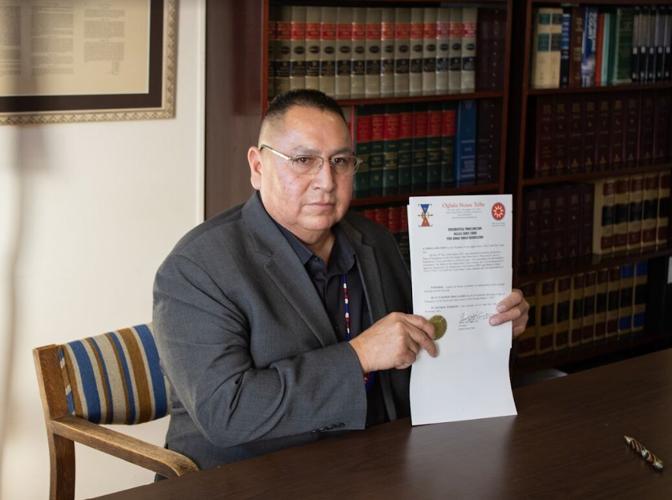
Oglala Sioux Tribe President Frank Star Comes Out signed into effect a State of Emergency Proclamation on November 18.
“It all snowballs into this,” Star Comes Out said. “So what do we do now? What are the next steps?”
In November, the tribe declared a state of emergency regarding public safety, but not much has changed since.
“My prayers go out to the Thunder Hawk family,” Star Comes Out said. “We’ll be looking into measures and features to prevent this from happening again. Pray for all the tribes that have powwows coming.”
One last prayer
In the days following his death, those close to the Thunder Hawk family have worked to fulfill their duties as Lakota relatives and provide support to the wife and children he left behind.

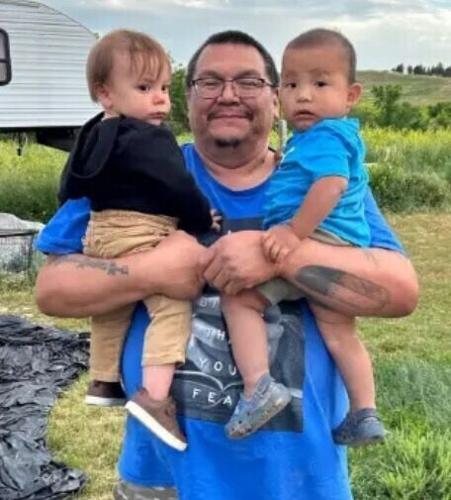
Tom Thunder Hawk
Santee Witt hosted a Native American Church Devotion Service at the Porcupine School Gym in honor of Thunder Hawk and with the help of two other church leaders was hosting a Native American Church funeral meeting Aug. 16 at the gym.
“It gives the family a chance to express something because he hears, he knows before he makes his ultimate journey,” Santee Witt said.
In many ways, Witt lived a life in unison with Tom Thunder Hawk.
Both men served as cultural educators for Pine Ridge Reservation schools. Thunder Hawk was a cultural educator at Loneman School in Oglala and Witt is a cultural specialist for the Lakota Waldorf School near Kyle. Both participated in the Native American Church — Thunder Hawk as a roadman, Witt as an ordained minister.
And for nearly 20 years, the two men were married to sisters. They shared family gatherings, prayed together in ceremonies and even adopted each other’s children in the Lakota way. Witt became Thunder Hawk’s son’s hunka father, and Thunder Hawk became Witt’s daughter’s hunka father.
Eventually, however, both men’s wives left them, but years later tried to reunite with their ex-husbands. It was there that the two men’s paths diverged.
When their wives were away from them, Thunder Hawk would express his hope to Witt that his wife would return to him. Thunder Hawk shared his belief that his wife still loved him and would eventually realize that. Witt, however, struggled to forgive his own wife.
“I didn’t take her back, but he ended up doing that for his,” Witt said. “That’s the kind of heart he had.”
Now Thunder Hawk’s wife says goodbye to the man who took her back, and Witt says prayers one more time for the man who walked beside him for so many years.
Lasting legacy: From Dewing to Whiteclay, 1870-2017
WHITECLAY — They came here first in the 1870s: farmers and ranchers seeking a better life in the Sandhills of northwest Nebraska.
Others came, too, alcohol peddlers seeking to turn a profit by selling booze to the Oglala Lakota, who had been forced onto the nearby Pine Ridge Indian Reservation in 1877.
In 1882, President Chester Arthur responded to pleas to end alcohol sales near the reservation by setting aside a 50-square-mile buffer zone south of Pine Ridge. But President Theodore Roosevelt reopened the zone to settlement in 1904.
It didn’t take long for a community to form near the reservation, as nearly 100 settlers were given land there, including Tom Dewing. The town took Dewing’s name for less than a year.
A post office named after nearby White Clay Creek was established in late 1904. The town has been popularly known as Whiteclay since, although its official name remains Dewing.
By 1940, the town had 112 people.
By 2010, it had 10 people, four beer stores and a steady supply of vagrants.
Eli Bald Eagle called Whiteclay home for six years before sobering up and heading back to the reservation in 2015. He said he watched a lot of his friends die over the years while drinking and panhandling on the streets.
Still, he said, nothing could have convinced him to stop drinking until he made the decision himself. He told a New York Times columnist visiting Whiteclay in 2012: “Nobody’s going to stop us from being alcoholics.”
And even though the 56-year-old Lakota man is sober and seeking to start his own small landscaping business on the reservation, his views on efforts to choke the flow of beer in the town haven’t changed.
“I understand they cut Whiteclay off, but what they didn’t cut off was the drinking.”
This story is co-published by the Rapid City Journal and ICT, a news partnership that covers Indigenous communities in the South Dakota area.
Amelia Schafer is the Indigenous Affairs reporter for ICT and the Rapid City Journal. She is of Wampanoag and Montauk-Brothertown Indian Nation descent. She is based in Rapid City. You can contact her at aschafer@rapidcityjournal.com.