NEW YORK — FTX founder Sam Bankman-Fried was ordered jailed Friday to await trial after a bail hearing for the fallen cryptocurrency wiz left a judge convinced that he had repeatedly tried to influence witnesses against him.
U.S. District Judge Lewis A. Kaplan ordered Bankman-Fried’s bail revoked after prosecutors said he’d tried to harass a key witness in his fraud case last month when he showed a journalist her private writings.
The 31-year-old has been under house arrest at his parents' home in Palo Alto, California, since his December extradition from the Bahamas on charges that he defrauded investors in his businesses and illegally diverted millions of dollars' worth of cryptocurrency from customers using his FTX exchange.

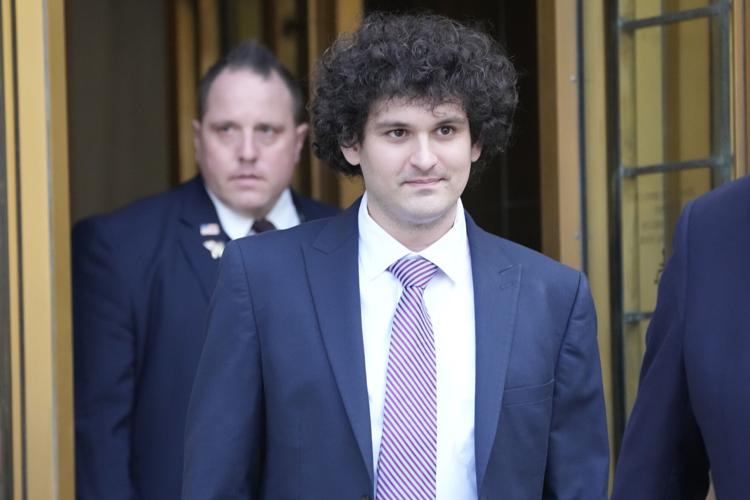
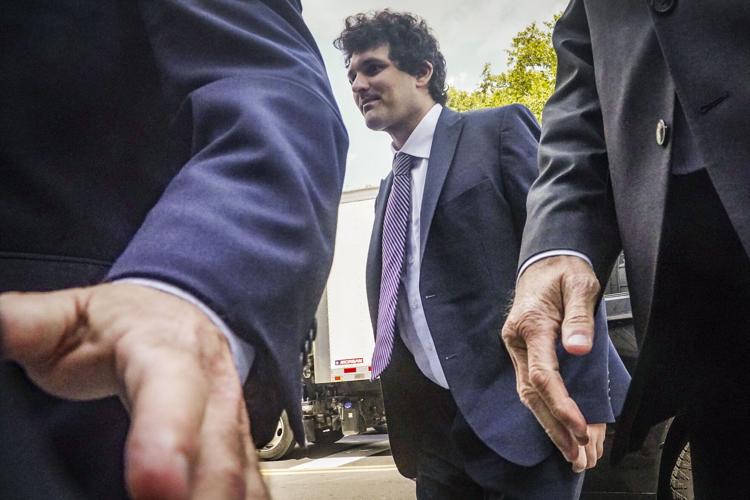
FTX founder Sam Bankman-Fried arrives Friday at Manhattan federal court in New York.
Bankman-Fried's $250 million bail package severely restricts his internet and phone usage.
People are also reading…
Two weeks ago, prosecutors surprised Bankman-Fried's attorneys by demanding his incarceration, saying he violated those rules by giving The New York Times the private writings of Caroline Ellison, his former girlfriend and the ex-CEO of Alameda Research, a cryptocurrency trading hedge fund that was one of his businesses.
Prosecutors maintained he was trying to sully her reputation and influence prospective jurors who might be summoned for his October trial.

Ellison pleaded guilty in December to criminal charges carrying a potential penalty of 110 years in prison. She has agreed to testify against Bankman-Fried as part of a deal that could lead to a more lenient sentence.
Bankman-Fried's lawyers argued he probably failed in a quest to defend his reputation because the article cast Ellison in a sympathetic light. They also said prosecutors exaggerated the role Bankman-Fried had in the article.
They said prosecutors were trying to get their client locked up by offering evidence consisting of "innuendo, speculation, and scant facts."

FTX founder Sam Bankman-Fried leaves federal court July 26 in New York.
Since prosecutors made their detention request, U.S. District Judge Lewis A. Kaplan has imposed a gag order barring public comments by people participating in the trial, including Bankman-Fried.
David McCraw, a lawyer for the Times, has written to the judge, noting the First Amendment implications of any blanket gag order, as well as public interest in Ellison and her cryptocurrency trading firm.
Ellison confessed to a central role in a scheme defrauding investors of billions of dollars that went undetected, McGraw said.
"It is not surprising that the public wants to know more about who she is and what she did and that news organizations would seek to provide to the public timely, pertinent, and fairly reported information about her, as The Times did in its story,” McGraw said.
Read the full story:
A beginner's guide to crypto lingo
Bitcoin
Bitcoin is a cryptocurrency created in 2009 by an unknown person (or people) using the alias Satoshi Nakamoto. Unlike traditional currencies such as the US dollar, bitcoin isn't controlled by a bank or government. Bitcoin is by far the most valuable and popular cryptocurrency in use today.

Investing in cryptocurrencies requires an appetite for risk and a whole new vocabulary.
Blockchain
A blockchain is a digital ledger and the key technology underpinning most cryptocurrencies, non-fungible tokens (more on those later) and other unique digital items.
Blockchain can be used to store all kinds of information, but so far its most common use is in recording cryptocurrency transactions. Once a transaction is made, it's entered on this public ledger, which is managed by a global peer-to-peer network — millions of computers, in bitcoin's case.
Blockchain is fundamental to bitcoin's appeal: As a decentralized database, it can't be controlled by any one person or group — unlike a fiat currency such as the US dollar, which is managed by a central bank.
Buy the f****ing dip (BTFD)
A rally cry for crypto bulls that urges investors to buy coins when prices drop.
Coinbase
The leading cryptocurrency exchange platform. The company went public in April, an event that many viewed as a turning point in the story of cryptocurrencies' journey into the mainstream marketplace.

The mobile phone icon for the Coinbase app is shown in this photo, in New York, Tuesday, April 13, 2021. (AP Photo/Richard Drew)
Cryptocurrency
An all-digital money system made up of "coins" or "tokens" that are controlled by a decentralized ledger.
Dogecoin
The oddball of the crypto family began as a joke based on the "doge" meme in 2013. But as cryptos have broadly gained mainstream interest, dogecoin has emerged as an unexpected heavy hitter. It now has a market cap of more than $30 billion and it has surged more than 5,000% so far this year. And unlike its more popular brethren, a single dogecoin is still cheap — it hit an all-time high of about 45 cents in April. Whether or not its a smart investment remains an active question.
Elon Musk
Tesla CEO whose tweets have been known to spark rallies in cryptocurrencies such as bitcoin and dogecoin.

FILE - In this Tuesday, Dec. 1, 2020 file photo, SpaceX owner and Tesla CEO Elon Musk arrives on the red carpet for the Axel Springer media award, in Berlin, Germany. (AP Photo/Britta Pedersen, Pool, File)
Ethereum
An open-source blockchain-based software that controls the cryptocurrency Ether. It is the second-largest digital currency by market cap at nearly $300 billion.
FUD ("fear, uncertainty, doubt")
In crypto parlance, FUD refers to negative information that weighs on an asset's value.
Mining
The complicated process by which new bitcoins are entered into circulation. Mining is not for amateur enthusiasts: It requires high-powered computers that solve complex mathematical puzzles to create a new "block" on the blockchain.
The mining process eats up a lot of computing power and electricity, which has led to concerns about bitcoin's environmental impact.
NFT
Non-fungible tokens, or NFTs, are pieces of digital content linked to the Ethereum blockchain. "Non-fungible" essentially means one-of-a-kind, something that can't be replaced, unlike, for example, a dollar bill that you can replace with any other dollar bill. In the simplest terms, NFTs transform digital works of art and other collectibles into one-of-a-kind, verifiable assets.

Sophia uses a brush to paint at Hanson Robotics studio in Hong Kong on March 29, 2021. Sophia is a robot of many talents — she speaks, jokes, sings and even makes art. In March, she caused a stir in the art world when a digital work she created as part of a collaboration was sold at an auction for $688,888 in the form of a non-fungible token (NFT). (AP Photo/Vincent Yu)
Satoshi Nakamoto
The pseudonym that refers to the person (or people) who invented bitcoin. Their real identity remains unknown.
Satoshis, aka "Sats"
The smallest unit of bitcoin ever recorded on the blockchain, equal to one one-millionth of a bitcoin.
Wallet
Like the physical thing you carry your cash and cards in, a wallet in the crypto world is a place to store digital currency. The main thing you need to know about wallets is that you must never, ever lose or forget your password.

Eyonys González poses for the photo with his bitcoin wallet at his home in Havana, Cuba, Monday, March 29, 2021. (AP Photo/Ramon Espinosa)