BALTIMORE — As a high school senior, Davontez Johnson — like many students his age — wasn't sure what he wanted to do with his life.
Not in his wildest dreams could he have imagined himself standing on a colorful carpet in a preschool classroom at Dorothy I. Heights Elementary, leading a gaggle of 4-year-olds in a chant and dance about phonics.
"Words have parts — that's syl-a-bles," the 19-year-old said, enunciating for effect. The preschoolers craned their heads up and echoed him. "Clap your hands now, syl-a-bles! Stomp your feet now, syl-a-bles!"

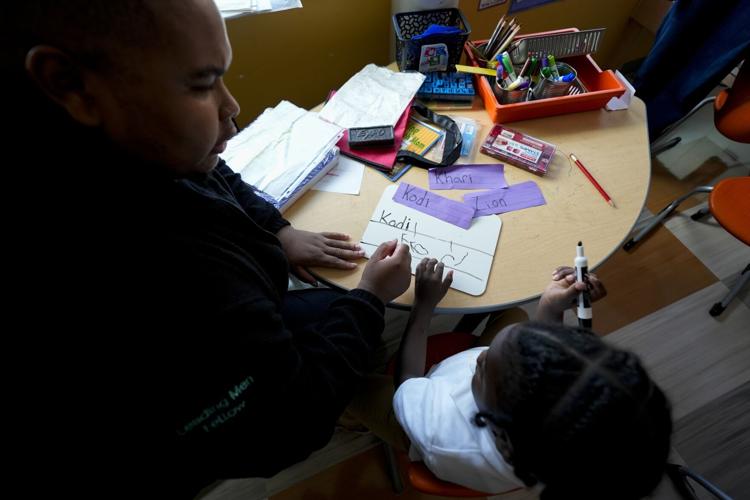
Leading Men fellow Davontez Johnson, left, helps preschooler Kodi to practice writing his name Oct. 3 at Dorothy I. Height Elementary School in Baltimore.
Johnson is part of the Leading Men Fellowship, which trains young Black and Latino men to become early literacy instructors in preschool classrooms across the country. It's a program that aims to tackle several problems at once: a shortage of early educators, a dearth of Black and Latino male teachers and the acute challenges boys of color face in schools because of their race and gender.
People are also reading…
"We're not only affecting change in the classroom with these school students, but (we're) also developing these young future educators," said Ivan Douglas of the Literacy Lab, which runs the Leading Men Fellowship.
Many fellows, like Johnson, are recruited right out of high school. After an interview process and intensive summer training, they go to work in schools where they may be among the only male educators. Fellows make between $16.50 and $18 an hour.
A former high school offensive lineman, Johnson knows some parents would say he looks out of place in a preschool classroom. The statistics back him up: Less than 1% of elementary and early education public school teachers are Black men, according to federal data. That's part of the reason he wanted to do it.
"I really thought it was a great opportunity. Because I know if I saw someone like me, you know, in pre-K, I'd be pretty excited," Johnson said. "You don't see a lot of young Black males."

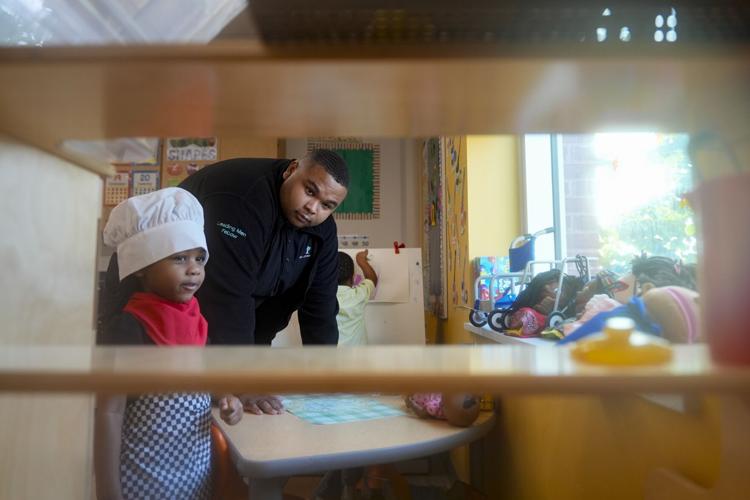
Leading Men fellow Davontez Johnson, right, interacts with a preschooler playing dress-up Oct. 3 during choice time, a classroom period where children can choose their own activities, at Dorothy I. Height Elementary School in Baltimore. The Leading Men Fellowship program is training young Black men to become literacy aides in preschool classrooms.
Researchers have shown that Black male students encounter discrimination before they even set foot in a kindergarten classroom, facing higher rates of expulsion and suspension from preschool even though evidence suggests they do not misbehave more than their white peers. Boys also are far more likely than girls to be expelled.
There's a growing body of evidence that Black teachers can make a difference for Black students — Black boys, in particular. In the years since the Leading Men Fellowship was founded in 2016, researchers found that students of color seem to fare better when they have teachers who look like them.
Johns Hopkins University economist Nicholas Papageorge, who is based not far from Heights Elementary, studies the impact of Black teachers on Black students. His research found that Black teachers have higher expectations for Black students than do non-Black teachers.
"If a Black student had a white teacher and a Black teacher, that white teacher had systematically lower expectations," Papageorge said.
His later research found Black students who have a Black teacher are less likely to drop out of high school and more likely to attend college. The effect of having a Black teacher had the greatest impact on Black boys from low-income households.

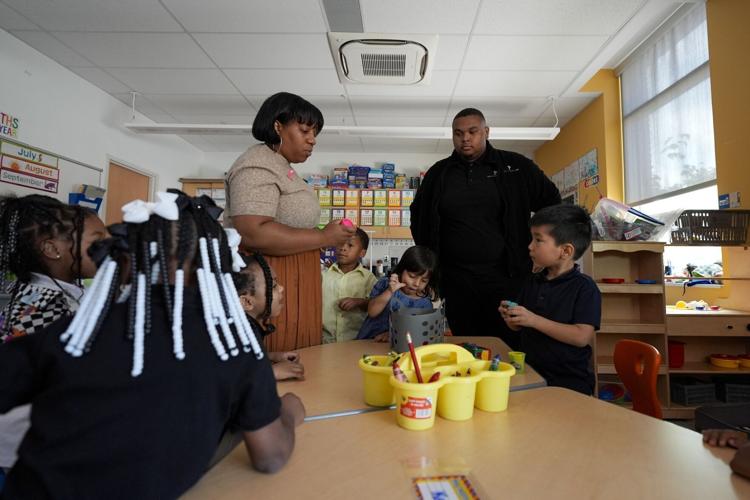
Preschool teacher Bridget Jeffreys and Leading Men fellow Davontez Johnson are surrounded by students Oct. 3 while distributing playdough for an activity at Dorothy I. Height Elementary School in Baltimore.
Through his coursework, Johnson learned the intricacies of early education — and that it involves a surprising amount of singing and dancing for someone not working on Broadway. Children learn best by repetition and when they can pair information with movements and song.
Bridget Jeffrys, whose preschool classroom hosts Johnson, said she never worked alongside a male educator until Johnson arrived at the start of the last school year. She said she's watched Johnson grow more confident with her students, going from reserved to enthusiastic. Jeffrys said his voice and dance moves could use some work, but he performs the songs with such heart that it doesn't matter.
"It was so beautiful because usually you don't see men really get down to the child level," Jeffrys said. "That excited them even more. A lot of kids think he's a big kid."
Johnson is studying political science at University of Maryland Global Campus and hopes to go into politics. His colleagues, though, encourage him to stick with teaching.

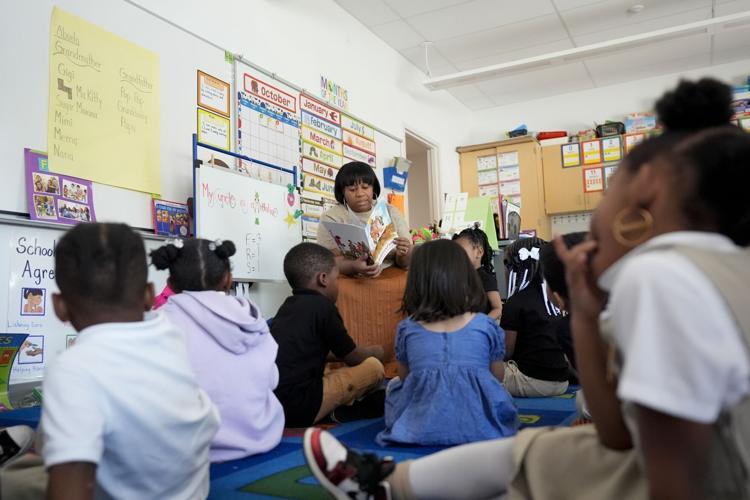
Preschool teacher Bridget Jeffreys reads to students Oct. 3 at Dorothy I. Height Elementary School in Baltimore.
While Johnson is there to provide targeted literacy instruction, he has been fully integrated into the school day. His second week in the classroom, he sang the class's morning greeting song in a robot voice. When a child squirms on the carpet or wanders away from story time, Johnson is there to rein them in.
On this October day, he pulled students aside to help them work on writing their names. He had only been with this cohort for a couple weeks, but many students were drawn to him. During free-play time, he encouraged a student who was working on a crayon rubbing of a leaf.
"You've done a wonderful job," he said to the girl, who stared up at him, eager for reassurance. Another student interrupted him by handing him a fistful of play money.

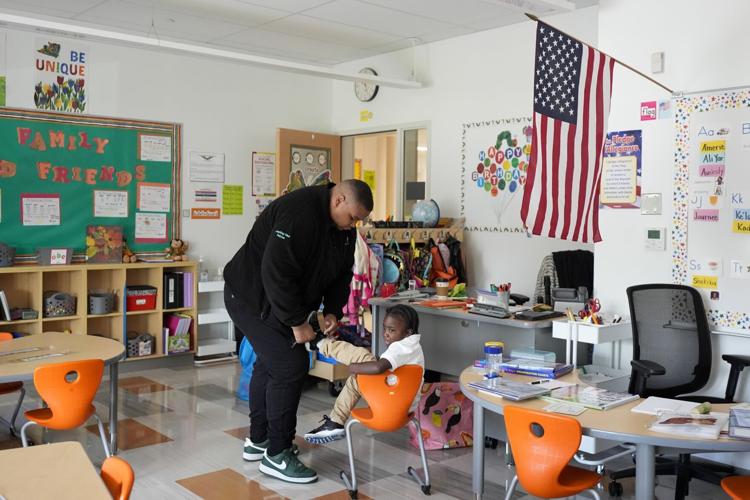
Leading Men fellow Davontez Johnson, right, ties preschooler Kodi's shoes Oct. 3 at Dorothy I. Height Elementary School in Baltimore.
After lunchtime, as most of the preschoolers sat on the carpet held rapt by a story read by Jeffrys, 4-year-old Kodi Hendricks wandered toward the door and peered into the hallway until Johnson beckoned him back.
Johnson bent his large frame to tie the boy's shoe and then they sat together for a penmanship lesson.
"What's the first letter?" he asked the boy.
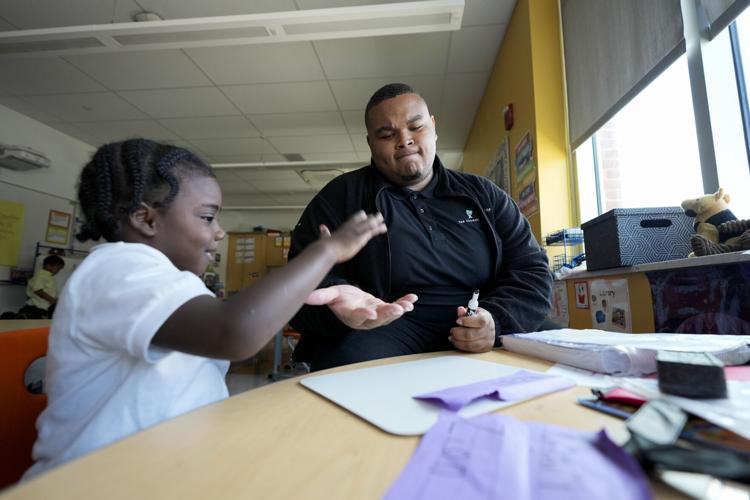
"K," he replied. Johnson showed him, in slow motion, how to draw a K.

Leading Men fellow Davontez Johnson, right, high-fives preschooler Kodi during a name writing exercise Oct. 3 at Dorothy I. Height Elementary School in Baltimore.
"No, I can't do it," said the boy.
"It's all right," Johnson said. He urged him on.
"You can do it. It just takes practice."