

Frustration is simmering among parents who say their young children are spending too much classroom time online, disrupting their learning and development at a critical time and clashing with stricter screen restrictions at home.
Grassroots coalitions across the country are emerging in school districts, as parents grow increasingly alarmed that digital activities are replacing hands-on learning and peer interaction with little oversight. Groups want more transparency on technology use, strict limits on screen time and more rigorous vetting on software products.
Julie Edwards grew worried when her daughter began coming home from kindergarten talking about "JiJi," the penguin who stars in an app on her school-issued iPad. JiJi guides her child through gamified math lessons that have become a favorite part of her day.
"It breaks my heart," said Edwards of Tujunga, California. "My kid comes home and she doesn't tell me about her teacher, she doesn't tell me about her classmates. She tells me about JiJi the penguin from her gamified learning app."
People are also reading…
Edwards was told that her daughter spends 15 to 30 minutes a day with JiJi. But even in small doses, what concerns Edwards is that Jiji is a central character in her child's school day. Edwards is planning to move her kindergartner to a charter school that limits screen time next school year. She'll join her fourth-grade sister, whom Edwards moved last year when screens began to affect her learning.
Gamified lessons on individual devices and video-directed read-alouds and sing-alongs have become more common in elementary school since the pandemic, including in transitional kindergarten and kindergarten. Nearly one-third of parents say their children under age 8 have used AI for school-related material, according to Common Sense Media, which surveyed more than 1,500 families. For these young students, early childhood experts say children should focus more on hands-on learning for development.
The American Academy of Pediatrics recommends families prioritize non-digital activities like play and social interaction for children 5 and under. Though the organization no longer recommends a specific time limit, an hour is a good goal, said Dr. Tiffany Munzer, the lead author of the organization's latest policy statement on technology use.
Parents said children as young as 4 are assigned lessons on tablets and Chromebooks as part of their academic instruction and are not always prevented from accessing apps such as YouTube and Minecraft during class, taking away from teacher-led learning.
In 2026, at least 16 states introduced legislation to reevaluate screen time or vet educational technology. At least four states — Kansas, Utah, Minnesota and Tennessee — are considering prohibiting devices in at least part of elementary school.
The movement to ban or severely restrict screen time learning for elementary-age students comes as nearly 40 states have passed legislation to prohibit or restrict cellphone use in schools. The push for restrictions runs counter to what is a reality of digital life for American families — whose young children at home can often engage in hours of daily screen time.
Tech's impact in the classroom
Too much screen time can lead to language, cognitive and social-emotional delays as well as challenges with how children manage daily tasks and control impulses, said Munzer, who is also a member of the American Academy of Pediatrics Council on Communications and Media Executive Committee.
Human-centered activities are vital for young learners, Munzer said.
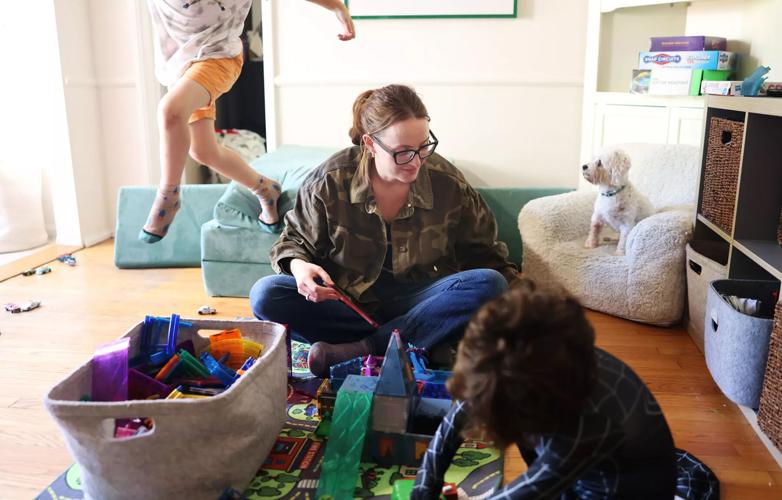
"Kids in the preschool and kindergarten years really benefit from hands-on play and tactile learning experiences," she said. "Young children learn best really through these socially mediated experiences and by involving the senses."
For Kate Brody, whose first-grade son attends a charter school in the San Fernando Valley, the addictive nature of her son's school-assigned iPad led to bathroom accidents during class. At first she thought the incidents were related to her son's adjustment to his new grade level. But then she discovered they were consistently happening during the classes' iPad time. Too invested, he would ignore his body's signals, she said.
"He's not able to tell he needs to go to the bathroom because he's sitting there with headphones on for an hour playing these games that are sort of addictive," said Brody, who handles communication for Schools Beyond Screens, a parent coalition pushing for changes in LAUSD.
An LAUSD spokesperson said elementary school students average between 31 and 50 minutes of screen time, adding that the district works with schools to ensure they are using technology responsibly and effectively. The use of one-to-one devices is left to the discretion of each school.
When screens are helpful
Arguments in favor of classroom technology typically point to equity issues and test preparation. In California, statewide assessments are typically taken online beginning in third grade. Because of that, districts need to ensure all students have some familiarity with devices, said LAUSD school board member Nick Melvoin. But testing is not a strong enough reason for children to spend so much time on devices, he added.
Still, technology can be helpful to learning if it is used and designed intentionally. Content that is age appropriate and used to supplement instruction can be beneficial as long as it avoids rewarding children for play, is not overstimulating and doesn't include autoplay or distractions like ads, Munzer said. Data privacy is also important to consider, she added, and certain devices can be helpful for students with disabilities.
But not all platforms measure up. And technology isn't always closely vetted, said Stanford University professor Rebecca Silverman, who has studied the effectiveness of educational technology.
"I think it's hard because there's so many products on the market," Silverman said.
How parents push for change
Distraction-Free Schools Policy Project, which has led advocacy at the state level, wants to prohibit individual devices in kindergarten through fifth grade and is pushing for a return to handwritten testing.
Individuals from districts across the state have begun attending the California chapter's meetings since it got off the ground in December, said Jodi Carreon, who co-leads it and runs a parent group tackling the issue in San Marcos Unified.
"We're trying to connect parents across the state. Every day we're getting new members," Carreon said.
Some California school districts are reevaluating their technology policies. San Marcos Unified is blocking YouTube on district-issued devices for students in elementary school.
LAUSD recently introduced a resolution that would require the district to develop a screen time policy and weigh prohibiting the use of one-to-one devices for students up to second grade. If passed, the board could implement the new policy as soon as next school year.
"Walking into classrooms, I've even seen kindergartners on iPads. It strikes me at my core," said Melvoin, who introduced the LAUSD resolution. "Kids should be outside, they should be playing, they should be using manipulatives and tactiles."


