WASHINGTON — President Donald Trump said Thursday he will nominate federal prosecutor Jay Clayton to be the next director of national intelligence, following pushback from U.S. lawmakers over his pick to fill the role temporarily.
"Few people anywhere in the Legal Community are respected at the level of Jay. I encourage the United States Senate to confirm Jay as soon as possible," Trump said in a social media post.
Clayton is the U.S. attorney for the Southern District of New York and a former chairman of the Securities and Exchange Commission.
Trump said loyalist and head of the federal housing agency Bill Pulte would take over as acting director on June 19 to replace Tulsi Gabbard, who resigned effective June 30. Pulte's appointment sparked a political standoff that derailed renewal of an expiring surveillance law.
People are also reading…

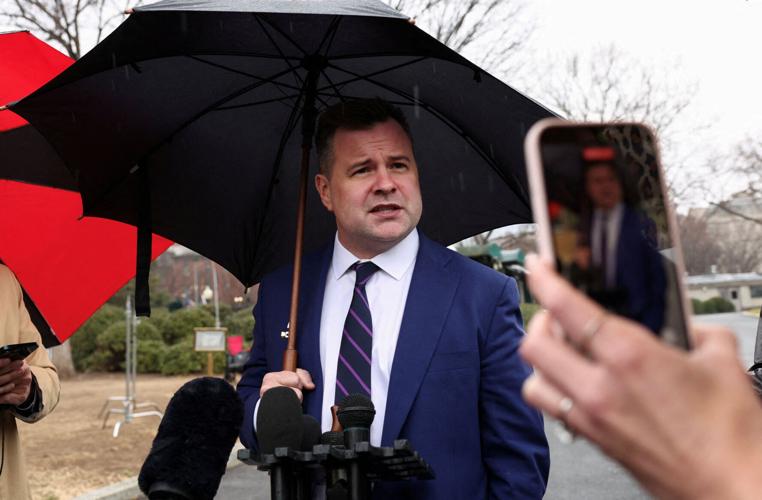
A reporter films with her phone as U.S. Federal Housing Finance Agency Director Bill Pulte speaks Jan. 9 at the White House in Washington, D.C.
The Republican-controlled U.S. House of Representatives on Thursday rejected a short-term extension of foreign surveillance powers Trump sought, deepening a political standoff over his selection of an inexperienced loyalist to serve as the top U.S. spy chief.
With surveillance authority due to expire after midnight Friday, the House voted 218 to 198 to reject a measure that would have extended the spying powers until July 2. Nineteen Republicans joined most Democrats to oppose the measure. Seven Democrats voted for the extension.
Senate Republicans also were expected to try to extend the program on Thursday, after a failed effort Wednesday.
Republican leaders sought to extend the program for three weeks to give Trump time to find a permanent replacement for Pulte. Trump called for the short-term extension Wednesday.
The appointment was met with outrage from Democrats and some Republicans over Pulte's lack of experience and Democrats vowed to shun efforts to extend Section 702 of the Foreign Intelligence Surveillance Act. Some Republicans also rejected an extension, saying the law lacks protections for U.S. citizens, including warrant requirements.

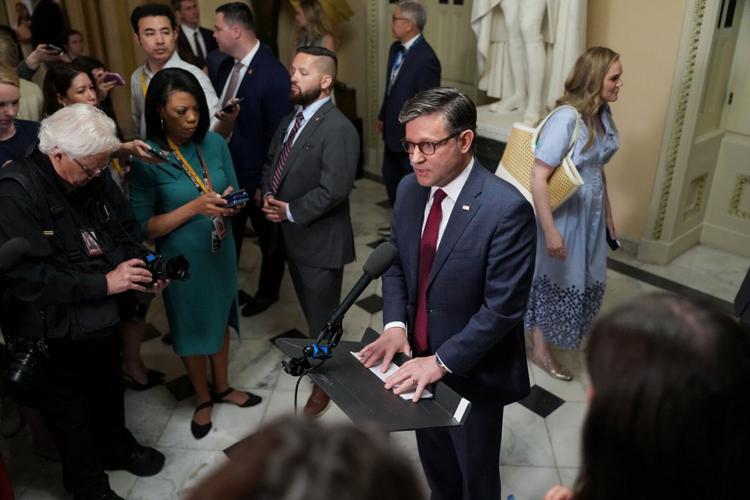
House Speaker Mike Johnson, R-La., speaks to the media Thursday after the House failed to temporarily extend FISA, the law that allows the U.S. to gather intelligence abroad, on Capitol Hill in Washington.
"It is shameful and it is very, very dangerous," an angry House Speaker Mike Johnson told reporters after the failed vote, which he blamed entirely on Democrats. "We did everything in our power to try to ensure that this statute does not expire," the Louisiana Republican added.
Johnson rejected a suggestion that Trump could replace Pulte with a more experienced candidate to break the deadlock and gain support for a FISA extension from Democrats, saying Pulte's appointment would last only for a short time.
Democrats contend that Trump picked Pulte, a federal mortgage regulator, because of his willingness to use confidential data to push mortgage fraud probes of the president's perceived enemies.
The House and Senate were due to leave Washington later Thursday. The House is scheduled to be out of session next week.

If the law is not extended, U.S. intelligence agencies will lose legal authority to collect emails, texts and cellphone data of foreigners believed to be located outside the United States without individual judicial warrants.
FISA advocates in Congress warned that the loss of legal authority could jeopardize U.S. national security at a time when the U.S. is at war with Iran and co-hosting the World Cup with Canada and Mexico.