A surge in voluntary departure agreements in immigration courts is raising concerns that Trump administration tactics are unfairly pressuring immigrants into leaving the United States, even if they have a legal right to stay.
Voluntary departures during the second Trump administration reached 89,494 cases as of May 1, according to a Stateline analysis of immigration court data processed by the Deportation Data Project, an academic research initiative. That’s more than seven times the number recorded in the last 16 months of the Biden administration (11,977).

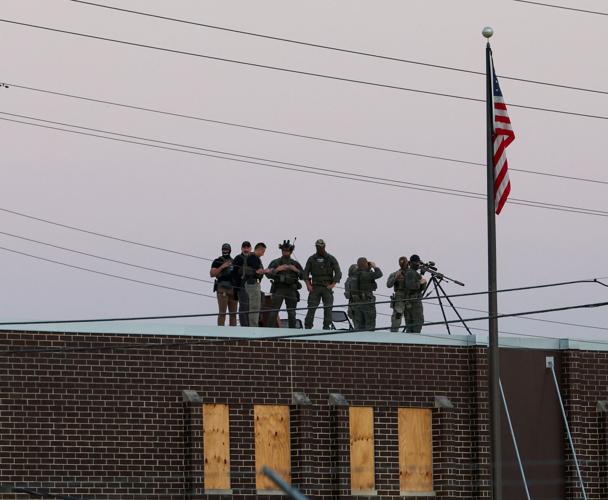
A group of federal agents stand on the roof of the U.S. Immigration and Customs Enforcement holding facility Oct. 3, 2025, in Broadview, Ill.
A 10-month-old policy of mandatory detention without bond, now being challenged in appeals courts and likely to be resolved by the U.S. Supreme Court, increases the pressure on immigrants to leave. Mandatory detention for immigrants who crossed a border illegally to get into the United States was upheld by an appeals court for Texas and Louisiana, which are the most common locations for voluntary departure cases, according to Stateline’s analysis.
People are also reading…
“Conditions in some detention facilities are dire and, especially in the locations where bond is unavailable, individuals may feel voluntary departure is their best option in those circumstances,” said Colleen Putzel-Kavanaugh, an associate policy analyst at the nonpartisan Migration Policy Institute.
Voluntary departure is a court agreement that requires an immigrant to pay for the trip out of the country and face fines for delays. A possible benefit for the immigrant is avoiding a court order of removal that could make it all but impossible to return to the U.S. and live here legally.
Voluntary departure doesn’t include people who used a government app to leave with a federally paid plane ticket and a cash incentive, now $2,600.
U.S. Immigration and Customs Enforcement is pushing to quickly build and open new detention centers, with human rights groups describing crowded, often unsanitary conditions. Since President Donald Trump’s inauguration, 51 people have died in the facilities, ICE reported.
“We see people choosing to take voluntary departure, not because they don’t have a right to stay in the United States, but because they can’t handle being in these really inhumane conditions in detention any longer,” said Shayna Kessler, director of the Vera Institute of Justice’s Advancing Universal Representation Initiative, which advocates for a system like public defenders for immigration court.

Voluntary departure could be the best option, Kessler acknowledged, but “without consulting an attorney it’s impossible to know.”
Under the Trump policy, people who crossed the border illegally and were later arrested by immigration enforcement are incarcerated without bond. The Laken Riley Act, signed into law last year, extended mandatory detention to immigrants arrested on suspicion of crimes as minor as shoplifting, even if the charges are later dropped.
The newer policy — which was described in the Project 2025 blueprint before Trump was elected in 2024 — would affect millions of people, no matter how long ago they came to the U.S. and even if they legally applied for asylum.
Three federal appeals courts put the mandatory detention requirement on hold but two let it stand, meaning the policy’s constitutionality likely will be resolved by the U.S. Supreme Court.
Earlier this year, a federal judge in Oregon accused immigration authorities of using the threat of extended detention to “win the numbers game at the cost of debasing the rule of law.”

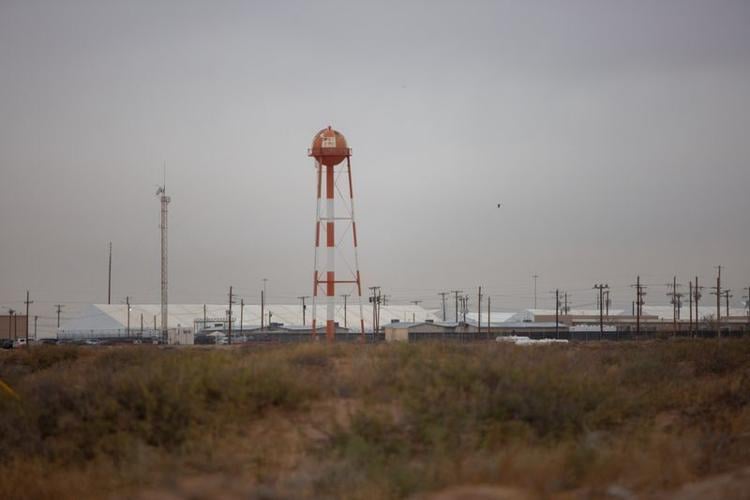
Camp East Montana, an ICE immigration detention center, is pictured from a distance.
“For the one detainee who has the audacity to challenge the legality of her detention and gains release, several more remain detained or succumb to the threat of lengthy detention, and then instead ‘voluntarily’ deport,” U.S. District Judge Mustafa T. Kasubhai wrote in a February opinion. He was referring to an agricultural worker arrested en route to the fields who won release after resisting pressure to sign voluntary departure papers.
One longtime immigrant in the same lawsuit, called Victor C.G. in court papers, said he was pressured to sign papers agreeing to leave for Mexico during a three-week detention after being arrested on his way home from work. He refused to sign and was released on bond after an attorney intervened; the man has lived in the United States for 26 years and had legal work authorization based on a pending visa for cooperating crime victims.
Similarly, an American Civil Liberties Union lawsuit in Illinois filed in October accused immigration authorities of “coercing and threatening detainees” to sign voluntary departure agreements while held in squalid, crowded conditions at a detention center.

A November restraining order in that case required immigration authorities at the Broadview facility near Chicago to hold immigrants in sanitary conditions with access to attorneys, and to give them enough time and language help to understand paperwork such as voluntary departure agreements.
Immigration judges can also apply pressure for voluntary departure, said Jacquelyn Pavilon, co-author of a report on voluntary departure for the Vera Institute of Justice, a New York City-based nonprofit with a mission to limit mass incarceration.
Notes from court observers, shared with the Vera Institute, show a pattern of judges suggesting voluntary departure, especially Republican-appointed judges speaking to immigrants without attorneys, Pavilon said.
In a Newark, New Jersey, immigration court observed by Stateline on May 21, one Trump-appointed judge suggested voluntary departure to a family from Colombia after denying their asylum claim. “This would at least avoid a removal order,” said the judge, Leila McNeill Mullican.

Pam Rosengard wears a button while protesting Immigration and Customs Enforcement agency outside of Great American Ball Park in Cincinnati on May 31.
The family, a married couple from Bridgeton, New Jersey, with a 20-year-old son who arrived in 2023, did not have an attorney. They chose to appeal McNeill Mullican’s decision instead of taking voluntary departure, saying they feared crime and Venezuelan-based gangs when they left in 2023. They told Stateline they would consider hiring an attorney for the appeal.
There were similar immigrant complaints about unfair pressure for voluntary departure during the first Trump administration and also under the Obama administration.
The Department of Homeland Security replied to Stateline questions with an unattributed statement: “We encourage all illegal aliens to take control of their departure with the CBP Home App.
“The United States is offering illegal aliens $2,600 and a free flight to self-deport now. We encourage every person here illegally to take advantage of this offer and reserve the chance to come back to the U.S. the right legal way to live the American dream. If not, you will be arrested and deported without a chance to return.”