WASHINGTON — Bats are critical players in global ecosystems, pollinating plants, dispersing seeds and eating huge numbers of insects.
One of only three lineages of flying vertebrates in Earth's history, there are more than 1,500 bat species living today. But their evolutionary history has been a bit of a puzzle for scientists.
The largest combined bat genome and fossil study ever conducted offers some clarity. Its findings indicate these flying mammals first appeared in Europe — not in North America, Asia or Africa as previously hypothesized — about 65 million years ago in the aftermath of the mass extinction event that doomed the dinosaurs. They then spread around the world.
The researchers assembled the largest collection of high-quality bat genomes to date, covering 103 species representing all 21 recognized families of bats. They integrated this data with an analysis of 44 fossil bats to decipher their evolutionary history and generate a bat family tree.
People are also reading…

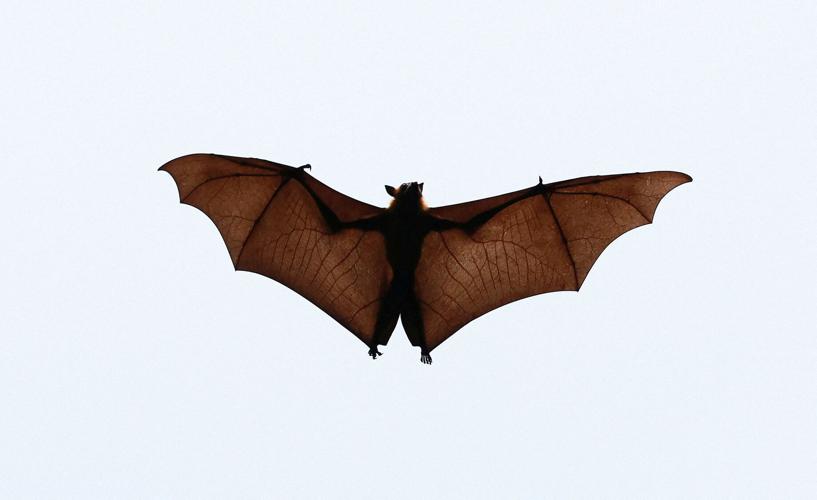
An Indian flying fox or fruit bat flies over trees Feb. 2, 2022, at Kodiyathur village in Kozhikode district in the southern state of Kerala, India.
They also concluded that, like flight, echolocation — the biological sonar system many bats use to navigate in the dark and catch flying prey — evolved near the dawn of bat evolution.
"I think being able to do both, fly and echolocate, opens up the most amazing opportunities to move into new niches — hunting at night when there's less competition and fewer predators, for example. Flight got them into the air. Echolocation let them own the night," said Sonja Vernes, a professor of biology at the University of St. Andrews in Scotland and one of the leaders of the study published this week in the journal Nature.
"Echolocation allowed bats to become nocturnal, essentially, and not compete with birds or be preyed on by diurnal (day-active) birds," said zoology professor Emma Teeling of University College Dublin, another of the study leaders.
Sally Beckwith of Starthrower Rehab in Sterling is currently caring and feeding orphaned baby bats.
The study pointed to bats first appearing in Europe about a million years after an asteroid struck Earth 66 million years ago, a calamity that enabled mammals to become the dominant land animals.
Relatively soon thereafter, bats reached Africa, making those two continents a hub of early bat evolution, according to evolutionary biologist Liliana Davalos of the State University of New York at Stony Brook, another of the study leaders.
Antarctica is the lone continent bats never inhabited. They now account for more than a fifth of the world's mammal species.
The oldest-known bat fossils date to about 52 million years ago. Genome and anatomical data helped identify the origin date of bats.

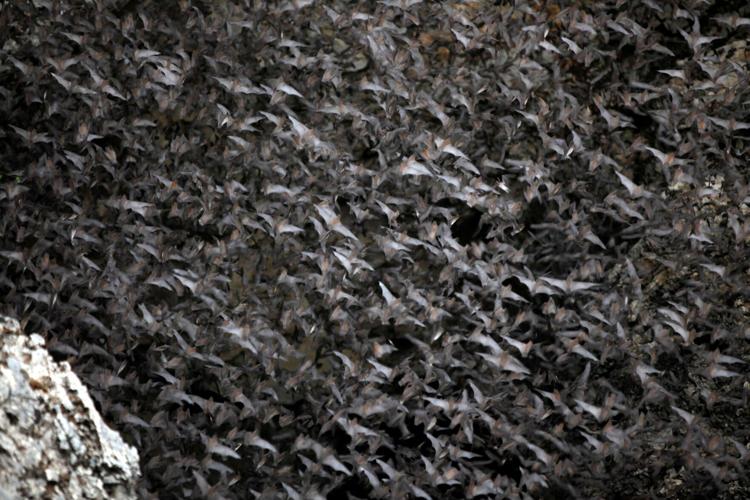
Bats from a cave near the Wat Khao Chong Phran Temple fly out of the cave in search of food at dusk Sept. 14, 2009, in Ratchaburi province west of Bangkok, Thailand.
Birds and pterosaurs
Bats are the only mammals to have achieved powered flight, joining the flying reptiles called pterosaurs and birds as the only vertebrates to do so. Birds survived the asteroid, but pterosaurs did not.
The pterosaur extinction may have opened ecological niches that a new lineage of flying vertebrates could fill.
Bat wings, built differently than those of birds and pterosaurs, are modified forelimbs featuring greatly elongated fingers that support a large skin membrane.
What the ancestors of bats looked like remains a mystery.
"We don't know for sure but I reckon they looked like tree shrews starting to grow long fingers,” Teeling said. “This is just a guess as all of the oldest fossils look like modern bats."
It’s also unclear whether flight or echolocation evolved first.
Bats use echolocation by making high-frequency ultrasonic sounds and listening to the returning echoes bouncing off objects to chart their surroundings. This ability can be seen in fossils based on anatomical traits such as an enlarged cochlea and specialized middle ear structures.
"Our oldest bat fossils show that they had both flight and echolocation capabilities, which doesn't help answer this question,” Teeling said. “We need to find the oldest 'pre-bats,' or transition fossils, and see if they had anatomical characteristics indicative of flight or echolocation."

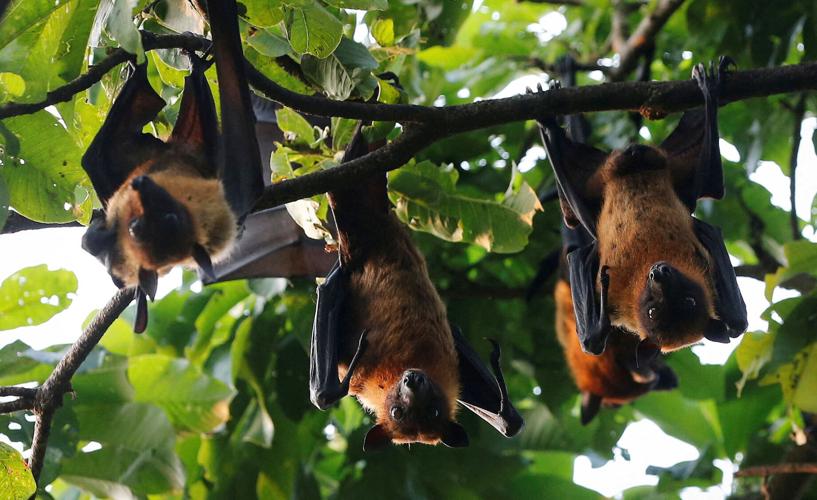
Indian flying foxes or fruit bats rest on tree branches Feb. 3, 2022, inside a temple complex at Kadambazhipuram village in Palakkad district in the southern state of Kerala, India.
Many bat species show remarkable resistance to disease and live exceptionally long lives for their size. The study lays the groundwork for research into the genetic basis of these traits.
"This work could eventually inform human research into aging, immunity and disease resistance," Teeling said.
Bats today come in many shapes and sizes, with differing diets and lifestyles. The largest is the giant golden-crowned flying fox of the Philippines, with a wingspan of 5½ feet. The smallest is the bumblebee bat of Thailand and Myanmar, with a wingspan of about 5 inches.
Many bats are insectivores. Others consume fruit, nectar, fish and, infamously in the case of vampire bats, blood.
There is an amazing array, including the likes of horseshoe bats, leaf-nosed bats, mouse-tailed bats, trident bats, ghost-faced bats, mustached bats, sucker-footed bats, hammer-headed bats and wrinkle-faced bats.
"Bats constantly surprise us,” Vernes said. “They're one of evolution's greatest experiments."