MEXICO CITY — It’s so hot in Mexico, howler monkeys are falling dead from the trees.
At least 138 of the midsize primates, who are known for their roaring vocal calls, were found dead in the Gulf Coast state of Tabasco since May 16, according to the Biodiversity Conservation of The Usumacinta group. Others were rescued by residents, including five that were rushed to a local veterinarian who battled to save them.
“They arrived in critical condition, with dehydration and fever,” Dr. Sergio Valenzuela said. “They were as limp as rags. It was heatstroke.”
While Mexico’s brutal heat wave was linked to the deaths of at least 26 people since March, veterinarians and rescuers say it killed dozens, perhaps hundreds, of howler monkeys.
In the town of Tecolutilla, Tabasco, the dead monkeys started appearing Friday, when a volunteer fire-and-rescue squad showed up with five of the creatures in the bed of a truck.
People are also reading…
Normally quite intimidating, howler monkeys are muscular and some can be as tall as 3 feet, with tails just as long. Some males weigh more than 30 pounds and can live up to 20 years. They are equipped with big jaws and a fearsome set of teeth and fangs, but mostly they’re know for their lion-like roars, which bely their size.
“(The volunteers) asked for help, they asked if I could examine some of the animals they had in their truck,” Valenzuela said Monday. “They said they didn’t have any money, and asked if I could do it for free.”
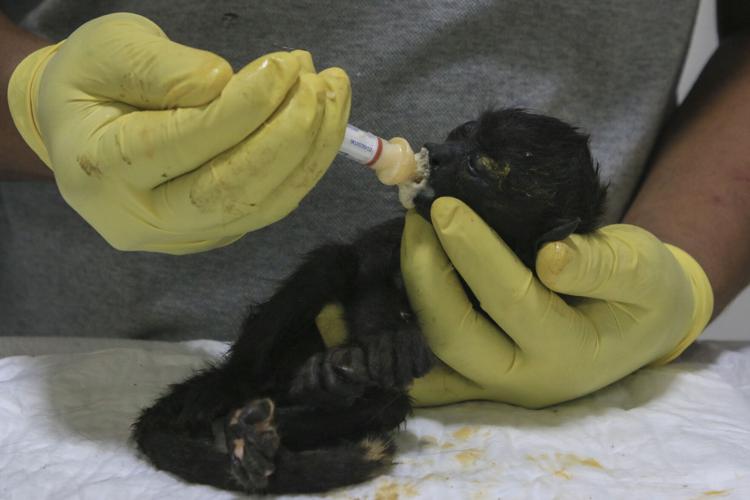
The veterinarian put ice on their limp little hands and feet, and hooked them up to IV drips with electrolytes.
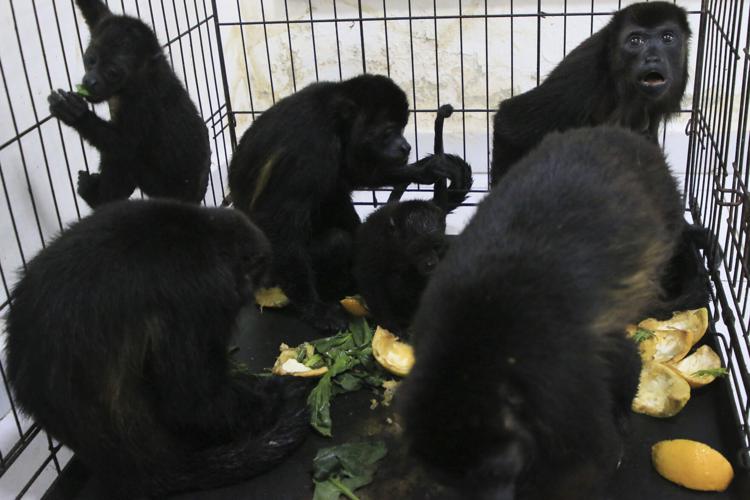
So far, the monkeys appear to be on the mend. Once listless and easily handled, they are now in cages at Valenzuela’s office.
“They’re recovering. They’re aggressive … they’re biting again,” he said, noting that’s a healthy sign.

Howler monkeys sit in a cage Tuesday at a veterinarian clinic after they were rescued amid extremely high temperatures in Tecolutilla, Tabasco state, Mexico.
Most aren’t so lucky.
Wildlife biologist Gilberto Pozo counted about 138 of the animals dead or dying on the ground under trees. The die-off started around May 5 and hit its peak over the weekend.
“They were falling out of the trees like apples,” Pozo said. “They were in a state of severe dehydration, and they died within a matter of minutes.”
Already weakened, Pozo says the falls from dozens of yards up inflict additional damage that often finishes off the monkeys.
Pozo attributes the deaths to a “synergy” of factors, including high heat, drought, forest fires and logging that deprives the monkeys of water, shade and the fruit they eat.
For people in the steamy, swampy, jungle-covered state of Tabasco, the howler monkey is a cherished, emblematic species; residents say the monkeys tell them the time of day by howling at dawn and dusk.
Pozo said the local people — whom he knows through his work with the Biodiversity Conservation of The Usumacinta group — try to help the monkeys they see around their farms. But he notes that could be a double-edged sword.
“They were falling out of the trees, and the people were moved, and they went to help the animals, they set out water and fruit for them,” Pozo said. “They want to care for them, mainly the baby monkeys, adopt them.
“But no, the truth is that babies are very delicate, they can’t be in a house where there are dogs or cats, because they have pathogens that can potentially be fatal for howler monkeys,” he said, stressing they must be rehabilitated and released into the wild.

A veterinarian on Tuesday feeds a young howler monkey rescued amid extremely high temperatures in Tecolutilla, Tabasco state, Mexico.
Pozo’s group set up a special recovery stations for monkeys — it currently holds five monkeys, but birds and reptiles also are affected — and is trying to organize a team of specialized veterinarians to give the primates the care they need.
The federal government acknowledged the problem Monday, with President Andrés Manuel López Obrador saying he heard about it on social media. He congratulated Valenzuela on his efforts and said the government would seek to support the work.
López Obrador acknowledged the heat problem — “I have never felt it as bad as this” — but he has a lot of human problems to deal with as well.
By May 9 at least nine cities in Mexico set temperature records, with Ciudad Victoria, in the border state of Tamaulipas, clocking a broiling 117 F.
With below-average rainfall throughout almost all the country so far this year, lakes and dams are drying up, water supplies are running out and authorities had to truck in water for everything from hospitals to firefighting teams. Low levels at hydroelectric dams contributed to power blackouts in some parts of the country.
Consumers also are feeling the heat. On Monday, the nationwide chain of OXXO convenience stores — the nation’s largest — said it limited purchases of ice to just two or three bags per customer in some places.
“In a period of high temperatures, OXXO is taking measures to ensure supplies of products for our customers,” parent company FEMSA said in a statement. “Limits on the sale of bagged ice seek to ensure that a larger number of customers can buy this product.”
But for the monkeys, it’s not a question of comfort, but of life or death.
“This is a sentinel species,” Pozo said, referring to the canary-in-a-coal mine effect where one species can say a lot about an ecosystem. “It is telling us something about what is happening with climate change.”
Massive die-off of Pacific Northwest trees linked to climate change

Christine Buhl, a forest health specialist for the Oregon Department of Forestry, uses an increment borer to core a dead western red cedar at Magness Memorial Tree Farm in Sherwood, Ore., Oct. 11, 2023. Iconic red cedars — known as the "Tree of Life' — and other tree species in the Pacific Northwest have been dying because of climate-induced drought, researchers say. Last year, Buhl and colleagues reported that red cedars were dying throughout the tree’s growing range not because of a fungus or insect attack, but due to the region’s “climate change-induced drought.”

Christine Buhl, a forest health specialist for the Oregon Department of Forestry, holds a tree core from a dead western red cedar, showing healthier rings toward the right of the sample and more drought-affected rings to the left, at Magness Memorial Tree Farm in Sherwood, Ore., Oct. 11, 2023. In recent years, at least 15 native Pacific Northwest tree species have experienced growth declines and die-offs, 10 of which have been linked to drought and warming temperatures, according to recent studies and reports.

Three dead western red cedars, center, at Magness Memorial Tree Farm in Sherwood, Ore., Oct. 11, 2023. Iconic red cedars — known as the "Tree of Life' — and other tree species in the Pacific Northwest have been dying because of climate-induced drought, researchers say. A term coined by researchers, “Firmageddon” refers to the more than 1,875 square-mile die-off of five fir species in Oregon, Washington and northern California.

Bark on a dead western red cedar at Magness Memorial Tree Farm in Sherwood, Ore., Oct. 11, 2023. Iconic red cedars — known as the "Tree of Life' — and other tree species in the Pacific Northwest have been dying because of climate-induced drought, researchers say. The die-off is likely to move uphill as temperatures warm in the coming decades, according to a study in the Journal of Forestry.

Christine Buhl, a forest health specialist for the Oregon Department of Forestry, uses an increment borer to core a western red cedar at Magness Memorial Tree Farm in Sherwood, Ore., Oct. 11, 2023.

Woodpecker nesting holes in a dead western red cedar tree at Magness Memorial Tree Farm in Sherwood, Ore., Oct. 11, 2023.

Property manager James Bailey looks at a dead Douglas fir among several dead western red cedars at Magness Memorial Tree Farm in Sherwood, Ore., Oct. 11, 2023. Firmageddon and Douglas fir die-offs have been linked to a combination of drought weakening trees and insect pests moving in for the kill.

Moss grows on the branches of a dead western red cedar at Magness Memorial Tree Farm in Sherwood, Ore., Oct. 11, 2023. Iconic red cedars — known as the "Tree of Life' — and other tree species in the Pacific Northwest have been dying because of climate-induced drought, researchers say.

An increment borer attaches to a vest worn by Christine Buhl, a forest health specialist for the Oregon Department of Forestry, after taking tree core samples at Magness Memorial Tree Farm in Sherwood, Ore., Oct. 11, 2023.

A section of a Douglas fir tree with the bark removed by scientists to examine insect damage that led to the tree's death following heat stress in the Willamette National Forest, Ore., Oct. 27, 2023. Firmageddon and Douglas fir die-offs have been linked to a combination of drought weakening trees and insect pests moving in for the kill.

Douglas fir trees that died as a result of insect damage following heat stress are visible in the Willamette National Forest, Ore., Oct. 27, 2023.

Sun shines on leaves on a big leaf maple tree in the Willamette National Forest, Ore., Oct. 27, 2023. In recent years, at least 15 native tree species in the region have experienced growth declines and die-offs, with 10 linked to drought and warming temperatures, according to recent studies and reports.

Dead needles hang on a western red cedar tree in the Willamette National Forest, Ore., Oct. 27, 2023. Iconic red cedars — known as the "Tree of Life' — and other tree species in the Pacific Northwest have been dying because of climate-induced drought, researchers say.

James Bailey, property manager, right, and Christine Buhl, a forest health specialist for the Oregon Department of Forestry, walk along a trail in the forest at Magness Memorial Tree Farm in Sherwood, Ore., Oct. 11, 2023. In recent years, at least 15 native tree species in the region have experienced growth declines and die-offs, with 10 linked to drought and warming temperatures, according to recent studies and reports. (AP Photo/Amanda Loman)