

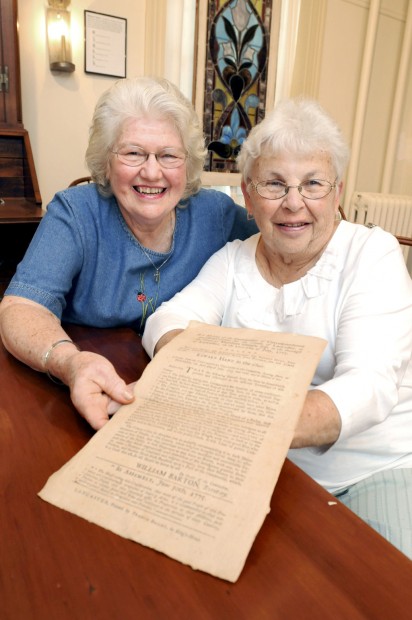
LITITZ, Pa. - In a fledgling nation hungry for men to fight in the American Revolution, conscientious objectors were frequently greeted with scorn, and their loyalty was questioned.
As war approached, leaders in Pennsylvania's Lancaster County sought to ease tensions by urging the growing number of German immigrants with religious objections to war to demonstrate their patriotism by giving as much money as they could afford to the revolutionary cause.
The proposition is spelled out in a July 11, 1775, public notice known as a "broadside," which is on display at the Moravian Archives & Museum here. Experts recently confirmed it as the only known English-language copy.
Lancaster played an important role in the nation's early history. It was the largest inland town in America, said Scott Gordon, an English professor at Lehigh University in Bethlehem. It was the nation's capital for one day - Sept. 27, 1777, while the Continental Congress was fleeing British troops who had captured Philadelphia. And it was Pennsylvania's capital from 1799 to 1812.
People are also reading…
Gordon stumbled across the broadside while researching another aspect of the colonial era. Driven by curiosity, he checked authorities on the historical significance of early American publications and confirmed its uniqueness.
The one-page broadside does not alter historians' understanding of colonial history, but it adds texture to the record of the fierce debate among colonists over how to deal with the Anabaptists, Quakers, Moravians and other religious groups that were built on pacifist principles and whose members were moving to Pennsylvania, Gordon said.
Early American policymakers wrestled with the conflicting forces of religious tolerance and wartime patriotism.
"There's nothing that's printed on this broadside that's brand new," Gordon said. "It's just one of those incremental steps by which this very new, local democracy tried to manage these competing diverse communities."
The 236-year-old broadside, yellowed but still clearly legible, urges citizens whose "religious scruples" prevent them from bearing arms to contribute toward the "necessary and unavoidable" expenses of the larger community.
"A cause that affects all, should be borne by all," the broadside warns.


