

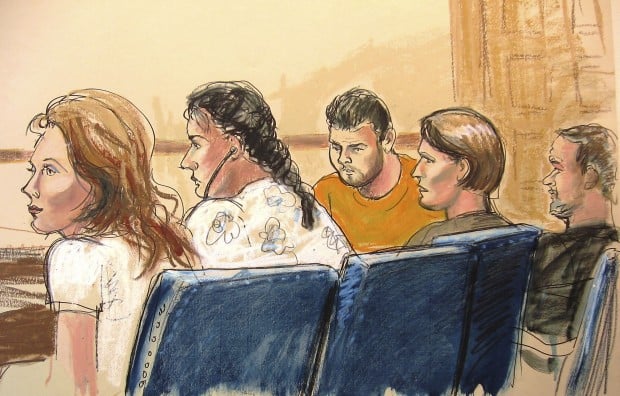
WASHINGTON - The FBI has arrested 10 people accused of serving for years as secret agents of Russia's intelligence service, the SVR, with the goal of penetrating U.S. government policymaking circles.
According to court papers unsealed Monday, the FBI intercepted a message from SVR headquarters, Moscow Center, to two of the defendants describing their main mission as "to search and develop ties in policymaking circles in US."
Intercepted messages showed they were asked to learn about a broad swath of topics including nuclear weapons, U.S. arms-control positions, Iran, White House rumors, CIA leadership turnover, the last presidential election, Congress and the political parties.
After a secret multiyear investigation, the Justice Department announced the arrests Monday in a blockbuster spy case that could rival the capture of Soviet Col. Rudolf Abel in 1957 in New York.
People are also reading…
There was no clue in initial court papers how successful the agents had been, but they were alleged to have been long-term, deep-cover spies, some living as couples.
These deep-cover agents are the hardest spies for the FBI to catch because they take civilian jobs with no visible connection to a foreign government- one was a reporter, editor and columnist at a New York Spanish-language newspaper. They are more elusive than spies who operate from government jobs inside Russian embassies and military missions. Abel was just such a deep-cover agent; he was ultimately swapped to the Soviet Union for downed U-2 spy pilot Francis Gary Powers in 1962.
The court papers described a new high-tech spy-to-spy communications system used by the defendants: short-range wireless communications between laptop computers - a modern supplement for the old-style dead drop in a remote area and hollowed-out nickels used by Abel to conceal and deliver microfilm.
But there was no lack of Cold War spycraft. According to the court papers, the alleged agents used invisible ink, stayed in touch with Moscow Center through coded bursts of data sent by a radio transmitter, used innocent-looking "brush" encounters to pass messages in public, hid encrypted data in public images and relied on fake identities and false travel documents.
Eight of 10 were arrested Sunday on suspicion of carrying out long-term assignments in the United States on behalf of Russia.
An 11th defendant, who allegedly delivered money to the defendants, is at large.
The timing of the arrests was notable given the efforts by Presidents Obama and Dmitry Medvedev to "reset" U.S.-Russia relations. The two leaders met last week at the White House after Medvedev visited high-tech firms in California's Silicon Valley, and both attended the G-8, G-20 meetings over the weekend in Canada.
FBI agents arrested the defendants known as Richard Murphy and Cynthia Murphy at their Montclair, N.J., residence.
Three other defendants also appeared in federal court in Manhattan - Vicky Pelaez and a defendant known as "Juan Lazaro," who were arrested at their Yonkers, N.Y., residence, and Anna Chapman, arrested in Manhattan on Sunday.
Richard and Cynthia Murphy, Juan Lazaro, Vicky Pelaez and Anna Chapman were held without bail.
Pelaez is a Peruvian-born reporter and editor and worked for several years for El Diario/La Prensa, one of the country's best-known Spanish-language newspapers. She is best known for her opinion columns, which often criticize the U.S. government.
Two other defendants, known as Michael Zottoli and Patricia Mills, were arrested at their Arlington, Va., residence. Also arrested at an Arlington, Va., residence was Mikhail Semenko.
Zottoli, Mills and Semenko appeared before a U.S. magistrate Monday in Alexandria, Va., according to the U.S. Attorney's Office.
Two defendants known as Donald Howard Heathfield and Tracey Lee Ann Foley were arrested at their Cambridge, Mass., residence Sunday.
In Moscow, calls to the Foreign Ministry and the SVR were not answered early Tuesday.


