

SAN FRANCISCO — The last time anyone saw Hugues de la Plaza alive, he was out celebrating a promotion with a few friends at a nightclub.
Later that night, the gregarious audio engineer with U.S. and French citizenship made a drunken call to a friend, and they made plans to see a movie the next day. Six hours later, a neighbor noticed blood dripping from the doorknob and porch at de la Plaza's apartment building.
Police found de la Plaza lying in a pool of blood in his living room, an open laptop on a coffee table and a broken wine glass nearby. Suicide, San Francisco police say.
The French aren't so sure.
To de la Plaza's parents, François and Mireille de la Plaza, who live in Brignogan on the Atlantic Coast of France, the San Francisco police appeared too busy or uninterested to fully investigate their only son's death. They lobbied the French government, which has taken the unusual step of ordering Parisian detectives to investigate and conduct their own forensic tests.
People are also reading…
Can this theory be right?
De la Plaza, 36, was found in June with stab wounds to his neck, chest and stomach. Strands of hair were stuck to the fingers of his left hand. And yet, neither a bloody weapon nor a suicide note was found. Blood was tracked from the kitchen through the living room and out the front door.
Nothing was missing from the apartment, and a building security camera showed de la Plaza coming home alone. His doors were locked.
The homicide detectives' theory — which strikes his family and friends as unlikely, even absurd — was that de la Plaza took drugs, stabbed himself, then washed or disposed of the knife before dying.
An autopsy found that de la Plaza had no drugs in his system and his blood-alcohol level was just above the legal limit for driving. But the medical examiner's report said his injuries were "not inconsistent with self-inflicted stab wounds."
And while police have pointed to the locked doors as evidence of suicide, a former girlfriend said the back door was secured only with a doorknob lock and that someone leaving could have closed the locked door behind them.
De La Plaza's parents are astonished.
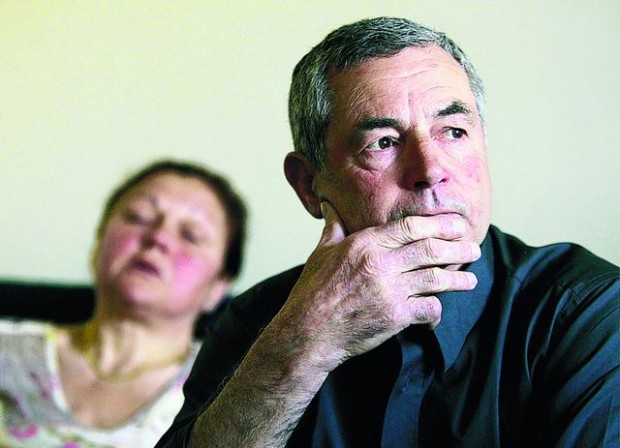
"In France we see CSI and all these American programs, so everyone thinks American police work this way. So when we tell stories of our situation, no one believes it," said François de la Plaza, 71, sitting next to his wife during a recent visit to San Francisco. The interview was translated by a friend.
Mark Bartscher, the man de la Plaza called at 2 a.m. to make plans to see "Hairspray," said his friend didn't sound like someone about to kill himself.
"He did sound drunk on the phone, but definitely not depressed," Bartscher said.
"Nothing to hide"
French officials say that if their investigators find anything of interest from tests on the blood, hair and electronics taken from the apartment, it will still be up to San Francisco police to decide if a homicide investigation should be opened.
The detectives assigned to the case declined interview requests because the case is still open.
But a police spokesman, Sgt. Neville Gittens, said the department has cooperated with the French.
"The opinion in homicide is, 'We don't have anything to hide. If they want to send somebody, send somebody,' " Gittens said.
"They're not going to do better than we can do coming from another country," Gittens said.
Friends said de la Plaza was an avid online dater and that his computer could hold clues to his death.
A former girlfriend, Melissa Nix, said the French government paid for tests on de la Plaza's computer and cell phone that showed he had logged on at 2:38 a.m. and that the power cord had been yanked from the machine. She said there is more work that can be done, such as finding out whom he e-mailed.
Police won't talk
Nix has testified before the city's police commission and filed a complaint with the city about the investigation, but she said police stopped speaking with her months ago.
"Homicide has tried to spin this as a suicide while maintaining, deceptively I believe, that they were pursuing this as a homicide. I've lost all confidence in the homicide department," said Nix, a reporter for the Sacramento Bee.
Last summer, after police told the de la Plazas their suicide theory, the family hired private investigator John Murphy. He said in an interview that he is convinced de la Plaza was killed.
For one thing, Murphy said, a couple who lived next door to de la Plaza told him they heard doors open and close three times after de la Plaza came home that night, and that footsteps were heard in an alleyway that connected to de la Plaza's back door.
Murphy said police never interviewed the couple.
Criminal-law professor Erin Murphy of the University of California-Berkeley agrees that police could have done more.
"There are a lot of questions that haven't been answered that could be by looking at his e-mails, or what was he searching for on Google," she said. "There are all of these kinds of questions … but as time goes on they are more difficult to answer."


