

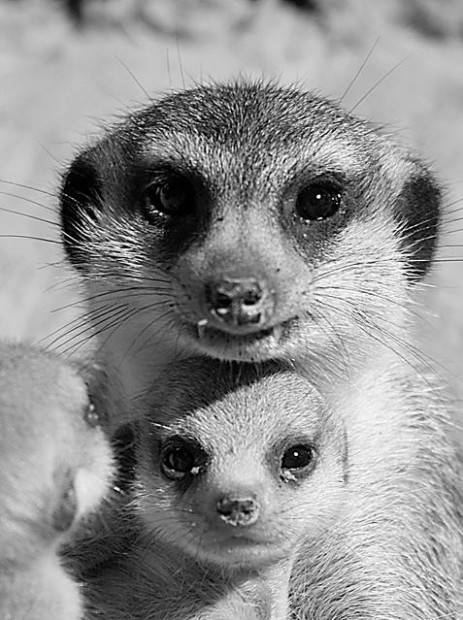
It's hardly algebra or physics, but meerkats have been observed actively teaching their young, something not often seen in wild animals.
While the young of many species learn by observing older members of their group, it's less common for adults to take direct actions with the only goal being teaching.
Researchers from the University of Cambridge in England observed meerkats gradually introducing cubs to prey, showing them how to handle captured insects and even removing the stingers from scorpions before giving them to youngsters.
"Although there are anecdotal reports of teaching in species from chimpanzees to killer whales, until this year solid evidence was really lacking," said Alex Thornton, co-author of the report appearing in today's issue of the journal Science.
There had also been evidence of teaching by cats, Thornton added, but that was hard to confirm because of the difficulty of studying large cats in the wild.
People are also reading…
Meerkats, small mammals found in southwest Africa, are not related to cats. They are about a foot long plus an 8-inch tail and weigh about 2 pounds. They live in groups.
"Meerkats provide the ideal study species to examine these questions because they eat a whole range of prey items including lizards, geckos, scorpions, spiders and small mammals that are very difficult for young pups to handle," Thornton said.
While evidence of teaching has been rare, Thornton said, "My feeling is that teaching is a lot more common than we had previously supposed. I think teaching is probably very common among species in which dependent young must learn complex skills. Teaching of hunting, for example, is likely to be common among felines, mongooses and birds of prey."
In addition, he said, he expects to see reports of teaching among insect societies.
"The important thing is to consider under what conditions we might expect one animal to actively promote learning in another."
There are many examples of animals learning simply by observation, he said, citing the spread of milk-bottle opening by birds in Britain as an example.
The difference is that in such cases the experienced animal doesn't have to make any changes in its behavior for others to learn from it.
In the case of the meerkats, however, the older animal catches prey and presents it, either dead or alive, to the youngster so it can learn to handle it — an activity that does not benefit the older animal.


