

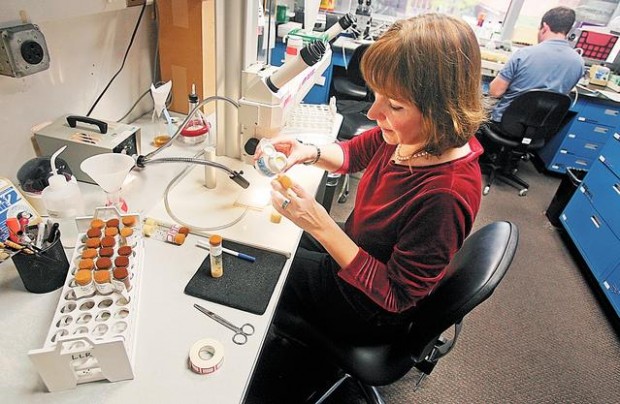
When most people see a fly, they try to shoo the pesky insect away — but not Linda Restifo. She sees a test subject that she hopes will lead her to a successful treatment for autism and other neurological disorders.
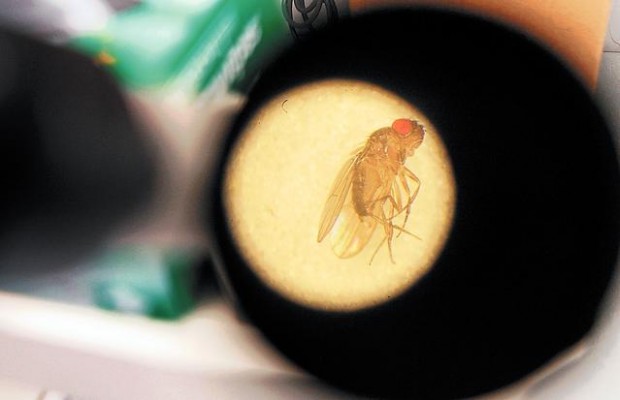
Fruit fly brains have similar proteins and mechanisms to human brains. Because of the similarity, fruit flies are an important model for studies in genetics, physiology and pathology.
"Fruit flies have led people to some of the central discoveries in genetics," said Restifo, a University of Arizona professor of neurobiology and neurology and a researcher with the Arizona Research Laboratories.
"They look quite different, but at a core level, genetically, we're really quite similar."
Restifo uses common fruit flies to screen drugs that may increase brain function in children with mental disorders such as autism, a developmental disability that typically involves delays and impairment in social skills, language and behavior. Estimates vary, but it could affect as many as one in 150 people in the United States.
People are also reading…
When Restifo began her research in 2001, the first question she set out to answer was how similar are the genes that control thinking, learning and memory in fruit flies and humans.
She found that about 70 percent of the human genes that can mutate or curl, found in people with autism, have counterpart genes in fruit flies.
"It was an important result. It gave me confidence that I was on the right track with the fly system, and it was a green light to go forward," she said.
Next, she set out to discover what's wrong with the shape and size of brain neurons, cells that process and transmit information, in people with autism.
"If you have gene mutations, it will affect the size and shape of neurons," Restifo said.
Because a researcher can't go around taking brain biopsies from people, there is limited brain tissue for research, Restifo said.
"You have to be more clever," Restifo said, such as using fruit fly brains.
While flies obviously don't talk, some exhibit behavior and social interactions similar to autistic behavior, Restifo said.
"We can imagine something approaching autism in fruit flies," she said. "It's not all that far-fetched."
Restifo takes single mutated brain neurons from a fruit fly and tries to figure out what's wrong with them and, more importantly, what can be done to correct it.
"The idea got stuck that there's nothing you can do about mental retardation or autism, that it's a fixed deficiency, and it can't be fixed," Restifo said. "I just don't believe that."
The brain has an enormous capacity for change, she said, using education as an example.
"Education can change the brain, and drugs can do the same."
And Restifo thinks there may be a drug to improve brain function in people with autism that's already been discovered and is waiting in the pharmacy.
She tests drugs that already have been approved by the Food and Drug Administration for a purpose other than improving brain function to see if they also may correct mutated or curly neurons.
For example, the hair-growth medicine Rogaine was originally used as an anti-hypertension drug, Restifo said.
"It's entirely possible drugs to treat autism are already out there," she said.
And it's much faster to conduct research with drugs that already have been approved because they've already been proved safe, she said.
"It's like starting halfway down the path."
Restifo has tested a catalog of 1,000 drugs on fruit flies. She said 45 have shown to straighten curly or "filagree" growth of neurons in flies, although some actually had the reverse effect.
The next step is to validate the results in mammals, starting with mice, Restifo said.
Tucsonan Sam Hawtree has two autistic sons, 20 and 22. He said he is always encouraged by any research that might help his boys.
"It sounds interesting and promising," Hawtree said of Restifo's work, but he added that he's eager for more tangible results.
"I'm encouraged someone is finding something that might help, even though its use might be far away."
A matter of convenience
Not only do fruit flies have genetic similarities to humans, they're efficient and convenient to work with, especially at universities.
Fruit flies have a short maturation time, so they can grow from larva to an adult in two weeks.
That means researchers like Linda Restifo need just months to study the effects of drugs on 10 generations of fruit flies — and the population of test subjects can expand and contract easily, so her number of test subjects can correspond with the school semester.
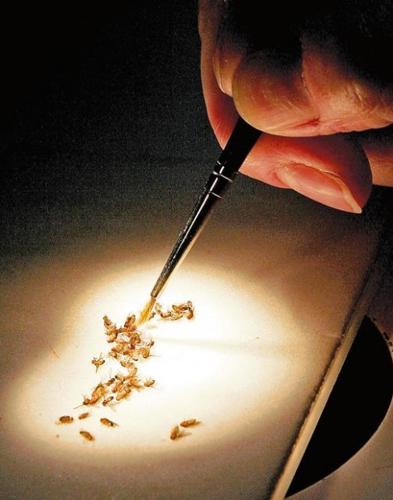
And thousands of flies can be housed in a small space — each is about the size of a single letter of newspaper print.
On StarNet: Want to know more about autism and how it affects people? Visit the Puzzle Pieces blog at go.azstarnet.com/ puzzlepieces to read more.


