CEDAR KEY, Fla. - The first rehabilitated turtles oiled by BP's massive leak were released back into the Gulf of Mexico on Wednesday, with scientists saying that animals taken in by rescuers - including birds - appear more resilient than was first feared.
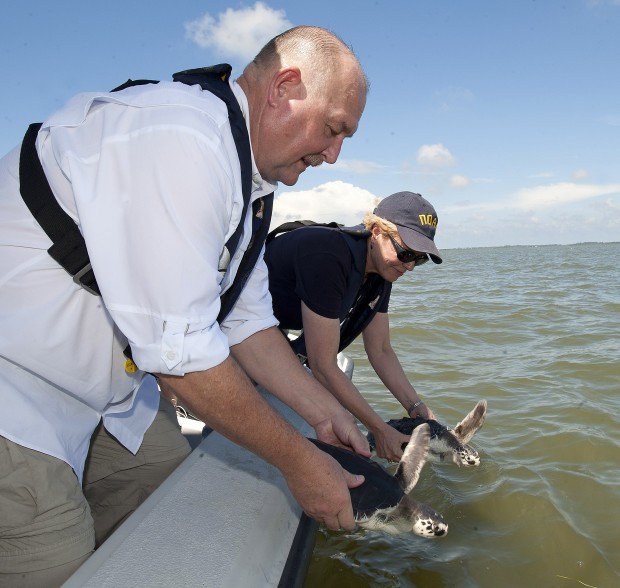
Retired Coast Guard Adm. Thad Allen, who is overseeing the oil crisis for the government, helped release the 22 oiled sea turtles about a mile off the coast of Cedar Key, an area unaffected by the spilled crude. They were the first oiled turtles found in the Gulf and rehabilitated.
"I think it's emblematic of us starting to look forward in the recovery," Allen said, smiling as he released some of the turtles. "This is a very pristine environment. This is their natural habitat."
Even though oil spill rescue crews have brought more sea turtles and birds to shore in the month since BP capped its broken well than in the previous month, wildlife officials said both kinds of animals have suffered less damage than what was originally projected.
People are also reading…
Rescuers have taken in 444 oiled turtles that were found alive since April 30, according to the National Oceanic and Atmospheric Administration. They found 522 turtles dead, though they've confirmed only that 17 of those had oil on them.
Government researchers have largely declined to discuss the turtles' causes of death.
Virtually all the live turtles - all endangered, most of them the rare Kemp's Ridley species - taken in have recovered quickly. Oiled turtles are scrubbed clean with dish soap and other cleaners, tested for health problems and fed at the centers. Once the turtles regain their strength, they're returned to the wild.
Many young birds were spared because the worst of the oil came in at the start of the nesting season rather than when chicks were learning to fly.
In all, about 1,933 oiled birds have been rescued, while 1,942 oiled birds have been found dead since the well blew on April 20.
By comparison, about 20,000 African penguins were rescued and washed after the MV Treasure tanker sank in 2000 off the coast of South Africa. In 1989, 1,604 rescued birds were brought in after the Exxon Valdez spill in Alaska, and 801 survived, according to the International Bird Rescue Research Center.
Wildlife officials warn that problems could surface later because it is unclear how much oil might still be in the Gulf. Allen also cautioned that while progress is being made, it could take years to determine the long-term impact.
"No, it isn't over," Allen said. "It's going be over in the wellhead shortly, and the source of the oil will be stopped. But as we know, there's a lot of oil that's not accounted for."