

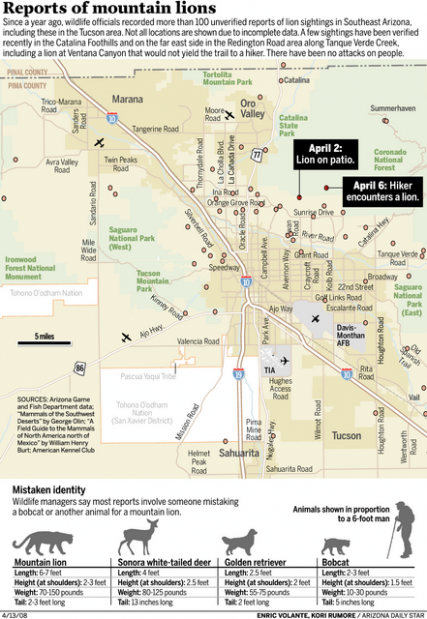
Last Sunday at dusk, Bill McManus thought the dog padding toward him on the Ventana Canyon Trail in the Catalina Foothills looked like a golden retriever. Then he realized it was a mountain lion.
Halting 40 feet away, the lion would not yield the popular trail. The 41-year-old hiker yelled and banged his walking stick on rocks, but the big cat did nothing more than lie down beside the trail and watch him.
"It acted more like a dog or somebody's pet than a wild animal," McManus recalled. "That's what concerned me the most — that it wasn't afraid of people. It acted more interested in me than scared."
Just after dawn four days earlier, Elizabeth Small watched through a window as a mountain lion lay on her Foothills patio near the north end of Swan Road. As she snapped pictures, Small felt exhilaration at seeing the secretive, solitary animal.
People are also reading…
Whether they chill us or thrill us, mountain lions are a part of urban life where cities border wildlands. In these two recent sightings and a few others that have been confirmed by wildlife officials, lions have not behaved aggressively. But officials are monitoring the area to make sure none has lost its fear of humans and become a public-safety threat.
"Some of our staff are keeping as close track as possible to other lion reports from the Foothills," said Elissa Ostergaard, an urban-wildlife specialist with the Arizona Game and Fish Department.
The Ventana Canyon Trail is where a Game and Fish officer shot and killed a female lion in 2004 after it confronted hikers, including an 8-year-old boy. Officers said they were concerned that the animal showed no fear, was unusually active in daylight and began stalking the hikers.
But attacks are extremely rare and even where cities and suburbs have grown deep into prime lion habitat, most people never know the big predators are around.
"Apparently some of these cats spend a tremendous amount of time in these areas," said Ted McKinney, a Game and Fish wildlife specialist.
"Other than eating pets, they're really not a problem for people," he said.
McManus, the hiker who encountered the lion on the Ventana Canyon Trail, said he wasn't worried until the lion got up and walked into the brush. He could hear it coming past where he stood on the trail. Maybe it was just going around him, but he couldn't see it, so he hiked back to the trailhead.
Game and Fish officials posted signs there warning hikers to be alert due to recent lion activity, Ostergaard said.
East of the city, officials in Saguaro National Park closed some hiking trails due to lion activity and state wildlife officials have been alerting people about sightings in areas along Tanque Verde Creek, including La Cebadilla Estates on the far Northeast Side.
Near that subdivision of lots of 5 acres or more, a wildlife manager reported on March 28 that he spoke to a woman who on two occasions had seen a lion run across the road while she walked her small children. The day after her second sighting, he found an indistinct track that he "was pretty sure was that of a mature lion."
McKinney and other researchers tracking radio-collared lions are finding that lions that venture into residential areas are highly variable in how much time they spend there.
The 16 lions McKinney has collared near Prescott and Payson since November 2005 spent from 1 percent to 96 percent of their time in residential areas, where most people had no clue.
The 96 percent lion was a female tracked over 20 months. In contrast, a male lion that sometimes accompanied her spent 25 percent of his time among homes, ranging in and out of Prescott.
McKinney said the female lion, which was about 8 years old when collared and is "getting to be an old lady now," was once videotaped lying beside a Prescott driveway.
His lions frequented areas of one or two homes per acre and of five to 15 homes per acre.
Some of 15 lions collared in an ongoing study in the Tucson area have been tracked into Catalina Foothills neighborhoods a few times in recent years.
One padded through darkness across a golf course in the heart of SaddleBrooke.
Kerry Nicholson, a University of Arizona graduate student conducting that study, said she has yet to analyze her data, but her lions seem to spend less time in town than the ones in Prescott. She has not identified any that dropped below Foothills neighborhoods into the city.
Two of her three lions that remain collared and under study are in the Sabino Canyon area. The other is around the town of Oracle.
After the owners of the 100-acre Cherry Valley Ranch in Oracle noticed a wet lion track near their swimming pool, Nicholson hurried to Oracle and trapped a young male lion.
Collared and released, the cougar roamed around Oracle for a month, then cut north, covering hundreds of square miles around Globe, Miami, Cutter and other communities before reaching Roosevelt Lake. A hunter shot it and turned in the collar.
There are occasional unverified reports of lions deeper in the city.
At 5:45 a.m. on Jan. 2, Everett Grondin was in his home on East Greenlee near Prince Road and Tucson Boulevard. He says his wife stepped onto the front porch and surprised a lion that quickly retreated.
"He was standing about 25 or 30 feet in back of the car along the driveway and he had a black cat in his mouth and he dropped it right there in the driveway," Grondin recalled.
When he stepped outside with a flashlight, he could see the crouching animal seemed to be thinking about coming back for the cat. He flashed the light in its eyes and made an aggressive move toward it and the animal disappeared.
Pima County Animal Care picked up the dead cat. Grondin posted a notice on a neighborhood Web site so his neighbors would be alert and keep their pets safe. No one called wildlife officers, who might have detected tracks or otherwise verified the sighting.
Grondin lives along Christmas Wash, which winds down from the Rillito River, a link to the Catalina Foothills.
Wildlife officials say perhaps 80 percent or 90 percent of citizens who report a lion are mistaken. They've seen a bobcat, dog or other animal.
But Jim Heffelfinger, a Game and Fish regional game specialist, said he wouldn't discount a report of a lion "even in the very center of the city."
"If it's near a major wash, it's certainly plausible," he said.
About 10 years ago he removed a lion from a mobile-home park just across the sandy Rillito River from the busy Tucson Mall, near Oracle and River roads.
Another time he removed a lion in a Marana yard within sight of Interstate 10.
Officials had a tougher time removing a lion in Douglas last month. A Game and Fish report gives this account:
When Douglas police called for help, a Game and Fish officer arrived there to find several police officers, a Cochise County sheriff's deputy, animal-control officers and emergency medical workers at a home where a groggy mountain lion was treed in the backyard. "The Douglas PD was not sure if it was a lion or a bobcat, but they had shot at it four times with a dart gun and it was unknown how many times the lion had been hit with sedative drugs," a wildlife official wrote.
An animal-control officer couldn't tell Game and Fish what types of sedatives he had fired. The animal officer snared the lion with a catchpole, but when he lowered it from the tree it became clear the cat was not adequately sedated.
The lion, a healthy young tom, began lunging and swiping until the officer struggling to control it was in danger of letting it escape. The wildlife officer, concerned that a half-drugged lion could soon be rushing at bystanders, fired her handgun twice and killed it.
Police and animal-control officers told her that after several reports of a lion in the city, they had called Game and Fish dispatch two days earlier and been told the agency would not respond unless the lion was cornered, according to the report.
The lion had been seen near a park where kids were playing and as phone calls kept coming in, animal-control officers began pursuit. The report said they "had been chasing the lion around Douglas all day."
In Tucson, the lion that sprawled on Elizabeth Small's Foothills patio just after dawn April 2 walked off after 15 or 20 minutes, she said.
One photo shows the cat's ears laid back — a sign that it may not have been pleased, perhaps because it knew people were nearby, said researcher Nicholson.
That day at dusk as Small entertained guests with that morning's lion photos, one man looked out the window and saw the lion was back. She said her group and the big cat gazed at each other before it went to a neighbor's watering hole.
"We saw her drinking," Small said with delight. "Then she headed southeast and up through the brush and we haven't seen her since."
Lion safety tips
• If you encounter a mountain lion, stay calm and do not run. Slowly back away and keep your eyes on the lion.
• Make yourself look bigger. Raise your arms over your head.
• If the lion becomes aggressive, fight back with whatever you have and stay standing.
• Supervise children, keep them close and in sight at all times.
• Be aware of your surroundings. Don't use cell phones or listen to music because it reduces your level of awareness.
• Report sightings to Game and Fish at 628-5376.
Source: U.S. Forest Service


