

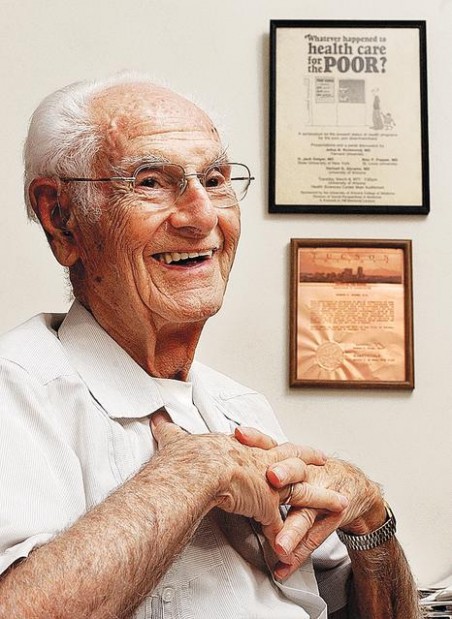
Dr. Herbert K. Abrams, an international leader in public health and a tireless advocate for affordable health care, died Sunday after a three-month battle with leukemia. He would have been 93 today.
Abrams — whose work included starting the UA College of Medicine's family medicine department and El Rio Health Center in Tucson, founding the Union Health Service in Chicago and developing public health programs in China and other countries — died at home surrounded by family and friends.
"He had a wonderful life and he died peacefully. I can't be sorry," said Sofia H. Abrams, his wife of nearly 57 years.
"He had visitors right up to the end, and even though he could no longer talk, when they touched his hand he would give them a good hand tickle to let them know he knew they were there."
Daughter Linda Abrams said her father wanted to be a social worker to help tackle the kinds of problems he witnessed during the Great Depression — but then realized he could accomplish as much with a career in public health.
People are also reading…
Despite her father's dedication to his career, Linda Abrams said, "He was a dedicated family man who never brought his work home and always made time for us."
Among the last visitors to Abrams' bedside Sunday was Rep. Raúl Grijalva, D-Ariz. "Dr. Abrams believed that health care is a right, that it was one of the fruits of living in this country. He fought for it all the time," Grijalva said Monday.
G. Marie Swanson, dean of the UA's Mel and Enid Zuckerman College of Public Health, visited with Abrams on Friday.
"He could barely breathe Friday, but he was so alert, we had a great visit," Swanson said. "He was going to be our convocation speaker in December and he said to me several weeks ago, 'I'll try to stay alive until then.' His spirit will always be with us, and his inspiration."
Abrams earned his medical degree from the University of Illinois in 1940 and received a master's degree in public health from Johns Hopkins University in 1947. He worked with the California Department of Public Health before returning in 1952 to his native Chicago. There he founded the Union Health Service, which celebrated its 50th anniversary in November. He helped organize neighborhood clinics and was head of preventive medicine for two years at Chicago Medical School before coming to the UA in 1968.
Abrams made his first trip to China in 1945 and his final visit last September, to meet with people with whom he had collaborated for 60 years.
While he spent five days at University Medical Center last month with pneumonia, he was visited by two delegates of the Chinese Consulate in Los Angeles, who came to honor him.
After two years at the UA, Abrams obtained federal funding to start what is now El Rio Health Center in 1970. He stepped down after 10 years as head of family medicine to start the UA Center for Occupational Safety and Health.
Among those he recruited to the UA were Dr. Andrew Nichols, the state senator and UA Rural Health Office director who died in April 2001 at the age of 64; and Dr. Augusto Ortiz, who spent more than 50 years treating farm workers and other poor people without regular health care in rural Arizona.
"Dr. Abrams really was a marvel, a treasure," said Martha Ortiz, whose husband, 89, is in failing health.
On July 1, U.S. Surgeon General Richard Carmona honored Abrams with the Surgeon General's Medallion, which recognizes exceptional achievement in public health and medicine. Carmona did not attend the award ceremony in the Abramses' Midtown home but spoke to Abrams by phone.
In addition to his wife, Sofia, and daughter Linda, both of Tucson, Abrams is survived by daughters Ellen Abrams of Tucson and Amy Persechini of Overland Park, Kan., and four grandchildren.
A memorial service has been scheduled for Sept. 2, from 2 to 6 p.m., in the DuVal Auditorium at University Medical Center.


