

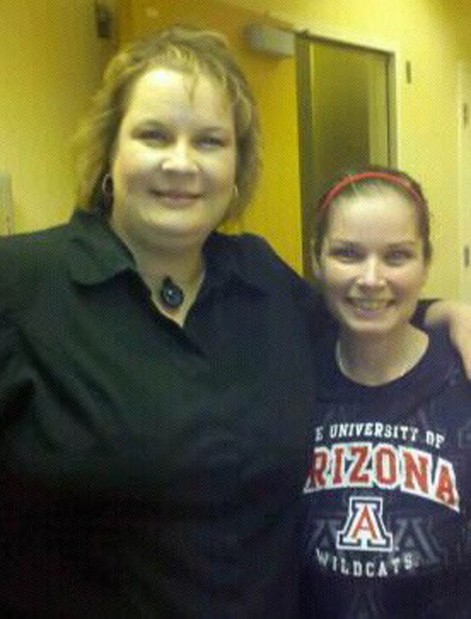
Tucson residents Jackie Boorse and Heather Thrall Roscoe call themselves "shunt sisters" for the brain shunts they each have to manage a rare neurological disorder.
Boorse, 28, and Thrall Roscoe, 39, first met in a hallway of the University of Arizona Medical Center in June 2010. Each had half of her head shaved, as each had recently undergone surgery to get a permanent cerebral shunt to drain a buildup of cerebrospinal fluid from the brain. They also both had the same neurosurgeon, Dr. G. Michael Lemole Jr.
Upon talking, the two women discovered they had something else in common, as both suffered from chronic idiopathic intracranial hypertension, a condition characterized by an increase in brain pressure when there's been no prior trauma or other obvious cause. They had both recently developed the disorder and were coping with the toll it was taking on their lives.
People are also reading…
Boorse was a premed student with aspirations of becoming a pediatrician. Thrall Roscoe was a senior planner with the city of Tucson. Their futures were uncertain. They've been friends ever since.
Now, more than two years after they first met, the pair have begun working on creating awareness.
Boorse reached out to the UA Neuroscience Club, which includes about 60 students who are interested in pursuing careers in neuroscience and related fields.
"I hadn't heard about IIH (idiopathic intracranial hypertension) before. ... We had Jackie and Heather speak at our meeting, and about 100 people were there," said UA Neuroscience Club founder and President Michelle G. Magana Mendoza.
"People were really engaged and very interested to learn more and how it had affected them," she said.
The students will hold a fundraiser for the Intracranial Hypertension Research Foundation this Friday evening at The Fix, a UA-area restaurant.
"I am so inspired by this young group of people who want to bring awareness of brain issues," Thrall Roscoe said. "No one ever understands when I tell them what I have. I wish there were support groups. The only other person I know with this is Jackie. I am thrilled I met her."
The condition can be managed to varying degrees, and severe cases that require a brain shunt are not common, Lemole said. He said the disease occurs in about one or two per 100,000 people in the general population, and at a higher rate in women of childbearing age. Obesity also is a risk factor, he said.
Boorse's symptoms began with blurry vision, and Thrall Roscoe's began with an unusual headache at the back of her head.
Both have suffered complications since receiving brain shunts back in 2010 when they first met. Thrall Roscoe had to get a new shunt when the first one failed and she developed an unusual speech problem that left her stuttering.
Boorse has had several more surgeries and now has permanent shunts in her brain and her lower back.
"I have had many ER visits when the headaches are unbearable," Boorse said. "The headaches are not normal. They are a million times worse than a normal migraine. ... Basically, there's not enough room for your brain in your head."
Boorse has lost most of her vision, can no longer drive and has been unable to finish her schooling. She's three credits short of earning her undergraduate degree as a biology major and longs to go back to school.
Thrall Roscoe considers herself somewhat of a miracle. She is back at work and credits Lemole with trying various treatments that helped her regain her speech. She gave students in the Neuroscience Club some advice based on Lemole's handling of her case:
"If you don't know what's wrong with them, treat them with hope," Thrall Roscoe said. "People in the medical profession should never give up on their patients."
Mendoza, a fifth-year senior who wants to be a physician, started the Neuroscience Club in 2009. The group's aim is to spread awareness of neuroscience to the community. One of the key parts of the club is getting to know patients.
"When you actually get to engage with a patient who has a disorder, it gives a human component that's necessary for being a good provider," Mendoza said. "You have to really understand patients, and learn through their eyes."
If you go
What: A fundraiser for the Intracranial Hypertension Research Foundation, hosted by the University of Arizona student Neuroscience Club. All are welcome.
Where: The Fix, "Arizona's Mac N' Chz Headquarters," 943 E. University Blvd., which will donate 10 percent of diners' bills to the fundraiser.
When: 4 to 10 p.m. Friday.
To take part: Diners must present a flier for the event at the register when they order. Fliers are available at various spots near campus or can be printed from www.facebook.com/NeurosciclubUA/events
Contact reporter Stephanie Innes at sinnes@azstarnet.com or 573-4134.


