

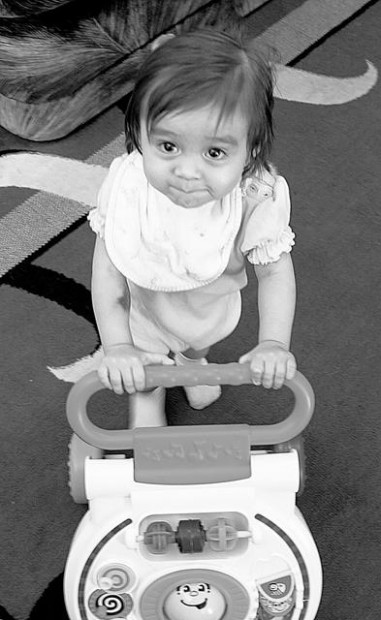
As Tucson toddler Tiana Lopez returned home last weekend after a spectacular recovery on an experimental heart device, the same device was pumping for another local baby with life-threatening heart failure.
Doctors at University Medical Center are hoping for the same outcome for this 8-month old baby — recovery of the child's own heart instead of resorting to a heart transplant.
Tiana spent three weeks on the child-sized heart-assist device — known as the Berlin Heart — after she suffered severe heart damage, possibly because of a viral attack.
While the device pumped for her failing heart, the 15-month-old girl — who had been put on the list for a heart transplant — recovered so well that UMC doctors released her Saturday.
"She's playing nonstop now. Her energy is great; she's eating and sleeping well. She's back to her normal self," said Ryan Lopez, Tiana's father.
People are also reading…
Such a return to health was considered unlikely when Tiana first arrived at UMC with a severely enlarged heart barely able to pump her blood. Doctors immediately requested permission from federal health authorities to use the unapproved Berlin Heart to keep her alive, sent to Germany for it, and implanted it in Tiana on Feb. 7.
To the surprise and delight of her entire medical team, Tiana's heart grew strong enough to pump on its own two weeks ago, ending her need for either a transplant or the device. Although not quite normal, her heart function improved enough to allow her to return home last weekend, with no limits on her activity.
"There was just no reason to keep her here any longer. She looked so good," said Rich Smith, director of the University of Arizona's artificial-heart program, who supervises the use of heart-assist devices and the total artificial heart.
"Each time we test her, she is improving, and as long as that continues, we're happy," he said. "We'll see her regularly in clinic — we'll be following her closely."
Praying for the same success is the family of Itxair Rodriguez. The baby was stricken two weeks ago with sudden heart failure, also likely because of a viral infection that struck the heart, her parents said.
After antibiotics failed to stop the damage, the baby was placed on the Berlin Heart on March 6, UMC officials said.
"She seems to be doing much better — she's drinking milk from her bottle again," said It-xair's father, Oscar Rodriguez.
Doctors have said they are seeing signs of improvement, similar to Tiana's, but have not ruled out the need for a heart transplant, he said.
But this time, the UMC team did not have to wait several days to get the Berlin Heart from Europe, as they did when Tiana needed it. For Tiana's case, they ordered two different sizes and used the larger one for her, making the smaller one readily available for Itxair.
"We went through all the hoops we had to go through to use it, getting permission from the FDA and from Germany," Smith said.
"But this time, we were able to take advantage of having it here when we needed it," he said. "We are very excited about being able to use these devices now. Before, the only option we had for these children was a transplant."
Designed especially for small children, the Berlin Heart has never been tested in the United States, so it is not approved for use in this country. However, it has been used in some 40 U.S. children, with special federal permission each time, since UMC used it first in 2000.
Convinced of its success, the UMC heart transplant team now plans to petition the U.S. Food and Drug Administration to grant a humanitarian device exemption for the Berlin Heart. That would allow its distribution here and eliminate time waiting for its delivery.


