

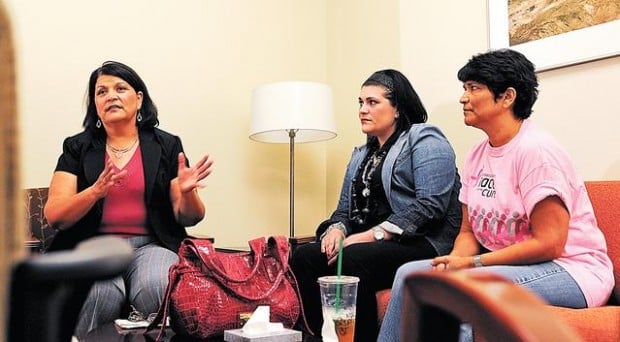
For Betty J. Villegas, cancer is a family legacy.
Her mother died of ovarian cancer at age 39 when Villegas was just 16.
Her great-aunt died of ovarian cancer at age 44, and another great-aunt was diagnosed with breast cancer at 40. Her uncle died of stomach cancer at 65, and her sister was diagnosed with breast cancer at age 44.
Villegas' diagnosis of breast cancer at age 52 wasn't too surprising. She had a mastectomy and barely took any time off from her job as a housing program manager for Pima County, even while she was in chemotherapy.
But what happened next was more unexpected. She tested positive for a mutation of the BRCA1 gene, putting her at a high risk for a second breast cancer.
Villegas struggled to break the news to her daughter, Olga Guzman-Flores, who had a 50 percent chance of having the gene mutation as well. Villegas worried for her young granddaughter, too.
People are also reading…
The mother and daughter's journey through the testing process — and the difficult decisions they faced about undergoing prevention surgery — is chronicled in a documentary titled "In the Family."
It's scheduled to air on PBS Wednesday, the start of Breast Cancer Awareness Month.
When Villegas, 55, first tested positive for the BRCA mutation, she wasn't sure what to make of it and didn't do anything about it. She initially didn't have any genetic counseling — something she wishes she'd done before the test. She didn't even tell her daughter for almost a year.
Until the test, Villegas always assumed her family members' cancer was environmental — they'd all lived and grown up on Tucson's South Side, where trichloroethylene, known as TCE, was found in water wells in 1981. TCE is an industrial cleaning chemical and is believed to have caused diseases, including cancer, among South Side residents.
But after finding a group on the Internet called FORCE — Facing Our Risk of Cancer Empowered — Villegas began researching hereditary cancer and discovered that testing positive for a BRCA mutation had serious implications. FORCE is dedicated to people whose lives have been affected by inherited breast and ovarian cancer.
Villegas had a 65 percent chance of developing a second breast cancer and a 60 percent risk of getting ovarian cancer in her lifetime. She found out that her daughter was at a high risk, too.
She ended up getting her other breast removed, and also having a hysterectomy, as preventive measures.
Once she heard about the test results, Olga Guzman-Flores, now 34, had to prepare herself.
She allowed filmmakers to follow her as she went through genetic counseling and decided what she'd do in the event of a positive test. The cameras also followed her through her test and receiving the result.
"I grew up so afraid of cancer that I am still afraid to do self-exams," said Guzman-Flores, a Tucson musician. "I'm so scared of what I'm going to find."
It was through FORCE that Villegas ended up meeting filmmaker Joanna Rudnick, who tested positive for a BRCA mutation at the age of 27.
Rudnick's experience inspired "In the Family," which chronicles her own process while deciding whether to have her healthy breasts and ovaries removed, or gamble on her high chances of developing cancer.
She must weigh her dreams of having children against her fear that holding on to her fertility will jeopardize her life.
Interspersed with Rudnick's story are those of other women, including Villegas and Guzman-Flores.
Because Guzman-Flores already has a child, she made the decision that in the event of a positive test, she'd have a hysterectomy and a double mastectomy.
Her aunt and Villegas' sister, 51-year-old Irma Santa Cruz, plans to have a double mastectomy soon. Santa Cruz has tested positive for the gene mutation and already has had a lumpectomy from a previous bout with breast cancer. She also has undergone a hysterectomy.
Like Villegas, Santa Cruz remains haunted by her mother's death. Santa Cruz was just 12 at the time.
Santa Cruz's 30-year-old daughter also has tested positive for the BRCA gene mutation, as has her son.
Santa Cruz, Villegas and her daughter now publicly advocate that women with family histories of breast and ovarian cancer — particularly Hispanics — should get genetic testing.
Villegas said too many Latinas she knows just accept what their doctor says and don't seek other opinions.
"Many of us as Latina women whose families have had a lot of cancer in our families, we just wait for the doom and gloom," she said.
"The thing is, we don't have to wait for it to happen. There are things we can do to reduce our chances. Knowledge is power, and I truly believe that while not everyone needs to be tested, if they have risk factors, they should consider it."
Breast cancer is the most commonly diagnosed type of cancer among Hispanic women, American Cancer Society data show.
Also, breast cancer mortality rates over the past decade have not decreased at the same level for Latinas as for non-Hispanic whites.
But a diagnosis doesn't have to be a death sentence, and preventive work can save a lot of heartache, Guzman-Flores said.
Unlike her mother, Guzman-Flores consulted with a genetic counselor at the Arizona Cancer Center before she was tested.
Counselor Jessica Ray said she is "non-directive" with the people who come to see her, but she lays out their options and lets them know the risks involved.
Typically, there are three options for people who test positive for a BRCA mutation — preventive surgery, increased screenings or preventive medicine such as tamoxifen.
Ray also spends 90 minutes with her clients, which is much more time than Villegas or Guzman-Flores said they were able to get with their oncologists.
Ray notes that a new federal law that takes effect in May — the Genetic Information Nondiscrimination Act — will prevent health insurance and employment discrimination on the basis of genetic information or a genetic-test result.
"I'm not as scared anymore that my mom is going to die," said Guzman-Flores, who is keeping her own test result private until the documentary airs.
"That's always been what I've been afraid of. Now that she's had the surgery, she's actually at less risk than the general population. This whole process of getting more information, it has really changed my life."
If you watch
Tucsonan Betty J. Villegas and her daughter, Olga Guzman-Flores, are featured in the documentary "In the Family."
It will air this week on KUAT-TV, Channel 6 in Tucson, at 11 p.m. Wednesday and at 2:30 a.m. Thursday.
The 90-minute film also will air at 9 p.m. next Sunday on UA Channel, which is cablecast in Tucson via Cox Communications' digital tier on Channel 116 and in the surrounding area via Comcast Channel 76.
DID YOU KNOW
TCE contamination, which Betty J. Villegas blamed for her family's cancers before she learned she had a gene mutation, was found in South Side wells in 1981. The wells were then shut down.
The trichloroethylene, or TCE, was an industrial cleaning chemical used to remove grease from airplanes in previous decades.
More than two decades of litigation over South Side groundwater contamination followed.
Notably, about 1,600 residents who said they suffered illnesses related to the contamination won an $85 million settlement from Hughes Aircraft Co. in 1991.
The last of six projects to clean up the South Side groundwater pollution began in 2007.
Source: Star archives


