

If a flesh-stripping piranha attacks the swimmer, University of Arizona doctors will be there to deal with the injuries.
If an anaconda — the world's largest snake — tangles with the swimmer, UA docs will be there to handle it.
If an exotic tropical parasite sickens the swimmer, UA specialists will be on hand to treat it.
If any injury, infection or illness befalls world record-setting marathon swimmer Martin Strel while he swims the entire length of the Amazon River in South America next month, a team of expert UA physicians will be there to handle the emergency, maybe even save his life.
Well, virtually "there."
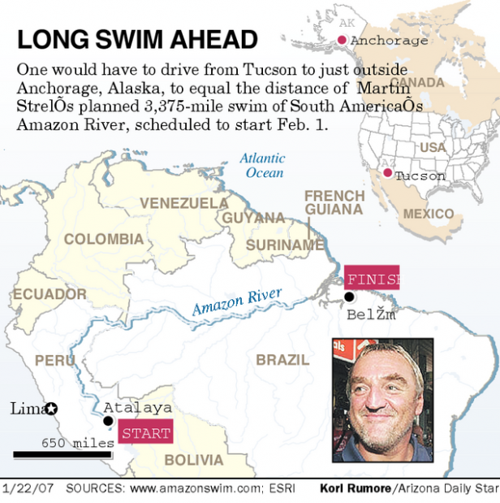
In fact, the UA doctors will be home in Tucson while Strel — a Slovenian super-athlete — tries to capture the Guinness World Record as the first and only human to conquer all 3,375 miles of the Amazon.
People are also reading…
Though a continent away, the doctors will be following Strel's every move, his every physical action and reaction, through the technology known as telemedicine — the UA's electronic video system hooked up by satellite to cameras and monitors attached to the swimmer during his Amazon odyssey, which begins Feb.1.
Without a doubt, this is the wildest use of the UA's state-of-the-art telemedicine system, widely recognized as the best in the nation. Launched here in 1996, the Arizona Telemedicine Program brings long-distance specialist, mental health and even trauma care to rural and urban hospitals across the state.
Linking it to a marathon swimmer negotiating a jungle river full of aquatic predators and strange parasites is a whole new video game. But the venture has a deeply serious ultimate goal.
"It's an unbelievable opportunity to be part of an historic moment," said Dr. Rifat Latifi, a UA trauma surgeon, associate director of the telemedicine program, and now medical director of the Amazon Virtual Medical Team for this swim.
"But my main goal in doing this is to get telemedicine publicized, so people can see what it can do, how it can bring health care to remote sites around the world."
And to do just that, during the 70 days it likely will take Strel to swim from Atalaya, Peru, to the Atlantic Ocean in Brazil, Latifi will fly south for several on-site consultations with the project. While there, he plans to introduce the telemedicine technology to indigenous tribes and villages along the river.
By the time Strel has swum the Amazon River, Latifi wants to have seen at least five villages along the river, in Peru and Brazil, setting up telemedicine connections to top experts at the UA and at major urban hospitals in South America.
"Going along on this record-breaking swim and being part of the human celebration will be great fun," he said. "But there is much more to it than that."
Aside from that larger mission, the immediate business of keeping Strel, 52, safe and healthy during this marathon will be no small job.
Though he's a proven veteran of record-setting swims — earning Guinness honors for swimming the world's other major rivers, including the Danube in Germany in 2000 (1,867 miles), the Mississippi in 2002 (2,360 miles) and the Yangtze in China in 2004 (2,488) — the Amazon will be by far Strel's longest swim, adding nearly 1,000 miles to his previous record.
But the real challenge — and risk — lies in the tropical nature of this mega-river and its formidable wildlife. In the Amazon, Strel will encounter life-threatening creatures seen in none of the other temperate-climate waterways he's navigated.
For starters, the Amazon is home to one of the most feared fish in the world, the piranha, known to strip the flesh of humans and livestock, and blamed for the deaths of some 300 people when their boat capsized there in 1981. He'll share the waters with the biggest snake in the world, the anaconda, known to occasionally attack anglers. Not to mention crocodiles and a few highly poisonous frogs that hang out in those parts.
"When I met Martin, I asked him, 'Why are you doing this — don't you know how dangerous this is?' " Latifi said. "He opened his jacket to show me his T-shirt, which said 'Achieve the Impossible.'
"He may be a bit crazy, but Martin is a really nice guy, a very down-to-earth human being. And he is an unbelievable human specimen. He's kind of beefy, but he has shoulders like steel, and he is in super shape."
Even so, for this unique swim, Strel's on-river medical team wants the support of the UA's telemedicine team — and the medical specialists from all over the world they can contact at the click of a key for whatever crisis may occur.
"This is a very fertile area for infectious disease, and I'd say he's at a pretty high risk for getting something while he's there," said Dr. Eskild Petersen, the UA's top specialist in global infectious diseases, who also will cyber-monitor the swim.
Malaria, dengue fever, cholera, leishmaniasis, yellow fever, river blindness, elephantiasis, Chagas' disease, emetic diseases — the list of microbial threats in the Amazon and its rain forest goes on and on.
"Using the telemedicine system, we should be able to get a good look at what shows up on him, what his symptoms are, and diagnose and treat the problem — at least that's the theory," Petersen said. "This is on the wild side of medicine. This is going to be interesting."
Figuring to swim some 60 miles a day for the 70 days, Strel will not only have his on-river medical team in tow, but also at least two small kayaks shadowing him for immediate rescue, if necessary.
Trying to answer the question everyone asks, he explains at length on his Amazon Swim Web site why he wants to work so hard, take such a chance, maybe even risk his life.
"To be the first and only … I'm going to swim that river or die trying," he starts off, in the spirit of every extreme adventurer.
Then he writes at length about the sorrows and miseries and wars of the world.
"What I will have in mind in the darkest days of that swim … is that in some way I am helping to protect, not only myself, but the rain forest from the hazards of exploitation and pollution … hazards threatening our environment as a whole.
"… So that people can live together in peace without fear of famine and violence and war. For all these reasons, I am going to swim that river."
To kick off the work of the UA-led Amazon Virtual Medical Team, UA trauma surgeon Dr. Rifat Latifi will spend next week on the Amazon River, helping marathon swimmer Martin Strel prepare for his Feb. 1 plunge. During the 70-day, 3,375-mile swim, Latifi will fly down for several on-river consultations with the project.
While there, Latifi will blog about the adventure online at www.amazonswim.com.


