

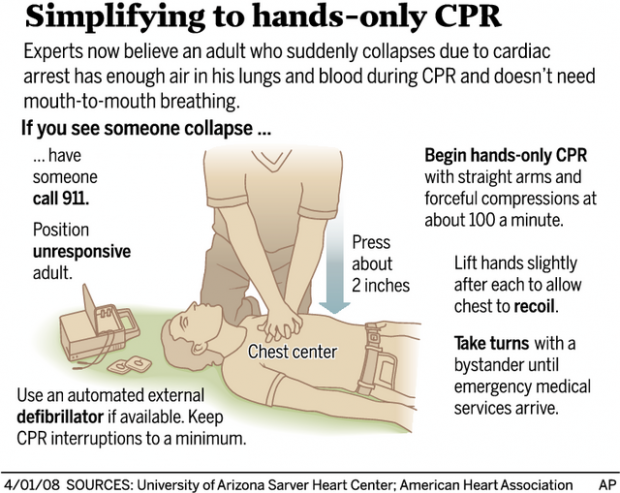
No longer do you have to give mouth-to-mouth to save a life. Simply pushing fast and hard on the victim's chest works just as well — and likely better, national experts now agree.
In a surprise move on Monday, the American Heart Association finally adopted what is known as the "new CPR" or "hands-only CPR," long advocated by the University of Arizona scientists who developed it.
In a major policy statement issued Monday, the association urged anyone who sees an adult collapse from sudden cardiac arrest to call 911, then immediately start hard and fast chest compressions if the person is untrained in conventional cardiopulmonary resuscitation (with mouth breathing) or is unsure of how to do it effectively.
That action vindicates years of research and effort by cardiac experts at the UA's Sarver Heart Center showing the far simpler "hands-only" method will save more lives with less brain damage.
People are also reading…
"The impact of this is enormous," said Dr. Robert Berg, a UA pediatric-critical-care specialist at the Sarver Center who co-wrote the Heart Association's statement. "There is no doubt this change is going to save a whole host of lives — our mothers, our fathers, our loved ones — who suffer cardiac arrest, a top killer of U.S. adults. It's simple, it's easy, and it can double, maybe triple, the survival rate."
The Heart Association, which sets guidelines for CPR training throughout the country, made the move based on recent studies in Europe and Japan that showed omitting mouth-to-mouth breathing from CPR doesn't reduce survival rates.
And it will very likely improve survival because more people will be willing to do it, especially on strangers.
Surveys show that a bystander is four times more likely to perform CPR on a collapsed victim if only chest compressions are required. People often are reluctant to give mouth-to-mouth due to fear of infection or confusion about how to do it. So they almost always just call 911 and do nothing.
The result has been decades of dismal survival rates — less than 6 percent — for sudden cardiac arrests that occur outside of hospitals. That means more than 300,000 Americans die of this every year. By contrast, those survival rates almost triple if effective resuscitation is given.
"By using hands-only CPR, bystanders can act to improve the odds of survival, whether they are trained in conventional CPR or not," said Dr. Michael Sayre, chair of the American Heart Association's Emergency Cardiovascular Care committee and associate professor in the Ohio State University department of emergency medicine.
"We want people to know that they can help many victims (of sudden cardiac arrest) just by calling 911 and doing chest compressions. Don't be afraid to try it," Sayre said.
The association has been inching toward this position in recent years. Its last policy statement, in 2005, still called for combination CPR but increased the number of chest compressions from 15 to 30 for every two mouth-to-mouth breaths. Only if someone was "unable or unwilling" to do the mouth breathing would chest compressions only be acceptable.
But the new policy gives equal standing to hands-only CPR, saying it's just as effective. The association took the unusual action of changing its policy two years ahead of schedule because of the recent studies.
"Absolutely delighted" with the move is Dr. Gordon Ewy, a UA physician who has worked with the local research team for 15 years to develop and test hands-only CPR and who has pushed hard to have it accepted and used worldwide.
"We knew from our research that the way to get the heart to survive is by pressing on the chest — your hands are the victim's heart," said Ewy, director of the Sarver Heart Center.
"But what really convinced us was the effect on the brain. Chest compressions get the blood flowing to the heart and the brain, so not only do people survive — they are much more likely to come out of this neurologically intact," Ewy said.
In a sudden cardiac arrest, the victim still has ample air in the lungs and blood, so breaths are not required. But the blood must be circulated to prevent heart and brain death. Chest compressions do that.
Further evidence came from studies showing that laypersons trained in conventional CPR typically take 16 seconds to do mouth-to-mouth breaths in between chest compressions — a possibly fatal delay from the four seconds they're supposed to take.
"I will never forget a woman who was doing CPR on her husband who said, 'Why is it every time I press on his chest, he opens his eyes, but every time I breathe for him, he goes back to sleep?'" Ewy said. "She summed up the situation exactly. The reality is he was coming out of a coma when she pressed on the chest but going back into a coma when she stopped."
Hands-only CPR calls for rapid, forceful chest presses — 100 a minute — while allowing for full chest recoil after each push, until paramedics take over or an automated external defibrillator is available to restore a normal heart rhythm.
This should be done only for adults who unexpectedly collapse, have abnormal or no breathing and are unresponsive. The odds are that the person is having cardiac arrest — the heart suddenly stops — which can occur after a heart attack or be caused by other heart problems.
A child who collapses is more likely to primarily have breathing problems — and in that case, mouth-to-mouth breathing should be used. That also applies to adults who suffer lack of oxygen from a near-drowning, drug overdose or carbon monoxide poisoning. In these cases, people need mouth-to-mouth to get air into their lungs and bloodstreams.
But in either case, "something is better than nothing," Sayre said.
The American Red Cross will continue to teach traditional CPR for cases of both cardiac and respiratory arrest.
"But we do advise on how to perform chest-compression-only CPR for those who are unwilling, unable, untrained or unsure how to perform full CPR," said Pamela King, national spokeswoman for the agency.
To learn 'Hands-Only CPR'
Free classes will be held at Duval Auditorium, University Medical Center, 1501 N. Campbell Ave.:
• Wednesday, 5:30 p.m.
• April 16, 5:30 p.m.
• For the schedule of future classes, go to www.heart.arizona.edu.
• For more information, go to www.americanheart.org/ handsonlycpr.


