As the parent of an adult son who suffers from a serious neurological disorder, Tucson resident Norma Bendshadler has spent months worrying about the novel 2009 H1N1 virus.
Now her anxiety is turning into frustration over getting her son vaccinated.
Bendshadler's 25-year-old son Dustin is not eligible to receive the nasal spray FluMist H1N1 live virus vaccines the county is administering at free clinics because it's not considered safe for people with chronic health conditions.
Dustin is also not among one of the at-risk groups on Pima County's priority list for injectable H1N1 vaccines, and his mother has been unable to find a provider who will give him one.
Bendshadler is not alone. Injectable forms of the H1N1 vaccine began arriving in Arizona this week, but only in very small amounts to doctors, clinics and other providers who ordered them through the state.
People are also reading…
The U.S. Centers for Disease Control and Prevention on Friday said that manufacturing problems have delayed production of the H1N1 vaccine and that the country will be 10 to 12 million doses short of what had originally been anticipated for October.
Arizona, which has a statewide population of 6.5 million, so far has received 70,000 doses of the nasal spray vaccine and slightly more than 100,000 doses of the injectable vaccine.
Pima County officials have not made any announcements about where the public may be able to find the injectable vaccine, which contains a killed virus. County officials on Friday said they received a small shipment of the injectable vaccines this week and expect to give out 400 at a previously scheduled free clinic for the nasal spray vaccine today.
In the meantime, many people with serious health conditions, as well as their parents and caregivers, must play a waiting game.
"We're getting a lot of calls at the department from people who want the H1N1 vaccine. We want them to have it, but they need to be patient," Will Humble, interim director of the Arizona Department of Health Services, said in a news release issued Friday.
"The quantities of vaccine coming into the state continue to grow, but slowly. And in the meantime, use good health hygiene: Stay home where you are sick, cover your cough and wash your hands thoroughly."
Bendshadler has kept her son home from his day program and other activities for the last three months, fearing that if he contracts H1N1 he could become seriously ill or even die.
To date, 39 Arizonans have died as a result of the novel H1N1 virus, including two children and one young adult in Pima County, all three of whom had underlying health conditions.
Though the H1N1 strain so far has not proven to be any more lethal than the regular seasonal flu, it has been disproportionately affecting children and young adults. At least 81 children nationwide have died of novel H1N1 this year, the CDC reported this week.
Of the Arizonans who have died of H1N1 this year, eight have been children under the age of 18.
Those with chronic health conditions, particularly asthma and other chronic lung conditions, appear to be at a higher risk. Of the total 39 Arizonans who have died of H1N1, 24 have had at least one underlying health problem.
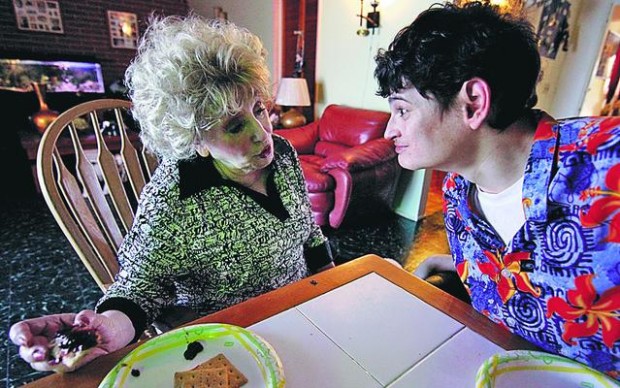
Dustin Bendshadler suffers from Angelman syndrome, a neurogenetic disorder that often results in developmental delays. In Dustin's case, he cannot walk on his own, suffers seizures and does not speak. He's also extremely susceptible to illness and almost died from a bout with pneumonia when he was 12, his mother said.
"He's very delicate and small, he weighs about 100 pounds," said his mother, who adopted Dustin when he was 6. "I've been calling all over the place and getting different answers. I can't find out anything and I'd sure like an answer."
Tucson retirees Barbara and Robert Mashburn are also concerned. Both suffer from heart conditions and are therefore not eligible for the live viral nasal spray vaccine. The Mashburns, upon hearing that injectable H1N1 vaccines had begun arriving in the county this week, called their doctor. But they were told their doctor didn't order any of the injectable vaccines.
Now they are wondering where to turn. Barbara, 68, says they are both washing their hands, and carrying hand sanitizer with them wherever they go. She has considered wearing a surgical mask when grocery shopping but so far has stopped short of doing that.
Similarly, retiree Joan Lowell said she's avoiding crowds, limiting her socializing and taking hand sanitizer with her wherever she goes. Lowell, 68, has pulmonary problems and is on supplemental oxygen at all times. Like the Mashburns, Lowell has called her doctor and the specialists who treat her and so far has no answers about the injectable H1N1 vaccine.
"I got the seasonal flu shot but this is really worrisome," Lowell said. "As soon as my grandkids get a sniffle or anything, my kids have to keep them away from me. I'm concerned, really, for my life right now."
Norma Bendshadler has kept Dustin at home and out of his day program for the past three months. Though he loves to go to the bowling alley, she's keeping him home from doing that, too.
"He's cute as a bug and I love him to pieces," she said. "I'm just very worried and concerned right now."
State and federal health officials are recommending getting two vaccinations this flu season — one for the regular, seasonal flu and another for novel H1N1, when it's available, of course. Antibodies will immediately begin developing after the vaccine is administered, but it typically takes eight to 10 days to be fully effective, health officials say.
The only type of influenza circulating right now in Arizona is novel H1N1, state health officials say. Arizona is one of 41 states where the virus is "widespread," and it's being blamed for increased volumes in local emergency rooms and a 10 percent absenteeism rate in the Tucson Unified School District, which is double the rate at this time last year.
People who are normally healthy and think they may have the flu are advised to stay home, drink lots of fluids and treat the symptoms. Most people will recover from H1N1 without medical intervention. Anyone who feels worse after a day or two or has trouble keeping fluids down should contact their doctor.
Immediate medical attention is advised for anyone who is having problems breathing, having chest pains or can't take care of themselves. If children are sick and become less responsive or cannot hold down fluids, state officials advise contacting a health-care provider right away.
Free walk-in Pima County H1N1 nasal spray vaccine clinics
• Today, 9 a.m. to 1 p.m., at 6920 E. Broadway in Tucson, Suites G and E. For more information, call 298-3888.
•●Tuesday, Oct. 20, and Thursday, Oct. 22, from 10 a.m. to 7 p.m. at Tucson Electric Park, 2500 E. Ajo Way.
●* The nasal spray vaccine is being administered only to eligible populations — healthy children and young adults between the ages of 2 and 24; health-care workers who are 50 years old or younger; and adults under the age of 50 who care for infants younger than 6 months.
**The county has a limited supply of 400 injectable H1N1 vaccines for Saturday's clinic. The nasal spray vaccine is NOT recommended for pregnant women or anyone with a chronic health condition. The injectable H1N1 vaccine is available from some providers who requested it, but supplies at the moment are extremely limited.
Who's most vulnerable to novel H1N1?
The U.S. Centers for Disease Control sand Prevention's Advisory Committee on Immunization Practices recommends that the following at-risk groups receive the vaccine before others: pregnant women, people who live with or care for children younger than 6 months of age, health-care and emergency medical services personnel with direct patient contact, children 6 months through 4 years of age, and children 5 through 18 years of age who have chronic medical conditions. The Pima County Health Department says children and young adults from 5 to 24 years of age are also a priority group because those populations have an increased likelihood of spreading the virus.
Thimerosal Concerns
There's some concern from critics that the novel H1N1 vaccines contain thimerosal, which is a form of mercury. The U.S. Centers for Disease Control and Prevention says the threat of danger from thimerosal is small. However, it has produced some vaccines for both the seasonal and the novel H1N1 virus that do not contain it. Federal officials say anyone getting a flu shot who doesn't want thimerosal in it should tell the provider. While it may be necessary to try more than one provider, officials say anyone in the U.S. who wants a thimerosal-free shot should be able to find one.
Resources
For additional information regarding seasonal flu and the H1N1 virus, call the Pima County Health Department's flu information line at 243-7800 or 1-866-939-7462. The federal government has a flu resource Web site at www.flu.gov