SAN MIGUEL — Drivers taking Indian Highway 19 south from Sells to the U.S.-Mexico border must be alert for hazards — namely, cattle.
One SUV parked along the side of the road awaiting a tow truck lost a battle with a cow.
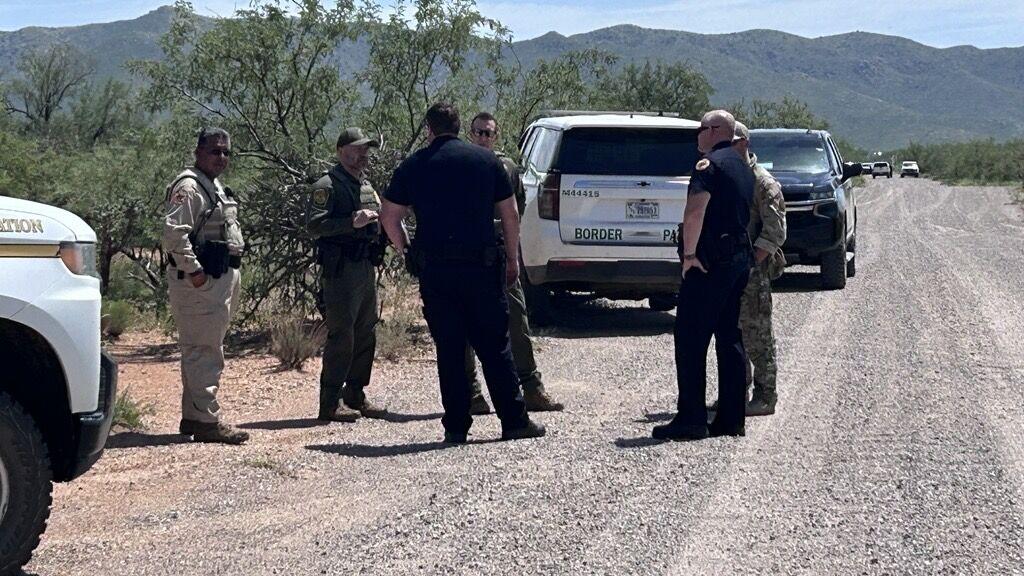
About 2 miles north of the border, a new housing development was in progress. A large Border Patrol facility sits nearby, and its distinctive white-and-green vehicles outnumber tribal police vehicles; both patrol the region to protect the population.
It's one sign that the 37,000-member tribe is making significant progress in securing its 62-mile stretch of the border, restoring order to a region of the border that was at one time challenged to keep from being overrun by narco and human traffickers.
Another sign, as observed by a group of reporters visiting the Chukut Kuk District: the pristine desert landscape on both sides of a series of physical barriers. Those barriers range from Normandy vehicle barriers to post-and-beam steel and concrete fencing and, finally, to closely spaced bollards rising more than 6 feet and sunk 10 to 15 feet deep, which would prevent virtually any vehicle less than an armored tank from busting through.
People are also reading…
The southernmost district of the American side of the Tohono O'odham Nation is the home of Chairman Verlon Jose, who led the tour along a nearly 20-mile stretch of the border on Sept. 3.
East of the San Miguel Gate, one of the nation's traditional routes into Mexico, the desert turns even greener as the land rises toward the Baboquivari Mountains. A light breeze kissed the tips of the ocotillo, creosote and mesquite in the lush landscape. Saguaro, prickly pear and other desert plants are thriving. Nary a piece of trash or trampled ground could be seen while traversing a dirt road paralleling the border and the terrain beyond.
The concrete and steel bollards that frame the San Miguel Gate give way to the post and beam fencing, then to the vehicle barriers at the foot of the Baboquivari Mountains, where the line of distinctive X-shaped posts supporting horizontal girders ends. Jose said the land east of the barriers is impassable to vehicles.
Placement of those barriers took a year of negotiations with elders to avoid harming lands or cultural assets, Jose said.
Though a partnership between Tohono O'odham and the Border Patrol has resulted in a 95% reduction in illegal border entries, Customs and Border Protection officials are still intent on overrunning tribal objections to build a 30-foot-high wall across the entire 62-mile southern border of the tribe's land base.
Tohono O'odham say their plan to secure their border is working, yet the feds insist on building a wall
The tribe had provided lands for a checkpoint, forward operating bases and integrated fixed towers to the Border Patrol to facilitate critical electronic surveillance efforts, Jose said.
It was an effort to secure the community from being subject to home invasions, terrorizing tribal members, destroying sensitive lands with abandoned vehicles and trash, and smuggling people and drugs through the reservation. Tohono O'odham spends about $3 million annually to supplement the Border Patrol, which also has a significant presence on the tribe's lands.
And they say their plan is working: Encounters declined by 62% from 2025 to nearly the end of the 2026 fiscal year in the Tucson Sector as a whole. The federal fiscal year runs from Oct. 1 to Sept. 30.
The tribe estimates it's about 95% in their area of the border.
"We see some migrants but not like before," said Mario Saraficio, the tribe's executive director of public safety. He oversees first responders, corrections, emergency services and environmental protection. "Maybe one or two, and they're mostly intercepted by the Border Patrol."
Also, he said, the hospital in Sells is no longer swamped with injured or dead migrants, which impacted care to tribal members.
Saraficio said his staff has a good working relationship with local Border Patrol agents. The two agencies work together to patrol and apprehend offenders.
Jose said the tribe was negotiating with the Border Patrol for ground sensors when CBP announced that it would commence construction of the 30-foot wall.
"It's clear that operational control comes from the White House's website," he said.
Officials said that a 60-foot band of land along the border in California, Arizona and New Mexico, called the Roosevelt Reservation, included the Tohono O'odham's lands, which they said justifies entering the reservation to build a bigger wall.
However, an administrative memorandum issued by President Donald Trump in April 2025 authorizing use of the Roosevelt Reservation for border security excluded "Federal Indian Reservations."
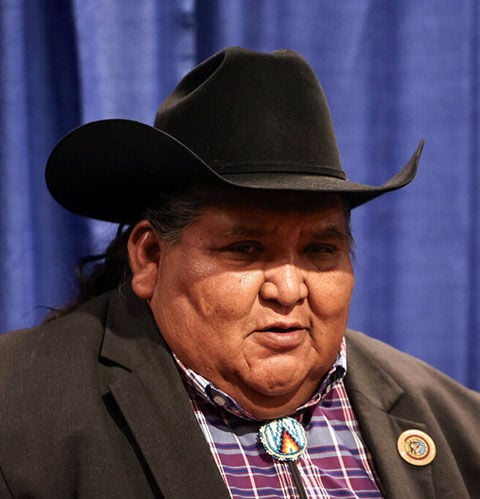
Jose
Their homes have become safer due to fewer migrants seeking food, water or money. Their tribal hospital in Sells no longer overflows with injured or dead migrants. The land is healing from vehicle and foot traffic. But the push for border security has come at a human cost to some tribal members who have faced harassment by the Border Patrol.
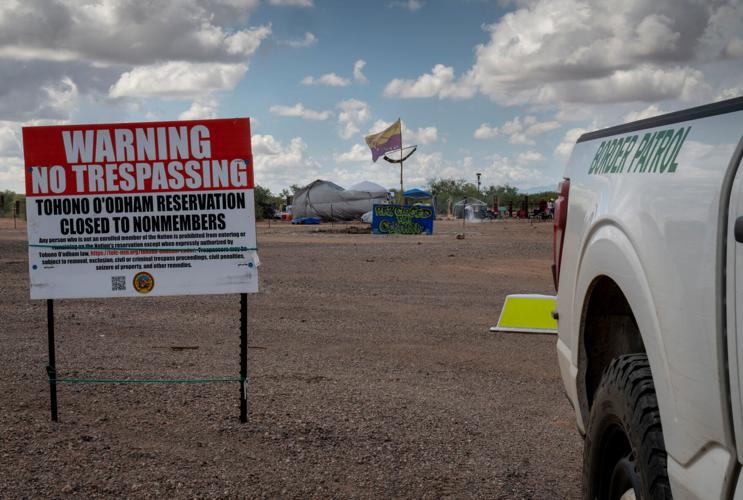
O'odham members have been holding a prayer vigil at the Tadai Me:i, or Roadrunner Fire Camp, at the San Miguel Gate since Aug. 9, when the tribe issued a no-trespassing ordinance.
CBP ignored the directive and sent in masked and armed agents who accompanied construction crews as they entered O'odham land on Aug. 25 to perform preconstruction activities in advance of building a 30-foot wall across the entire expanse of Tohono O'odham's border.
While Tohono O'odham people continue advocating for protecting their lands, another group is protecting the last of a stand of cottonwood trees in Lochiel. The group Rally for the Valley has about two dozen people encamped at the tree in an attempt to keep it from being bulldozed for wall construction.
Big Bend: Opposition results in brief pause
The scene is different in South Texas.
In August, CBP issued a pause on wall construction until Sept. 30, after a coalition of ranchers and business owners, local officials, landowners, environmentalists, some Republican voters and a Native rights group formed by non-federally recognized peoples advocated against any construction in the 517-mile sector. That area includes Big Bend National Park, Big Bend Ranch State Park and many privately owned ranches and homesteads.
During an online press conference on Sept. 2 by wall opponents, Val Verde County Sheriff Joe Martinez said that, like others in the region, he's open to commonsense approaches like a smart wall, but not to a wall that would impact the lives of his friends and neighbors.
"We have rock art sites that will be destroyed or tampered with," he said. "Ranches will be split and homesteads stranded on the south side."
Martinez said he would personally tour people to see the canyons, which have irreplaceable rock art sites.
Dinah Bear, an attorney and consultant specializing in federal environmental law and Southwest border issues, identified key differences between Big Bend and O'odham trust and ancestral lands.
First is the region's geography. "There are cliffs as high as 1,500 feet bordering the Rio Grande," she said. The rugged terrain on both sides of the border clearly accounts for why the Big Bend Sector has the lowest apprehensions along the border, according to CBP, Bear said. Land in Arizona is mostly more open than in the Big Bend area.

Trespass signs are posted at the San Miguel Gate prayer camp on the Tohono O'odham Nation.
A second factor is the status of part of the Big Bend area as a national park. "There are many other public lands being seriously damaged along the border — national wildlife refuges, national monuments, national memorials — but people rally around a national park more than any other type of public land designation," she said.
Then there's the near-unanimous bipartisan opposition to CBP construction. "The border sheriffs and border county judges, including stalwart Republicans who have advocated for border security for years, are against what was proposed for Big Bend," she said.
"Indeed, it’s my understanding that Gov. Greg Abbott is taking credit for pausing construction."
The final factor: proposed vehicle barriers instead of a wall at Big Bend. In other cases, border wall opponents concerned about its adverse effects on communities, wildlife, water, historic sites, religious sites and other issues do not oppose vehicle barriers, she said.
"Vehicle barriers have been helpful in stopping people driving into wilderness areas and other protected areas, and they don't block wildlife or use 700,000 gallons of water a day during construction," such as what the last wall consumed, Bear said.
"But vehicle barriers make no sense at Big Bend," Bear said.
"Imagine if the Grand Canyon was at the border and the South Rim was the boundary line. It would be like putting the vehicle barriers on the North Rim. People would have to go down the Canyon and up the Canyon with a car."
And people like Bear are sounding the alarm over the massive amounts of taxpayer dollars being handed out with no safeguards to ensure responsible use of those dollars.
"Congress appropriated $46.55 billion for border wall construction in the 2025 reconciliation bill known as the Big Beautiful Bill," she said. "Since 2021, the Department of Homeland Security has waived 35 statutory provisions and 18 regulations or whole sections of regulations that govern federal procurement and contracting."
DHS waived 24 laws and 10 regulations for every sector along the border in 2025.
"That means that $46 billion is going out the door without the usual safeguards that Congress mandated for taxpayers' money," Bear said.
At the time, then-Homeland Security Secretary Kristi Noem said the move was essential because "the Tucson Sector is an area of high illegal entry where illegal aliens regularly attempt to enter the United States or smuggle illicit drugs."
However, as Jose pointed out and as is borne out by CBP's own statistics, the number of encounters has greatly declined in the Southwest from 2.476 million during fiscal year 2023 to 443,671 in fiscal year 2025, the latter with final numbers — a drop of about 82%.
"When they built the wall, they said that the 62 miles here was going to create a funnel effect because there was going to be a gap and then everybody was going to come through here," Jose said. "That didn't happen."
Jose: 'The wall is a political move'
Jose said the rush to build a 30-foot wall through his tribal lands was a political move. And he fears that building a wall that has been proven to be easily breached will not only cause environmental and cultural damage but render it even more difficult for the 3,000 members on the other side of the gate to access services.
The three gates that O'odham people have used to move back and forth are currently under an informal agreement with the government, with only O'odham tribal members allowed through to access services like health care.
Back at the San Miguel Gate, a helicopter hovered overhead as the tribal delegation stopped at the Tadai Me:i prayer camp.
To access the north side of O'odham lands, tribal members who are citizens of Mexico can use the gate but only to travel within reservation borders, Jose said. "They can only enter the reservation to get services like domestic services, health care, education and other such services," he said. That requires a phone call, or if the tribal member lacks a phone, ringing a special bell on the gate, which is kept locked except for passage.
To use a port of entry, they would have to request a permit to enter the United States. The permits, known as I-94 permits, would be coordinated through the tribe, Jose said. "They'll issue them a permit for a day, a couple days, or however long they need to be here."
The Big Beautiful Bill instituted a $1,000 "parole" entry fee for visitors who don't have documentation like a visa or other authorization documents. And that's per trip.
Jose said one elder walked through the wash nearby to catch a ride to Sells. "The government apprehended him and they deported him back to Mexico, and released him in Nogales," he said. "This guy doesn't speak English. He speaks a little bit of Spanish, but mostly speaks O'odham."
The elder had no money or way to call for help, so he had to try and hitchhike home. It took about a week.
"But there's an elder lost out there. And bad things happen out there," Jose said. "But we have to go through it, because of this political ploy to build these barriers that separate our people, separate our families, separate our members."

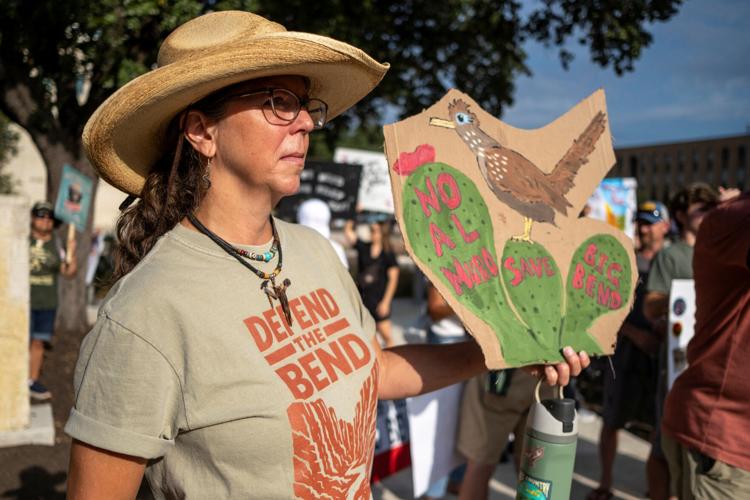
Shea Cockrell was among protesters who rallied in August outside the U.S. federal courthouse in San Antonio, Texas against border wall construction in Big Bend National Park.
"When the construction was announced to come here, we immediately came down to set up this prayer camp because we've seen what kind of destruction is happening on either side of us," said O'odham member Amy Juan, one of the residents. "And so we felt that it was important to ready ourselves and ready our people for whatever is coming."
"If I went to your home and built a wall right straight through the middle of your home, you wouldn't like that," Jose said. "If I separated your family and you couldn't see each other, you wouldn't like that."
Jose said that instead of a wall that is easily breached with an angle cutter, the government could resolve the border issue with two steps.
"First, America needs to kick its drug habit," he said. "There's a demand for drugs here. And so whenever there's going to be a demand, there's gonna be a supply." Instead of spending billions and billions of dollars on the wall, he said, rehabilitation and education centers could help stem the demand.
The other step: immigration reform. People come to the country to work and send money home, but they also want to go home, he said. Others are fleeing war-torn countries.
In any case, Jose said, "Whatever we have right now is not working."


 Saguaros marked for removal on Tohono O'odham Nation as tribe fights wall