Tensions are escalating between the Tohono O'odham Nation and U.S. immigration authorities amid the Trump administration's push to build 30-foot-tall border-wall barriers along the Nation's southern boundary with Mexico, despite the tribe's objections.
Early Tuesday morning, 20 armed, masked agents from U.S. Customs and Border Protection entered the Tohono O'odham Nation's land, accompanying border-wall contractors as they began wall construction activities, tribal leaders say. The contractors' unauthorized presence on tribal land continued into Wednesday.
"These illegal actions by border wall contractors put decades of successful partnership in jeopardy," Tohono O'odham Tribal Chairman Verlon Jose said in a statement Wednesday. "As the federal government knows, effective border security relies on modern technology, not outdated and expensive static border walls. This overreach by the Trump administration must stop, and our sovereignty, along with tribal sovereignty across the country, must be respected."
People are also reading…
The contractors' entry onto Tohono O'odham land comes two weeks after the Nation's leaders posted "No Trespassing" signs at its entrances, in anticipation of border-wall construction beginning despite the Nation's vehement opposition.
"The contractors, who are on the Nation illegally, were accompanied by agents as they worked on three separate locations near the border with drill trucks to conduct soil sampling and other activities," tribal leaders said in a social media post Tuesday night.
CBP, the parent agency for Border Patrol, also deployed Border Patrol's tactical unit, known as Bortac, to protect the border-wall contractors as they start drilling work, tribal leaders said in the post. CBP says Bortac is used in "emergent and high-risk incidents requiring specialized skills and tactics."

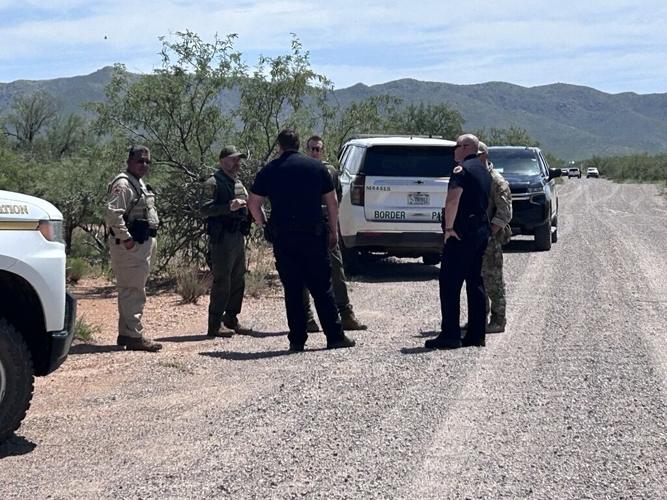
Tohono O'odham police officers talk with U.S. Customs and Border Protection agents at one of three "pre-construction" sites where border-wall contractors have started work this week. Tribal leaders say CBP agents and contractors illegally entered the Nation's land this week to start survey work on the construction sites.
In an emailed statement to the Arizona Daily Star, CBP Commissioner Rodney Scott defended the agency's actions.
CBP "is moving forward with a 62-mile project to close a longstanding border security gap in southern Arizona, known as the Tucson 5 project," Scott said in the Wednesday statement. "The project will close one of the most dangerous smuggling and trafficking corridors on the Southwest border: remote desert that has facilitated decades of drug loads, migrant deaths, and cartel activity. Congress funded this work, a Federal court has affirmed it, and CBP is carrying it out under the legal authorities that apply."
Bureau of Indian Affairs personnel are also on the Tohono O'odham reservation this week, and south of the border, Mexican police are working in coordination with the Department of Homeland Security, CBP's parent agency, to protect the worksite from the southern side, tribal leaders said.
U.S. authorities have also deployed a "tethered balloon" for "enhanced monitoring," the tribe said in the social media post.
Tohono O'odham police have been on the scene, tribal officials said, but CBP set up a vehicle blocked to prevent the tribal police from issuing citations or removing contractors.
'Prioritize personal safety'
So far, interactions between tribal police and federal law enforcement have been "peaceful and professional," the tribe said in the post.
Tribal members should avoid escalating the tense situation, as the Nation's leadership confers with their legal team "to determine what can be done to deescalate the situation, remove unauthorized individuals from our land, and move forward with appropriate legal filings," the post said.
"We want to stress the importance of the safety and well-being of our tribal citizens. We encourage all Tohono O'odham on both sides of the border to remain vigilant and prioritize their personal safety," the post said. "We support tribal members who choose to exercise their first amendment rights of free speech and the right to peacefully protest."
The Nation has also received messages of solidarity from supporters within and outside of Arizona, Chairman Jose told the Star Wednesday afternoon.
"Regardless of race, color and creed, we’ve been getting calls about standing with the Tohono O’odham Nation," Jose said in an interview. "This has been our land, this has been our home since time immemorial, and the destruction that will be caused, you couldn’t even put a dollar value on it to us."
The Nation is preparing to ensure that everyone remains safe if larger protests occur as construction work increases, he said. So far, CBP has only undertaken preliminary survey work, which CBP said would be completed by Sept. 4, Jose said.
"But I think once we see machinery start to roll in, I believe it's going to escalate on both sides," he said. "They’re gonna escalate in moving dirt, destroying the land, and so will the people."
Jose told the Star in April that the federal government's efforts to build not just one, but two border walls through the tribe's ancestral lands, which stretch into Mexico, were a "betrayal" of the tribe's trust, after decades of collaboration between the Nation and U.S. authorities on border security.
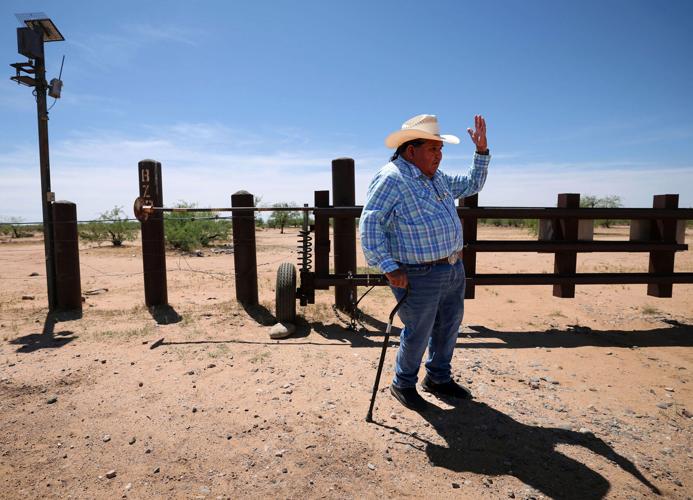
On Wednesday, social media posts shared by tribal members showed a caravan of apparent CBP vehicles converging around the area of the San Miguel Gate, one of three openings along the Nation’s 62-mile stretch of border where enrolled tribal members can pass through the low-lying vehicle barriers that currently line the Nation's southern boundary.

Tohono O'odham Nation Chairman Verlon Jose is pictured in April near the San Miguel Gate, one of three gates on the reservation's southern boundary that allows tribal members to visit ancestral lands in Sonora, Mexico. Tribal leaders said masked, armed CBP agents and border-wall contractors "illegally" entered Tohono O'odham Nation land Aug. 25 and Aug. 26 to begin work on the border-wall project that is strongly opposed by the tribe.
Mexican police can be seen just south of the border as U.S. construction crews operate drilling equipment, with drones and a helicopter circling overhead, according to photos and videos shared by the Instagram account Tadai Me:i.
Tucson Democratic Mayor Regina Romero and the Tucson City Council unanimously approved a resolution in July opposing border wall construction on the Tohono O'odham Nation.
"I stand in solidarity and respect the sovereignty of the Tohono O'odham Nation and its people," Romero said in a social media video Wednesday. "We are deeply concerned about the impact of the border wall on its people and local wildlife. The city of Tucson urges our congressional delegation to work with Homeland Security to stop construction immediately."
Laws waived for border wall
U.S. Rep. Adelita Grijalva, a Tucson Democrat, said she and other border-region Congress members have sent a letter to DHS and the Interior Department "urging the agencies to suspend construction until meaningful tribal consultation has taken place," she said in a statement, following a Monday town hall discussion in Ajo on border-wall construction.
Grijalva said she also plans to introduce a bill to end DHS's "sweeping authority to waive federal laws to expedite border-wall construction."
DHS has waived dozens of federal environmental and cultural protection laws to allow for rapid construction of its border-wall projects, despite the dramatic decline in the number of migrant apprehensions by Border Patrol since 2024.
That waiver authority has also paved the way for DHS to construct a second border wall near the fragile Quitobaquito Springs in Organ Pipe Cactus National Monument. The spring is home to three endangered species and is sacred to the Hia-Ced O’odham and Tohono O’odham people.
"For the Tohono O'odham Nation, this is not just a border," said Grijalva, who also visited the springs on Monday. "The border cuts through an ancestral homeland that existed long before the United States or Mexico, long before the international boundary was drawn where it is today. It separates communities and families. It makes traditional practices more difficult. It places enormous pressure on lands and places that hold cultural and spiritual significance."
The Tohono O'odham Nation reservation land spans 2.8 million acres, and the tribe has 37,000 enrolled members, both in Arizona and in Sonora, Mexico, where the Nation's ancestral lands stretch south to Hermosillo. The reservation's boundaries were established by a series of executive orders starting in 1917.
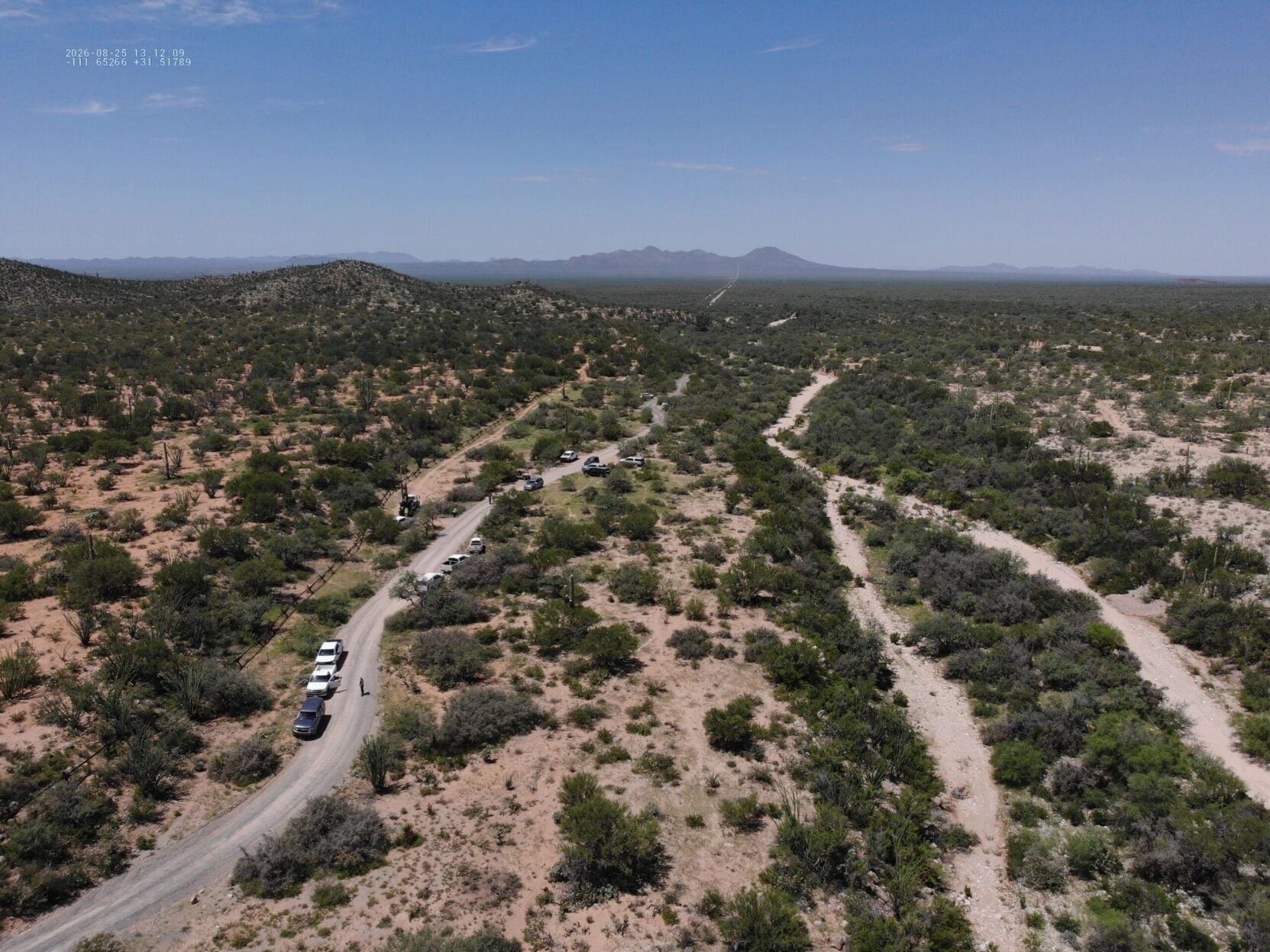
Against the tribe's wishes, border-wall contractors began drilling work on the southern boundary of the Tohono O'odham Nation reservation on Tuesday, tribal officials say. A spokesperson for the U.S. Department of Homeland Security said the work was being conducted on a 60-foot strip of federal land along the U.S.-Mexico border known as the Roosevelt Reservation. But CBP and contractors have to use tribal land to access the sites.
In June, the tribe sued DHS over its plans to build two parallel border walls along the entire 62 miles of the reservation's southern boundary with Mexico, where there's currently only a vehicle barrier, as well as surveillance technology the Nation has approved in collaboration with CBP.
On Aug. 14, a federal judge rejected the Nation's bid to immediately halt construction of the border wall. Judge Richard Leon in Washington, D.C., said the tribe can't stop the planning and construction activities because CBP will be operating on a federal strip of land along the southern border, known as the "Roosevelt Reservation," and that the Nation's concerns are secondary to the need for border security.
"Given the national security and foreign policy considerations related to the border wall, deference to the government is warranted,'' he wrote.
Tribal leaders have argued there's no way that the two 30-foot-tall walls DHS has planned could fit into the 60-foot-wide strip of federal land.
In June, CBP awarded a contract to Texas-based SLSCO LTD to build a primary border wall along the Tohono O'odham Nation's southern boundary with Mexico, the so-called "Tucson 5 Project."
CBP's parent agency, the U.S. Department of Homeland Security, received a windfall of funding last year under the "One Big Beautiful Bill," which allocated $170 billion to border security projects, ICE detention and immigration enforcement. That includes $51.6 billion allocated for border-wall construction and Border Patrol checkpoint expansion projects.
Pima County Board of Supervisors Chair Jennifer Allen said Wednesday she was "outraged" by CBP's "armed incursion" onto the tribe's sovereign land.
"I call on the federal government to end this armed incursion of the Tohono O’odham Nation, to immediately leave the Nation’s lands, and to respect the sovereignty of the Tohono O’odham," Allen, a Democrat, said in a statement. "I stand with the Nation and implore U.S. Senators Mark Kelly and Ruben Gallego to do all that they can to investigate this unlawful incursion and seek to hold accountable those responsible."
Contact reporter Emily Bregel at ebregel@tucson.com. On X, formerly Twitter: @EmilyBregel

Emily Bregel
Border reporter


 Plans for border walls on Tohono O'odham land a 'betrayal,' chairman says