Dimas Misael Cardona Bahr works nine-hour days in a Honduras factory, churning out Nike-branded university logo apparel that’s eventually shipped to the United States.
The college football fans who buy it pay more for a single T-shirt than he makes in a day.
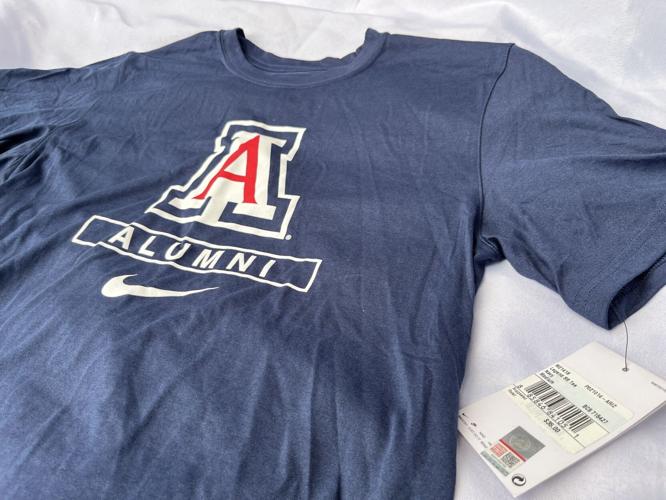
He flinched at the $35 price tag for a polyester University of Arizona alumni Nike T-shirt that his factory helped produce, as he recounted his struggle to afford a modest lifestyle for his wife and two young children on his weekly salary of about 2,400 Honduran lempira - the equivalent of $97. That's slightly below what the Global Living Wage Coalition considers to be a living wage in Honduras.

This $35 Nike T-shirt featuring the University of Arizona logo likely resulted in no more than 21 cents for the garment worker who made it.
“Everything that we have to do, what the struggle is for us in a week, it does not seem fair,” Cardona Bahr, who works in the factory’s ironing press room on upwards of 750 shirts per day, said through an interpreter who works with labor advocates in Honduras. Those advocates put Lee Enterprises in touch with Cardona Bahr. “The truth is no, it is not enough money to really maintain a home. Our salaries are low. We aren’t able to cover all of our expenses with this salary.”
People are also reading…
Cardona Bahr and the nearly 1,500 workers at that factory, Southern Apparel Contractors, are one piece of the global supply chain that fuels the estimated $5 billion licensed collegiate apparel business. U.S. universities earn millions each year in royalty revenue from sales of licensed gear, though it represents a small percentage of the schools’ overall revenue.
Top schools like Ohio State University and the University of Alabama pulled in nearly $14 million and $12 million, respectively, last year alone from royalties. Other Division I schools like the University of Nebraska and the University of Wisconsin-Madison made more than $3.5 million each.
Worker advocates and apparel industry experts say universities - especially public colleges funded by taxpayers - could do more to protect workers in a system that prioritizes profits.
“At the end of the day, it has their name on it,” said Mark Anner, a labor and employment relations professor at Penn State and founding director of the Center for Global Workers’ Rights. “They have a lot of leverage.”
Over the years, many colleges have taken steps to improve worker conditions in factories where its gear is made. The institutions have created and funded organizations such as the Worker Rights Consortium and the Fair Labor Association, which monitor conditions in overseas factories. They've entered into codes of conduct that are aimed at prohibiting the worst abuses. Some make public the list of factories and countries where their gear is made. Experts agree those changes have had an impact, but say more needs to be done. For example, less than half of NCAA Division I Football Bowl Subdivision universities are part of the WRC and the FLA.
“When a brand makes an Ohio State sweatshirt, a University of Michigan T-shirt, a University of Texas jacket, they are contractually bound to meet a certain set of labor conditions in the factories they use to make that clothing,” said Scott Nova, executive director of the Worker Rights Consortium.
But still, workers in the apparel industry earn poverty-level wages, less than 1% of the final retail price of a shirt, according to estimates by researchers studying the global apparel industry.

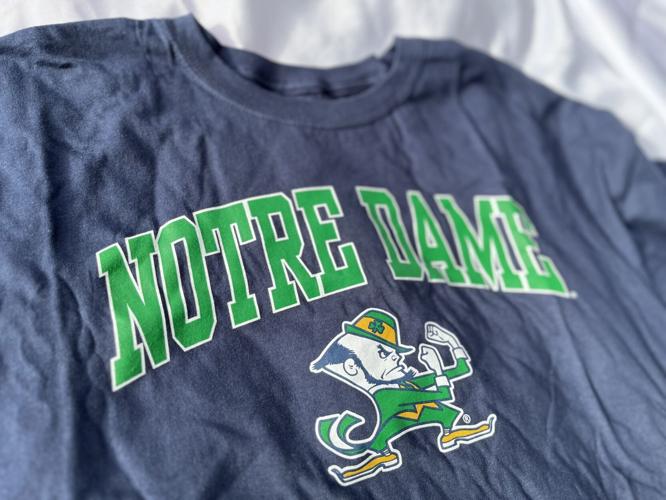
This $21.99 Fanatics-branded University of Notre Dame shirt was made in Nicaragua.
That means for one $21.99 Notre Dame Fighting Irish T-shirt – made in Nicaragua and currently being sold in the university’s online book store – the workers who produced the garment likely earned no more than the U.S. equivalent of 13 cents, while retail markup and brand profit accounted for more than 70% of the final price. The minimum wage there is less than half of what the Global Living Wage Coalition estimates would be enough to cover their expenses.
A $59.99 University of Missouri sweatshirt made in El Salvador resulted in a single worker’s pay of no more than 36 cents. The university pulled in more than $1.8 million in royalties last year.
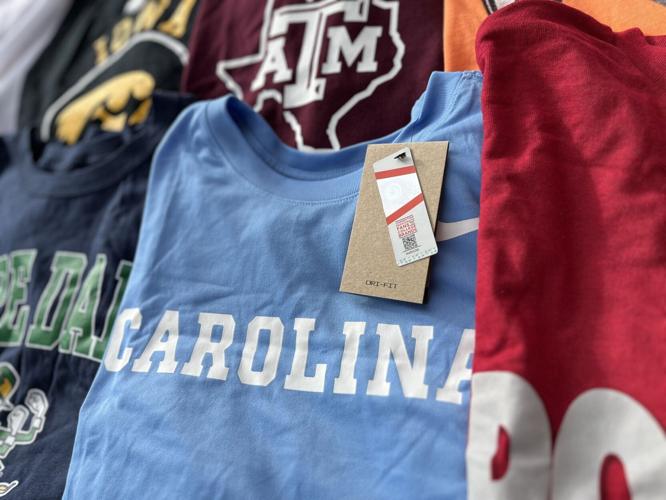
A $35 University of North Carolina Nike T-shirt made in El Salvador resulted in 21 cents for a garment worker, while the university made $4.6 million in royalties last year.
For a $25.99 Honduran-made Oklahoma State University T-shirt, a garment worker made 16 cents.
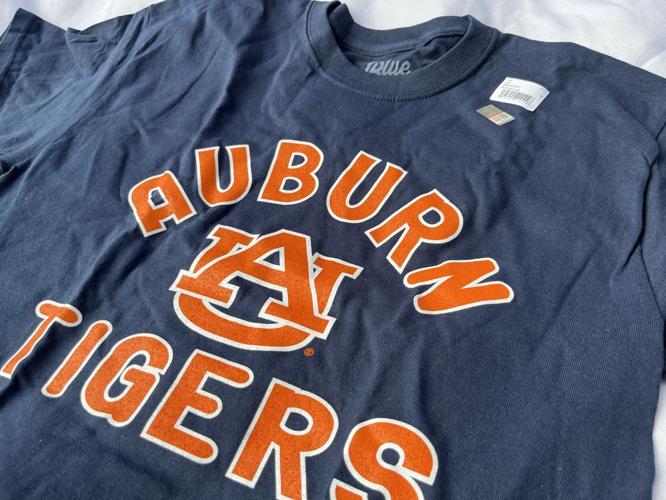
The Auburn Tigers T-shirt selling for $24.99? Fifteen cents.
“We deserve a better salary,” Cardona Bahr said. “We work for very well-known brands and I think the factory could take us more into account. I think the universities could pressure the company. … They’re more concerned about themselves and getting the work done.”
In Bangladesh, garment workers earning a minimum monthly wage of 8,000 Bangladeshi Taka – or $72.50 – are facing poverty so extreme that their food consumption is below what nutritionists recommend, according to the Asia Floor Wage Alliance, a labor group that advocates for garment workers across the continent. Experts have estimated a living wage there is at least $200 per month.
“They work with empty stomachs,” said Sultana Begum, a former Bangladeshi child garment worker who is now an activist with the Green Bangla Garments Workers’ Federation, a group that fights for higher wages, building safety and worker rights. “On the other hand, the owners of the garment factories lead a luxurious life.”
Along with poverty, workers making university logo T-shirts, hoodies and more continue to face harsh conditions including wage and severance theft, unsafe conditions, sexual harassment and threats of violence over unionizing.
“We continue to see labor rights violations in a lot of university factories," said Nova, whose monitoring organization is funded by about 175 top U.S. universities – including the universities of Arizona, Virginia and Wisconsin – that helps to identify and rectify problems in factories and the entire apparel industry, where university logo apparel is made alongside gear for professional sports teams and other fashion brands.
“It’s a model defined by tremendous pressure placed on the factories by the brands and retailers to produce cheaply and quickly,” Nova said.
A Lee Enterprises Public Service Journalism Team analysis of records from U.S. universities and investigative reports by workers rights organizations, along with interviews with university licensing officials, global apparel-industry experts and garment-worker activists, found:
- Wage theft, union-busting, harassment, poverty wages and other abuses are rampant at factories making university logo apparel, despite efforts made by colleges over the years to try to improve conditions for workers.
- The biggest apparel brands, including Nike, have resisted efforts to resolve worker complaints, even in cases where the abuses are well-documented. Advocates say universities haven’t put enough pressure on powerful brands that could make change in the industry.
- Many colleges do require their apparel licensees to adhere to manufacturing codes of conduct that forbid things like child labor, but enforcement of such codes is spotty, and the result is that some violations go unchecked. Colleges rely on external monitoring organizations including the Worker Rights Coalition and the Fair Labor Association, along with private licensing agencies like the Collegiate Licensing Company, to catch violations at thousands of factories across their supply chain.
- Many brands and universities are reluctant to talk about the issue. Brands including Nike and Colosseum did not respond to requests for comment about their manufacturing standards and labor rights issues. And several Division I universities – including Auburn, Clemson, Penn State, and Arkansas – did not respond to questions or public records requests about their licensing standards and practices.
Some university officials say other large institutional buyers – such as professional sports leagues – need to work with them to spur real change in an industry with so many different players who profit off cheap labor, from retailers to clothing brands to factory owners. Stricter U.S. trade policies could also help, advocates say.
“It’s a little distressing that it’s being left to us,” said Kyle Muncy, licensing director for the University of Connecticut, a college considered to be one of the leading advocates for better garment worker conditions. “This can’t continue to be just a university endeavor. That continues to be the biggest challenge we have on a regular basis. … We need more people in the village.”

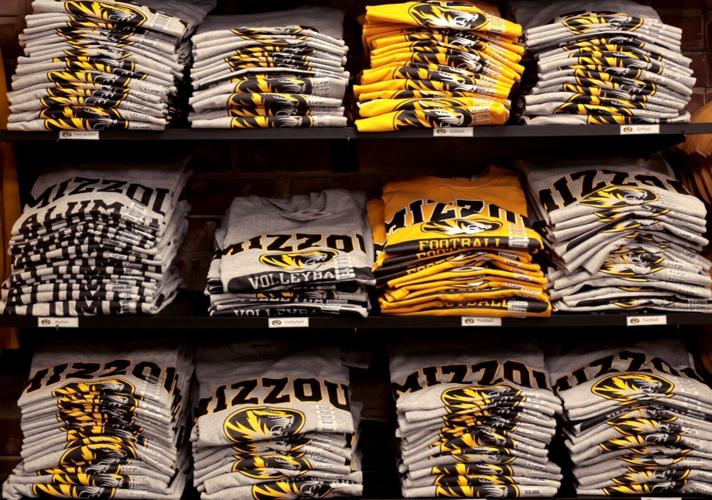
University of Missouri athletic gear — jerseys, sweatshirts, t-shirts and hats — are on sale before the start of a football game between Missouri and LSU on Saturday, Oct. 7, 2023, at Tiger Team Store at Memorial Stadium in Columbia, Mo.
Factories rife with problems
Take the case of Hong Seng Knitting, a garment factory in Bangkok, Thailand, and former Nike supplier that made gear bearing the logos of at least two dozen NCAA Division I FBS colleges, including some of the top names like Alabama, Texas and Duke. In 2021 the Worker Rights Consortium uncovered what it describes as an “illegal wage theft scheme” that took place at the factory in 2020 in the wake of the COVID pandemic. Lee Enterprises was unable to reach factory officials.
The WRC said factory management compelled workers to sign a form stating they wanted to take voluntary unpaid leave instead of receiving a lower wage during periods of low production – which they are legally owed. It caused affected workers to lose more than 15 days worth of wages.
“The factory coerced workers to acquiesce to this scheme and retaliated against workers who spoke up against it,” according to the WRC. “There is overwhelming evidence that the leave was involuntary and that the scheme was illegal.”
All told, more than $800,000 is still owed to more than 3,300 impacted workers. Those wages are significant for the workers, but represent just 0.01% percent of Nike’s annual profits of more than $5.1 billion in 2022.
But Nike to date hasn’t resolved the issue, despite pushes from the WRC, its member universities and other advocacy groups and a ruling supporting workers from the Thai government. The apparel giant did not respond to multiple requests for comment from Lee Enterprises about Hong Seng Knitting workers’ lost wages and broader issues of labor rights violations at Nike-associated factories.
“We need more pressure from universities on Nike if it’s going to get resolved,” Nova said. “Ultimately Nike has to believe that if it does not comply with university labor standards, it will face economic consequences. … Obviously, the pressure hasn’t been enough because they haven’t fixed the problem.”

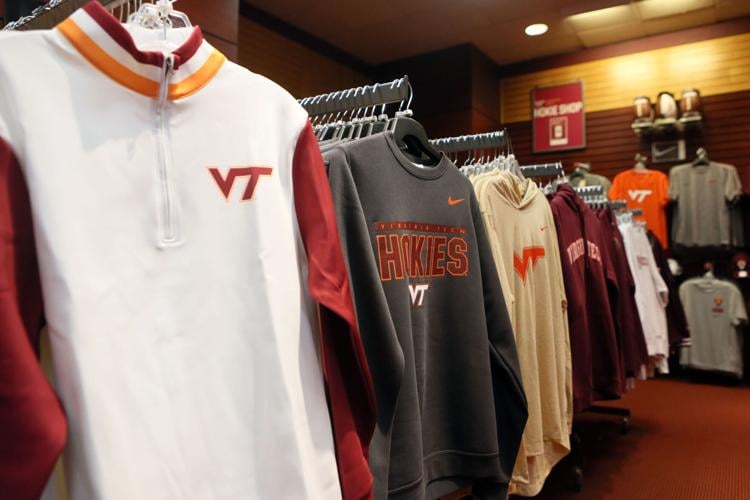
Virginia Tech licensed apparel for sale in the Lane Stadium Hokie Shop prior to the start of the Pittsburgh Virginia Tech football game in Blacksburg, Va., on Saturday, Sept. 30, 2023.
Lee Enterprises asked 10 of the top Division I universities – Oklahoma State, Illinois, Missouri, Virginia, Penn State, Duke, North Carolina, UCLA, Wake Forest and Virginia Tech – if they’ve engaged with Nike over the Hong Seng Knitting case.
None responded as of Oct. 25 – except Virginia Tech.
A Virginia Tech spokesman said in a statement that it “continue(s) to monitor and review this matter and we will continue to work with the WRC and its membership to hold all of our licensees to the high standards we have in place.”
It’s a challenge because Nike is “an important business partner” for universities but also the “toughest brand to deal with,” Nova said. More than half of FBS schools have apparel deals with Nike, which pays many of them millions per year. The University of Texas’ 15-year Nike deal alone is worth $250 million to the school.
“But the test of the system is ultimately not how they perform in the easiest cases,” Nova said. “Workers are owed that money. They need to be paid.”
The alleged wage theft at Hong Seng is just one example of what workers making college logo gear face on an ongoing basis. Investigations published by both the WRC and FLA this year detail illegal firings of union officials, discriminatory practices against the LGBTQ+ community, unsafe work areas and wage theft at factories around the world.

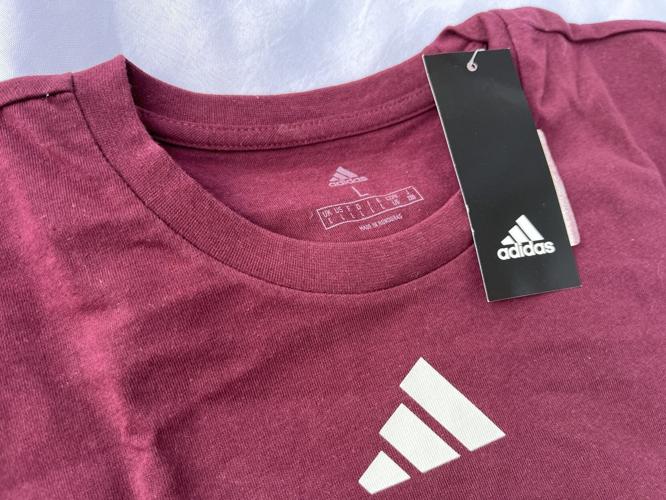
This $30 Adidas-branded shirt likely resulted in no more than 18 cents in pay for the worker who made it.
In another case, a WRC investigation alleges a former Adidas supplier in Cambodia illegally fired workers and denied them severance in violation of Cambodian law. The WRC noted “no corrective action has been taken,” despite asking Adidas and other suppliers to get involved. In a statement, an Adidas spokesman said follow-up investigations were “unable to find any legal non-compliance” and that the company is “committed to fair labor practices.”
A factory making ‘47 Brand college logo apparel in El Salvador subjected LGBTQ workers to discriminatory practices, fired union officials, and was inconsistent with payment of medical leave, according to a Fair Labor Association investigation. The brand told Lee Enterprises that it “proactively moved to implement” remediation but that it could not comment further due to ongoing legal proceedings.
At the Honduras factory where Cardona Bahr works, Southern Apparel Contractors, which is owned by U.S. company Tegra Global, workers in 2022 were forced to pay back the company a day of lost wages that occurred after a national transportation shutdown, in violation of their collective bargaining agreement. More than 200 workers organized a spontaneous work stoppage to protest, leading the company to suspend some of them without pay, according to the Worker Rights Consortium.
“We were punished for a week,” Cardona Bahr said. “It had a big impact for me and for my colleagues who experienced the same thing. We were angry because this kind of situation had never happened before. It was very difficult, that one week of suspension. I was home, no work, and didn’t have any income for that week.”

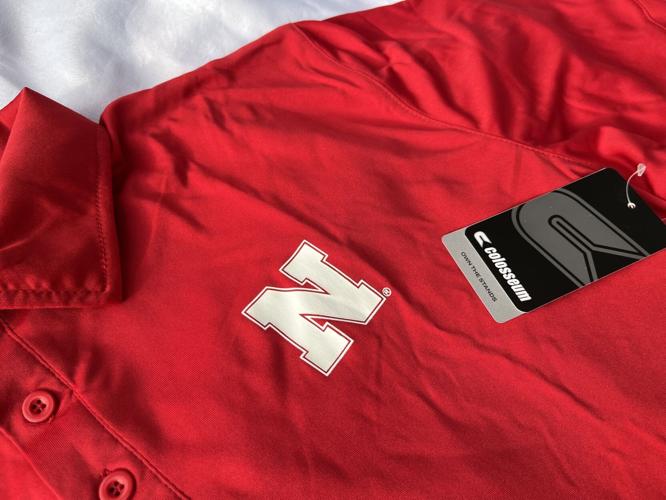
This University of Nebraska-Lincoln shirt was made in China. It's selling for $39.99. A garment worker likely was paid no more than 24 cents to make it.
Eventually, with pressure from the WRC and the workers’ union, the situation was resolved and the workers including Cardona Bahr were repaid and reinstated. In that instance, the WRC was able to prove the company’s actions were in violation of Honduran law, and brand and university codes of conduct. A Tegra Global official declined to comment further on the incident and referred to the WRC’s report.
Despite the steady stream of issues, engagement by universities on the issue appears to vary widely. Of 133 NCAA Division I Football Bowl Subdivision programs, just 53 are members of the WRC and 48 are Fair Labor Association members. Many are affiliated with both groups.
“What they will say is, ‘Our fans don’t care about that, or our students, or that isn’t something that's important on our campus, or in our city,’” Muncy said.
But Muncy said those arguments don’t hold water.
“It's the right thing to do,” he said. “It doesn't cost anything to be engaged. It doesn't cost anything to be more involved. It doesn’t cost anything to have a robust code of conduct and have higher standards. It's a question of whether you want to have some difficult conversations with the brands you do business with.”
Pressure from student activists in the 1990s and early 2000s over sweatshop conditions led dozens of colleges to create manufacturing codes of conduct, the primary enforcement tool that exists today.
But the codes are not created equally and enforcement is spotty. Robert Handfield, professor of supply chain management at North Carolina State University, said most universities don’t have people who specialize in apparel or factory audits, so they rely on the brands to do it.
Muncy, of UConn, acknowledged that campus licensing directors like himself are “not in the factories every day.”
“We are just trying to leverage our relationships when a problem is uncovered and do the best we can to resolve it,” Muncy said. “There is no perfect factory around the world, no matter what levels of engagement you try to have.”

This $35 Nike T-shirt featuring the University of North Carolina was made El Salvador, where a garment worker was likely paid no more than 21 cents to make it.
For example, some U.S. universities – including Michigan, Penn State and North Carolina – have forced their suppliers to sign on to the Accord on Fire and Building Safety in Bangladesh, a binding agreement to improve safety conditions in factories there.
But that agreement only came about after advocates pressured global brands in the wake of the 2013 Rana Plaza disaster, which killed 1,134 people, mostly garment workers, who were trapped in an eight-story building when it collapsed in Dhaka, Bangladesh’s capital city.
Since then, the accord has expanded beyond Bangladesh into Pakistan. Yet 10 years later, the majority of colleges still haven’t required their licensees to sign the agreements.
“Those universities that have not signed, in a very strong word, I would say they’ve contributed, … in precarious working conditions, in unsafe working conditions for workers,” said Kalpona Akter, a Bangladeshi labor activist and former child worker. “They are always welcome to step up and join with (the) Accord or such an agreement that really helps workers.”
And many major brands including Nike, Levi Strauss, Walmart and Amazon, still have yet to commit. Most of those brands did not respond to our requests for comment. Amazon sent a generic statement that it is “committed to ensuring that the products and services we provide are produced in a way that respects human rights and the environment.”
Limited tools for reform
Advocates across the globe bemoan that changing the industry largely falls to them – U.S. and foreign trade policy don’t incentivize better treatment of global garment workers. Organizations like the WRC have limited influence to address poor conditions that are not illegal.
“If there’s a minimum wage violation, we have a basis for taking action,” said Nova, of the WRC. “But if it’s simply workers complaining that their wages are too low, even though they are at the minimum wage, that unfortunately isn’t something that the university codes can address. Wages are too low in the industry all across the world including in the university-related factories, even where the legal minimum wage is being paid.”

This Fanatics-branded University of Notre Dame shirt was made in Nicaragua.
There have been creative attempts in the past to make bigger structural changes, but they’ve been ultimately unsuccessful.
In 2006 the Worker Rights Consortium attempted to create a so-called “Designated Supplier Program,” where universities would have required licensees to sign long-term production agreements with factories that would have paid a living wage. It had the support of more than 50 universities, but the proposal ran into antitrust issues and was never implemented.
“We tried a bunch of workarounds,” Nova said. “They wanted the program to be so limited and narrow that it wouldn’t have been effective. That was the one real opportunity. Since then, we’ve tried to make the best of the codes.”
And a fair trade factory called Alta Gracia in the Dominican Republic, founded in 2010 with the help of the Worker Rights Consortium and other apparel executives, paid its workers a living wage and served as a model for the industry. But pandemic-related business challenges prompted its permanent closure in 2021.
Until enough pressure builds across the apparel industry, it’s hard to change the fundamentals of an industry where fair wages and other worker protections are hard to come by. Solving it will require more coordination on behalf of all actors, said Sif Thorgeirsson, who leads factory investigations at the Fair Labor Association.

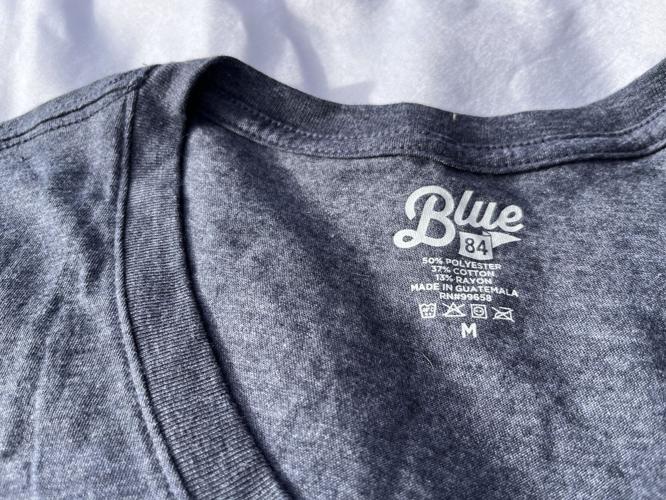
This Blue 84-branded shirt, featuring the Pennsylvania State University logo, was made in Guatemala, where garment workers earn the U.S. equivalent of $367.90 per month.
“That’s almost like asking me about world peace,” Thorgeirsson said. “It’s part of the reason why this is still such an issue … because it’s incredibly complex. I don’t think we can rely solely on factories and brands to resolve structural issues that ultimately need governmental support and assistance.”
Until that happens, universities that care about the issue have taken matters into their own hands. For example, at UCLA, they’ve cut down their licensees from more than 300 in 2010 to a current total of 126 companies that are able to produce goods with their logos on it. It’s easier to manage quality in a less complex supply chain, said UCLA licensing director Liz Kennedy.
“We can afford to be choosy here,” Kennedy said. “Having a license is a privilege. We do have support from our university system on the code of conduct. It’s great to have that, but it’s not going to enforce itself, is what we’ve learned.”
The intense market pressures of the global apparel industry have squeezed workers for decades, since overseas apparel production started ramping up in the 1980s and 1990s as brands left the U.S. in search of lower labor costs and higher profit margins. Instead of running their own factories, brands have increasingly outsourced production to outside suppliers.

This Auburn Tigers shirt was made in Honduras, where garment workers earn between $2.43 and $3.06 per hour.
That results in a “tremendous downward pressure” on subcontractor factories, said Matthew Williams, an expert in the global apparel labor movement and a lecturer at Loyola University in Chicago.
“The factory owners essentially have to run sweatshops if they want to stay in business,” Williams said.
Brands' and retailers’ actions during the COVID pandemic also worsened conditions. At the onset of the pandemic in spring 2020, brands canceled orders en masse, backing out on about $40 billion in orders. Workers ultimately paid the price of those actions, said Jason Judd, executive director of Cornell University’s Global Labor Institute.
“It was a mess,” Judd said. “Companies and buyers panicked. They were closing stores, laying off staff, canceling orders, which meant suppliers weren’t getting paid, which meant workers weren’t getting paid. They panicked and a lot of people suffered. When things go wrong, it’s people at the bottom who pay.”
Asking questions
The poor conditions in garment factories are nothing new to Akter, the Bangladeshi labor activist who started working in garment factories at the age of 12 to support her family. Long hours, unpaid overtime, verbal, physical and sexual abuse, poor air circulation and hostile management conditions were among the issues she and her coworkers faced, she said.
“Their life is supposed to be improved,” Akter said. “They should get out of poverty because they’re working.”
But the issues have continued. And when workers attempt to unionize, “they’re being threatened, beaten … and forced to leave the community,” she said.

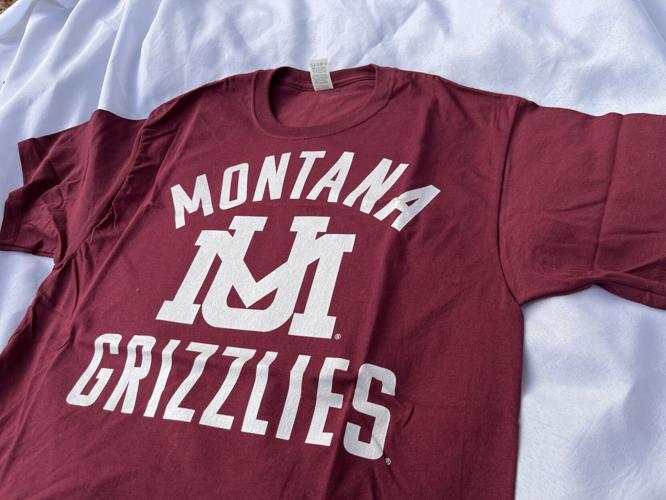
This $24.99 University of Montana shirt was made in El Salvador, where garment workers earn $359.16 per month.
But Western consumers have largely been ignorant of the issues faced by global apparel workers, except when disasters have served as a rude awakening to their plight.
“Consumers have become more aware of the concept of fast fashion, but they tend to think of brands like H&M and Shein first,” said Emily Stochl, advocacy manager at Remake, a fashion sustainability advocacy group. “They forget that all of the biggest fashion brands, whether they are a big-box retailer, designer, former mall brands or sportswear are manufactured in similarly exploitative conditions.”
Sifat Amita, a recent Penn State University graduate, who was born and raised in Bangladesh, said she didn’t know much about the plight of garment workers until the deadly Rana Plaza disaster. At Penn State, she joined the United Students Against Sweatshops chapter, but was disappointed when the group’s activism – including in the case of Hong Seng Knitting – did not appear to impact university administrators to alter the school’s relationship with Nike.
“We need to create more awareness among the consumer, among the student groups to make this kind of anti-sweatshop movement successful,” Amita said. “We have a lot to do.”
Photos: College clothing made in factories rife with labor violations, poverty wages

An Oklahoma State T-shirt sells for $25.95 on Amazon. But the garment worker who made it likely earned no more than 16 cents.

University of Missouri athletic gear- jerseys, sweatshirts, t-shirts and hats are on sale before the start of a football game between Missouri and LSU on Saturday, Oct. 7, 2023, at Tiger Team Store at Memorial Stadium in Columbia, Mo.

University of Missouri athletic gear- jerseys, sweatshirts, t-shirts and hats are on sale before the start of a football game between Missouri and LSU on Saturday, Oct. 7, 2023, at Tiger Team Store at Memorial Stadium in Columbia, Mo.
University of Missouri athletic gear — jerseys, sweatshirts, t-shirts and hats — are on sale before the start of a football game between Missouri and LSU on Saturday, Oct. 7, 2023, at Tiger Team Store at Memorial Stadium in Columbia, Mo.
Virginia Tech licensed apparel for sale in the Lane Stadium Hokie Shop prior to the start of the Pittsburgh Virginia Tech football game in Blacksburg, Va., on Saturday, Sept. 30, 2023.

The Hokie Shop clerks await the opening of the gates in the west side concourse prior to the start of the Pittsburgh Virginia Tech football game in Blacksburg Va. Saturday Sept. 30 2023.

Children apparel and novelty items for sale in the Lane Stadium Hokie Shop prior to the start of the Pittsburgh Virginia Tech football game in Blacksburg Va. Saturday Sept. 30 2023.

This $35 University of Virginia shirt was made in Peru by '47 Brand.

This $39.99 University of South Carolina shirt was made in El Salvador.

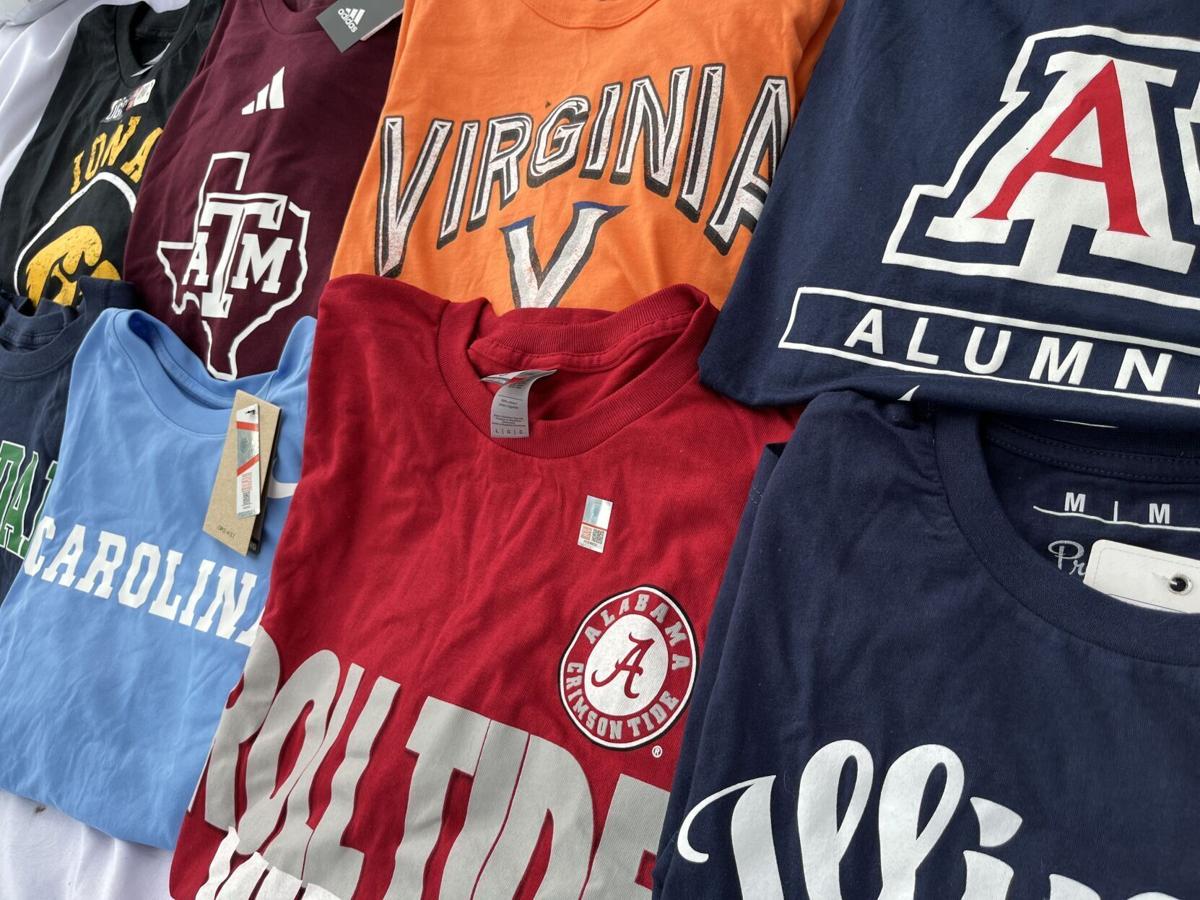
This $30 Adidas-branded Texas A&M shirt was made in Honduras.

This $30 Adidas-branded Texas A&M shirt was made in Honduras.

This $35 '47 Brand University of Virginia shirt was made in Peru.

This $35 T-shirt was made in Peru. Garment workers there earn the U.S. equivalent of $275.96 per month.

This Oklahoma State T-shirt sells for $25.95 on Amazon. But the garment worker who made it likely earned no more than 16 cents.

Oklahoma State University earned more than $2.3 million in royalties in 2022 from sales of college logo gear.

This $35.99 Penn State shirt was made in Guatemala.

This $38.84 Purdue University shirt was made in China.

The University of South Carolina pulled in $3.8 million in royalties in 2022 from the sale of logo gear like this T-shirt.

The University of Nebraska-Lincoln raked in nearly $4 million in royalties from apparel sales in 2022.
This $35 Nike T-shirt featuring the University of North Carolina was made El Salvador, where a garment worker was likely paid no more than 21 cents to make it.

This $21.99 Fanatics-branded University of Notre Dame shirt was made in Nicaragua.
This $21.99 Fanatics-branded University of Notre Dame shirt was made in Nicaragua.

This Oklahoma State T-shirt was made in Honduras.

This $59.99 Mizzou sweatshirt was made in El Salvador, where workers earn $359.16 per month.
This $24.99 University of Montana shirt was made in El Salvador, where garment workers earn $359.16 per month.

This $24.99 University of Montana shirt was made in El Salvador. A garment worker likely was paid no more than 15 cents to make it.
This University of Nebraska-Lincoln shirt was made in China. It's selling for $39.99. A garment worker likely was paid no more than 24 cents to make it.

Workers making university logo T-shirts, hoodies and more earn poverty-level wages and continue to face other harsh conditions including wage and severance theft, unsafe conditions, sexual harassment, and threats of violence over unionizing.

The University of Illinois made $1.3 million in royalties in 2022 from the sale of college logo apparel.

This Pressbox-branded University of Illinois shirt was made in Pakistan, where garment workers are paid between $84.40 and $101.58 per month.

The University of Iowa raked in $4.6 million in gross royalties from the sale of their logo gear in 2022.

This University of Iowa shirt was made in the Dominican Republic, where workers earn the U.S. equivalent of between $200 and $370 per month.
This Auburn Tigers shirt was made in Honduras, where garment workers earn between $2.43 and $3.06 per hour.
This Blue 84-branded shirt, featuring the Pennsylvania State University logo, was made in Guatemala, where garment workers earn the U.S. equivalent of $367.90 per month.
This Fanatics-branded University of Notre Dame shirt was made in Nicaragua.

Workers making university logo T-shirts, hoodies and more earn poverty-level wages and continue to face other harsh conditions including wage and severance theft, unsafe conditions, sexual harassment, and threats of violence over unionizing.
This $30 Adidas-branded shirt likely resulted in no more than 18 cents in pay for the worker who made it.

The University of Alabama earned nearly $12 million in gross royalties in 2022 from the sale of its logo gear, like this Roll Tide Y'all T-shirt.

The University of Arizona pulled in $2.5 million in 2022 in royalties from the sale of logo gear bearing its name and marks.
This $35 Nike T-shirt featuring the University of Arizona logo likely resulted in no more than 21 cents for the garment worker who made it.
Hayleigh Colombo is a member of the Lee Enterprises Public Service Journalism Team. Kimberly Wethal, Brendan Denison, Timothy Stanley and Faith Redd contributed to this report.