

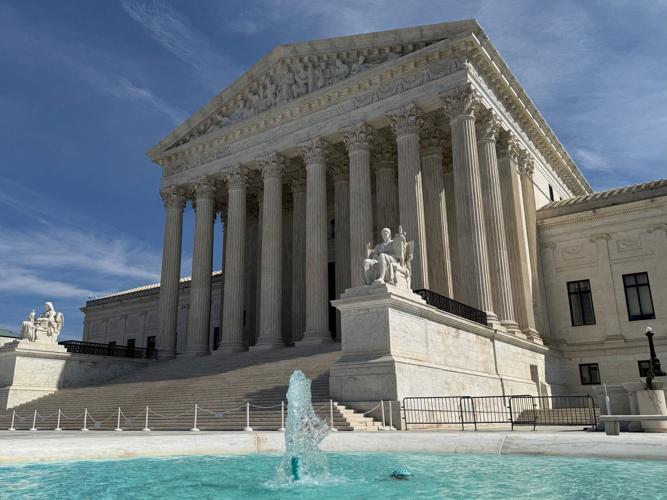
The attorneys for Arizona children who were sexually abused for years by their father are asking the U.S. Supreme Court to rule that Arizona's high court is unconstitutionally allowing religious institutions to unilaterally determine when they don't have to report congregants who tell them they are molesting children.
Attorneys John Trebon and Lynne Cadigan want the justices to set aside the unanimous July ruling by the Arizona Supreme Court that shields the Church of Jesus Christ of Latter-day Saints and two of its bishops from any liability for failing to report that Paul Adams told church bishops and others about his years-long abuse of his children. The lawsuit contends the failure to report to authorities Adams' admissions allowed him to continue to molest his children for years.
In throwing out the lawsuit, the Arizona Supreme Court ruled that religious institutions are entitled to decide when their doctrines require them to keep secret a confession made by a congregant about child abuse. The Arizona justices said the First Amendment provisions allowing "free exercise'' of religion preclude those decisions by church officials from being second-guessed by trial judges.
People are also reading…
The July ruling also said it is the religious institution — and not courts — that get to decide who, beyond "clergy'' members, also are exempt from requirements to report child abuse to authorities.
Trebon and Cadigan are arguing to the nation's high court that the ruling was legally wrong.
"It is the role of the judiciary, not churches, to interpret secular state standards,'' Trebon said. "The Arizona Supreme Court wildly misapplied the First Amendment to emasculate a neutral state statute."
A ruling in favor of the children would most immediately allow them to pursue their claims that the church and its officials bear liability for the fact that their father continued to molest them long after he had told not just two bishops but others about what he was doing.
It also would overturn the binding precedent that the Arizona Supreme Court set in the July ruling, which says that, in all future cases, churches, synagogues, mosques and other religious groups will get to claim immunity based solely on their own interpretation of what their faith requires — and not what a jury might decide.
The attorneys for the children say the U.S. Supreme Court needs to overturn that.
"The Arizona opinion effectively grants immunity to and creates an incentive for religious organizations to conceal child sex abuse,'' they wrote in a 36-page filing.
"It needlessly put the integrity and safety of children in harm's way despite decades of widely known child sexual abuse hidden by religious organizations,'' they said. "The Free Exercise Clause should not be used as both a sword and shield to encourage and exempt clergy from reporting any and all child sexual abuse under the cloak of Church doctrine.''
Confessions went unreported
The facts of the case are not in dispute.
In 2011, Adams, a Bisbee resident, confessed to Bishop John Herrod that he had molested his 5-year-old daughter. That confession under Arizona law, as it would be in most states, was considered privileged and Herrod was not required to report it to authorities.
Herrod, however, subsequently asked Adams' wife, Leizza, to join them, where Adams repeated his confession. Herrod counseled them together and recommended that either Adams turn himself in or that Leizza report him to the authorities, but did not report Adams himself.
The incident then came to the attention of Robert Mauzy, who succeeded Herrod as bishop. That led to a disciplinary proceeding that resulted in Adams' excommunications in 2013.
Here, too, there was no reporting to authorities.
Adams continued to rape that one daughter for an additional seven years, into her adolescence, and also abused her infant sister. He even recorded the abuse on videos and posted them online.
It all became public in 2017 when officials in New Zealand found a video online. Adams subsequently died by suicide in jail after his 2017 arrest.
His wife was sentenced to 2 1/2 years in prison after admitting she did not report that her children were being molested. She was released in 2020.
Non-clergy also heard the confessions
It is clear, Trebon and Cadigan noted, that the Arizona law that requires most people to report incidents of sexual abuse does have exceptions for "a confidential communication or a confession.''
The legal issue, they are telling the U.S. Supreme Court, is whether the subsequent conversations by Adams, like his original confession, were not subject to disclosure.
"Other states where the clergy hold the privilege, except Arizona, require a judicial determination of 'confidentiality' to exist,'' they wrote.
"But the Arizona Supreme Court declared that the First Amendment 'compelled' it to construe (amend) the statute to defer a finding of 'confidentiality' based on Church doctrine rather than objective reality. We contend the First Amendment does not compel any such result.''
They said the facts of the case show this is about more than just what Adams told Herrod.
"The LDS Church held several disciplinary proceedings involving 30 or more persons who also learned of the sex abuse, but failed to report,'' they told the court. "Leizza Adams, admittedly not a clergy member, attended and heard confessions of abuse during the disciplinary proceedings.''
But they said the Arizona justices "did not seem interested in factual 'confidentiality,' '' instead only noting that disciplinary proceedings are supposed to be confidential.
"No matter that theory and practice did not match,'' the attorneys for the children wrote.
There are other problems with the Arizona Supreme Court ruling, Trebon and Cadigan said.
While state law does have exemptions from reporting "a confidential communication or a confession,'' Arizona law contains no statutory definition for either. And the lawyers said even the Arizona justices recognized that fact, saying they were deciding the case based on "common meanings.''
"Still, the (Arizona Supreme) Court held that it is solely the role of the Church to determine whether a communication is confidential,'' they said.
The Arizona court's reasoning
In ruling in favor of the LDS Church and its bishops, Arizona Supreme Court Justice John Lopez argued that he and his colleagues had no choice but to rule against the children's lawsuit. He based that on the First Amendment, which says Congress may make no laws respecting the establishment of a religion or its free exercise, something Lopez said gives churches "an independence from secular control or manipulation.''
"Put simply, the Religion Clauses give religious institutions the power to decide for themselves, free from state interference, matters of church government as well as those of faith and doctrine,'' Lopez wrote.
That's the wrong interpretation of the First Amendment, Trebon and Cadigan told the U.S. Supreme Court.
They argue that what the First Amendment requires is a neutral — and objective — interpretation of the words in the law.
"Instead, the (Arizona) court empowered the Church to define and apply the relevant state standards using its religious doctrine,'' they wrote.
"The First Amendment Free Exercise Clause was misused as a tool to change a neutral child abuse statute into one that is 'compelled' to exempt clergy from reporting any abuse, confidential or not,'' they said.
In a prior written statement, Church of Jesus Christ of Latter-day Saints spokesman Doug Andersen said the abuse in this case was "reprehensible, and the Church has always condemned it.'' He also said the church has always been willing to help the victims in this case.
But Andersen said Arizona law recognizes the confidential nature of religious confession. And he said the Arizona Supreme Court ruling affirmed "that these religious protections are to be respected alongside society's shared commitment to protect the vulnerable.''
Howard Fischer is a veteran journalist who has been reporting since 1970 and covering state politics and the Legislature since 1982. Follow him on X, Bluesky and Threads at @azcapmedia or email azcapmedia@gmail.com.


