A U.S. senator from Arizona is behind an effort to recognize the Artemis II crew with a Congressional honor rarely awarded to astronauts.
Separate bills were introduced Wednesday, June 24, by Sen. Mark Kelly, D-Arizona, and retiring Nebraska GOP Rep. Don Bacon in both the Senate and House to award the Artemis II crew a Congressional Gold Medal. The bipartisan legislation comes more than two months after the four astronauts returned from the first crewed moon mission in more than half a century.

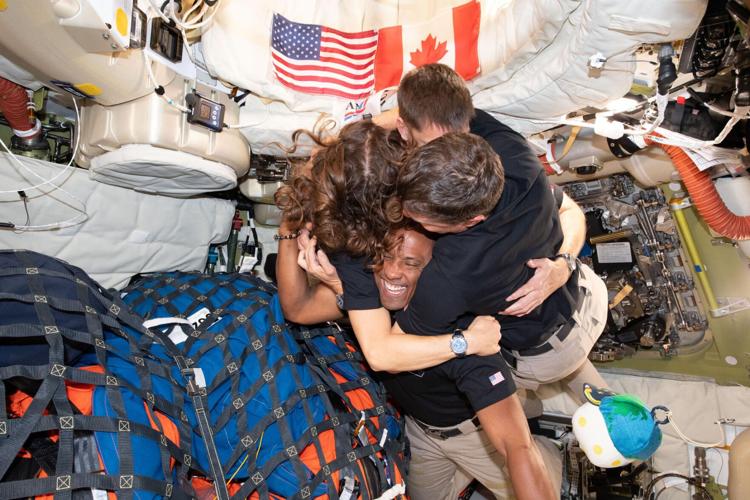
The crew members of Artemis II embrace following the historic lunar flyby April 6, during which the astronauts flew farther from Earth than anyone in human history while seeing sights of the moon's far side never seen in person.
The bills would first have to pass through Congress and be signed into law by President Donald Trump. If that were to happen, the Artemis II astronauts would become just the second ever crew to receive a Congressional Gold Medal after the honor was bestowed on the Apollo 11 crew in 2009 – 40 years after that historic mission.
The USA TODAY Network was the first to report the story.
People are also reading…
Here's everything to know about the Congressional Gold Medal, and why some lawmakers think the Artemis II astronauts are deserving of the honor amid NASA's drive to return humans to the moon.
Lawmakers seek to award Congressional Gold Medal
Kelly and Bacon introduced the legislation more than two months after NASA's Reid Wiseman, Victor Glover and Christina Koch and the Canadian Space Agency's Jeremy Hansen returned from the landmark Artemis II spaceflight.
To date, the only other time astronauts were awarded the medal was in 2009 when Neil Armstrong, Buzz Aldrin and Michael Collins received the honor for their part in the historic Apollo 11 moon landing in 1969.
Former astronaut went to space four times
Kelly, a retired NASA astronaut, attended the April launch from Florida of the historic crewed spaceflight around the moon.
Prior to his career as a public servant, Kelly, 61, was a Navy fighter pilot who saw combat and also a NASA astronaut who piloted — and even commanded — four NASA space shuttle missions between 2001 and 2011. During his astronaut career, Kelly spent a total of 50 days in space and traveled more than 20 million miles, according to his Senate biography.

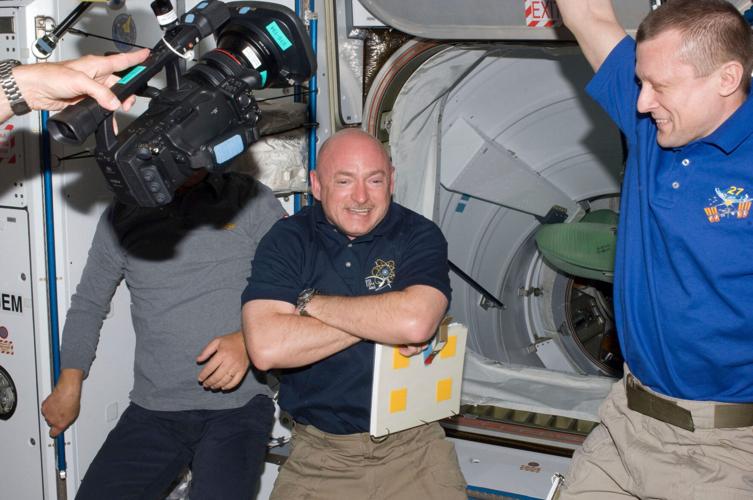
Mark Kelly is pictured May 18, 2011 being welcomed aboard the International Space Station after arriving on space shuttle Endeavor.
Kelly ultimately retired from both the Navy and NASA in 2011 — the same year that his wife, Gabby Giffords, a former Democratic congresswoman from Arizona, was shot and nearly killed in an attempted assassination in Tucson. He was first elected in 2020 as a U.S. senator.
Mark Kelly's twin brother Scott Kelly was also a NASA astronaut.
Kelly, Bacon, praise NASA's Artemis II astronauts
While it's rare for astronauts to be nominated for a Congressional Gold Medal, Kelly and Bacon said in statements first provided to the USA TODAY Network that the historical significance of the Artemis II mission made the crew worthy of the honor.
“Reid, Victor, Christina, and Jeremy carried human space exploration farther than it has ever gone before,” Kelly, who is also considering a 2028 run for president, said in a statement. "They reminded Americans what we're capable of when we work together ... For pushing the boundaries of human achievement, the Artemis II crew deserves this honor.”
Bacon praised the "extraordinary astronauts" in his statement, saying the mission carried on the iconic Apollo program's legacy in space exploration. The astronauts, Bacon said, "carried that legacy farther than any humans have ever traveled from Earth."
What is a Congressional Gold Medal?
The Congressional Gold Medal is the oldest and one of the highest civilian honors awarded by Congress.
The medal was first awarded in 1776 to George Washington during the American Revolution. Since then, Congress has broadened the recognition to include civilians and groups who have made a "long-standing impact on American history and culture," according to the Smithsonian.
What was the Artemis II mission?
The second mission under NASA's multibillion-dollar Artemis program, Artemis II marked the first time humans flew near the moon in more than 50 years.
The four astronauts rode in NASA's Orion spacecraft, which hitched a ride to space atop NASA's powerful 322-foot Space Launch System rocket during an April 1 launch from the Kennedy Space Center.
During the 10-day spaceflight, the Orion vehicle carried the astronauts around the moon and back to Earth without landing on the lunar surface.
Along the way, Wiseman, Glover, Koch and Hansen surpassed a record set during the infamous Apollo 13 mission in 1970 — traveling a historic 252,756 miles from Earth. They also bore witness to sights of the moon's far side never before seen by human eyes while traveling as close as 4,067 miles above the surface during a lunar flyby.
Splashing down April 10 in the Pacific Ocean near California, the mission ultimately served as a successful test flight, ensuring that both the SLS rocket and Orion spacecraft operated as expected during a crewed mission.
Upcoming Artemis III to precede moon landing
NASA is already making preparations for the next mission under the lunar campaign, the ultimate objective of which is to send humans back to the moon and construct a $20 billion moon base where astronauts can live and work.
Due for 2027, Artemis III aims to send a new crew of astronauts – NASA's Randy Bresnik, Andre Douglas and Frank Rubio, as well as the European Space Agency's Luca Parmitano – on an Orion vehicle to Earth orbit, where they will spend two weeks testing spacesuits and docking capabilities with two commercial lunar landers. Those landers are Blue Origin's Blue Moon lander, and SpaceX's Starship HLS (human landing system).
The mission is a complex one involving three separate rocket launches — NASA's SLS, Blue Origin's New Glenn and SpaceX's Starship — to get all three spacecraft to orbit.
A successful test mission would set the stage for the first human moon landing under the program during Artemis IV. Targeted for 2028, the mission would be the first time humans set foot on the moon since NASA's iconic Apollo era ended in 1972.
NASA views the moon program as a vital stepping stone to eventually send the first crewed expeditions to Mars — and it all largely began with Artemis II.


 U of A is mission control for new space probe launched to study distant stars, planets