From the start of high school, Ignacio knew he wanted to go to college to become a nurse practitioner. But when he learned that being undocumented disqualified him from in-state tuition at Arizona’s three public universities, his plans unraveled.
“It was definitely a hard time navigating through high school knowing that I probably wasn’t going to be able to afford college,” said Ignacio, who is being identified by his first name because of his immigration status. “I was like, ‘it’s unattainable, I’m not even going to try hard.’”
That shifted during his senior year, though, when he learned of Proposition 308. The 2022 ballot initiative promised in-state tuition to students who had graduated from an Arizona high school after attending for at least two years, regardless of their immigration status.
People are also reading…
“Prop. 308 — it changed my perspective on things,” he said. “It motivated me just to keep going.”
The initiative narrowly passed that November, with 51.2% of the vote. The following spring, Ignacio enrolled at Estrella Mountain Community College. His career goal changed, and he eventually transferred to the University of Arizona, where he’s now pursuing a double major in law and political science.
Ignacio’s experience reflects what Prop. 308 was designed to do: Reopen college as a realistic option for undocumented students who had grown up in Arizona. But three years after the law took effect, it remains difficult to say how many students have actually benefited—and how many were left behind.
Though national experts estimated that more than 3,600 undocumented students a year could qualify for in-state tuition under the measure, Arizona put no centralized system in place to oversee its rollout, track participation or ensure consistent implementation across colleges and universities.
“There wasn’t an effort from the governor or the Board of Regents, or any other effort to implement it,” José Patiño, vice president of education at Aliento, a nonprofit working with undocumented Arizonans, told AZCIR. “It was left basically to people who cared.”
As a result, students and advocates have shouldered much of the work required to benefit from the law, during a moment when political hostility toward immigrants has intensified nationally. Advocates suspect some students are still paying the higher, 150% tuition rate that applied to undocumented students at state universities before Prop. 308 passed, while others may be forgoing college entirely.

Implementation of Proposition 308, the voter-approved 2022 ballot initiative promised in-state tuition to students who graduate from an Arizona high school regardless of their immigration status, has been inconsistent.
“I think at the end of the day, even though we want them to advocate for themselves, the students shouldn’t have to carry that burden of having to go look for resources,” said Blanca Alcantara-Hershey, a coordinator in the University of Arizona’s AGAVE office, a student support center. “We could avoid all that by having a streamlined process.”
Arizona’s disjointed implementation has taken on new urgency as the Trump administration moves to challenge tuition equity laws in other states, creating confusion and fear among families weighing whether college is worth the risk. Taken together, the gaps suggest Arizona may have missed a narrow chance to make the promise of Prop. 308 real, and advocates say students are paying the price.
Along with Washington, D.C., Arizona was one of 22 states with a tuition equity law on the books as of September. Texas and California were the first to implement such measures in 2001.
These policies often draw bipartisan support, given their potential to reduce high school dropout rates, encourage undocumented students to pursue higher education and provide an economic boost. One 2022 analysis projected that students enrolling under Arizona’s Prop. 308 could strengthen the workforce and inject about $23 million into the state’s economy, while another found that any lost tuition revenue from in-state rates could be offset by increased enrollment.
In Arizona, three Republican lawmakers sponsored the bill to take the matter to voters, and it received overwhelming support from Democrats. The “Yes on Prop 308” committee was also chaired by a Republican, and groups like Aliento and ScholarshipsA-Z worked alongside the Greater Phoenix Chamber of Commerce and other business leaders to secure its passage.
Not all Republicans endorsed the measure, however. Some who had supported a 2006 initiative barring students without lawful status from receiving aid or in-state tuition urged voters to oppose Prop. 308, citing concerns about tuition costs and fairness.
After the initiative passed in 2022, the Arizona Board of Regents — which oversees Arizona State University, Northern Arizona University and the University of Arizona — held a meeting to revise its non-resident tuition policy. At the time, ABOR executive director John Arnold, now UA’s chief financial officer, acknowledged that only a small number of students would be affected immediately but said he hoped participation would “dramatically increase over the coming years.”
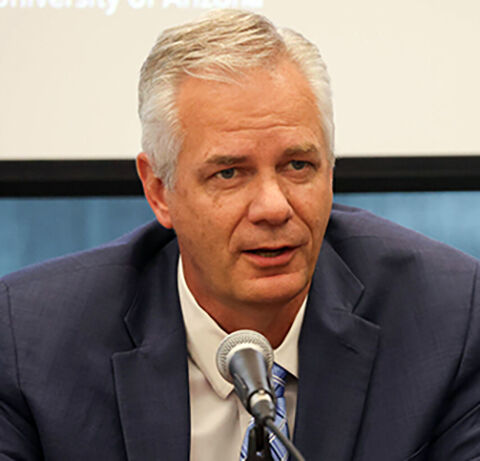
John Arnold
Arnold described the procedural policy change as “pretty straightforward,” and it passed unanimously. But multiple regents raised pointed questions about its implementation, including whether the three universities were prepared to enact the change the following semester and whether there was “any sort of communications plan to ensure that qualified students know about this.”
Arnold replied that the universities were excited to move the program forward, and that ABOR would rely on the schools to ensure eligible students were informed. Regent Larry Penley pushed back, arguing responsibility extended beyond the universities.
“When we offer these opportunities to students, promotion really is incumbent upon us,” said Penley, who did not respond to AZCIR’s recent request for comment. “And in many cases, I don’t think we’re taking as seriously as we need to the job to join with the three universities and really promote things like this to the public.”
Advocates working with undocumented students applying to college would likely agree with Penley’s assessment. Several told AZCIR that implementation lacked consistency because schools approached it differently, often requesting varying documents and information to prove eligibility. That led to confusion for students.
Carolina Silva, executive director of ScholarshipsA-Z, which assists undocumented students in southern Arizona, said one school asked for a driver’s license to prove residency—something those without legal status cannot obtain in Arizona. Her organization intervened, she said, helping the school identify alternative documents students could realistically provide.
“Some institutions created more hoops for students to jump through, not realizing, again, it would become another barrier,” Silva said. “It’s continued to just be a battle every step of the way.”
AZCIR requested information from 22 universities and community colleges on how many students have received in-state tuition through Prop. 308 since it took effect. Just seven schools were able to provide a number. Fourteen said they did not track usage, which is not required under the law. Yavapai College did not answer repeated requests for information.
Across the seven schools with data, about 720 students had received in-state tuition through the initiative as of the fall 2025 semester: 432 at Arizona State University, nearly 200 at Pima Community College and fewer than 70 at UA. For comparison, there are an estimated 11,000 undocumented students enrolled in higher education in Arizona, with about 1,000 graduating from high school annually.
Asked about AZCIR’s findings, a spokesperson for Democratic Gov. Katie Hobbs said the language approved by voters did not designate a lead agency for Prop. 308’s implementation, leaving responsibility to the Arizona Board of Regents for the state’s public universities and the governing boards of the state’s community college districts.
ABOR spokesperson Megan Gilbertson insisted the board provided clear policies, supported the schools in interpreting the law and provided “systemwide coordination.” She repeatedly pointed to the board’s FAQ page for Prop. 308, which she said is updated as questions arise.
Gilbertson did not share specifics about how the board communicated with schools to ensure consistency, however, acknowledging that “each university’s student information system is uniquely configured.”
As with the universities, implementation at community colleges was left to individual campuses, according to David Borofsky, executive director of the Arizona Community College Coordinating Council. The nonprofit works to support and promote collaboration among community colleges.
Policy changes involving access for immigrant students often cause “confusion and errors at first,” requiring active monitoring to work as intended, according to Tanya Broder, senior counsel of health and economic justice policy at the National Immigration Law Center.
“You can’t just declare victory and go home,” she said. “You really need to invest in making sure that these laws lead to good outcomes for the people.”
The FAQ document crafted and updated by the Board of Regents does not spell out how students can show they qualify for in-state tuition. It instead directs those with questions to contact the financial aid or residency classification office at their university.
What happens next largely depends on where a student enrolls.
Ignacio, who received in-state tuition at Estrella Mountain Community College before transferring to UA, said the process wasn’t particularly difficult at Estrella Mountain. At UA, finding the correct form to show he qualified “definitely took some digging.”
UA’s registrar site outlines the documentation requirements and links to a form for students seeking the “Arizona High School Graduate – Qualifying Non-Citizen tuition rate.” Students at Pima Community College likewise must submit a form and documentation, though a spokesperson said the “specific paperwork required can vary depending on each student’s situation.”
Jessica Martinez, a coordinator in UA’s AGAVE office, said students who learn of their eligibility through community organizations like ScholarshipsA-Z often know how to proceed. Those without that support may not know where to look.
Officials at ASU and Maricopa Community Colleges, the latter of which could not provide a count of students using Prop. 308, said applicants do not need to submit extra paperwork. Eligibility is determined using materials already included in applications, such as high school transcripts.
“We looked at making sure we weren’t collecting unnecessary information that wasn’t required under the law, just to make the barrier to enrollment that much easier for our students,” said Lindsey Wilson, a Maricopa Community Colleges spokesperson.
Lesli, an undocumented student being identified only by her first name, applied to ASU in the fall of 2022 before Prop. 308 took effect and was classified as an out-of-state resident after being accepted.
Her high school counselor called the university, explained Lesli’s status, and her residency classification and tuition rate were corrected. Without her counselor, though, Lesli—who saw college as too costly before Prop. 308—said she would have struggled to navigate the mix-up.
“I would have been stuck, and I just wouldn’t know where to start or where to go,” Lesli said.
Officials at NAU declined to explain how their students indicate they qualify and instead directed AZCIR to the university’s Prop. 308 website, which does not include instructions for demonstrating eligibility.
Silva, with ScholarshipsA-Z, said the qualification process can hinge on “who you know” within the admissions office at any given school. “It’s kind of still like three times the amount of work and time and headache a regular student would do,” she said.
Those added hurdles come as an unprecedented, nationwide crackdown on immigrants has heightened the stakes for undocumented students and their families. Patiño, with Aliento, said uncertainty around on-campus immigration enforcement and post-graduation paths to employment is making some question whether higher education is worth pursuing at all.
“How do we speak to the community about Prop. 308 and college, given the climate that is going on at the federal level?” he asked.
In April, President Donald Trump signed an executive order directing federal agencies to stop the enforcement of local laws granting in-state higher education tuition to undocumented students, contending they favor “aliens over any groups of American citizens.”
As of Jan. 6, his administration had sued seven states — Illinois, California, Oklahoma, Minnesota, Kentucky, Texas and Virginia — over tuition equity laws and policies. Kentucky, Texas, Virginia and Oklahoma sought to comply with the federal directive and end their policies but are facing challenges in court. Florida voluntarily repealed its law in February.
So far, the administration has not challenged Arizona’s statute, and state Attorney General Kris Mayes issued an opinion affirming that Prop. 308 complies with relevant federal laws. Still, advocates say the national backdrop continues to shape how families weigh their options.
As Silva works to increase visibility around Prop. 308, she said she has seen a shift in attitude among some of the families her organization assists, noting they “are just really scared in this moment.”
Despite that fear, she emphasized that “there is more access in Arizona than there has been for the past 20 years” — if students know how to claim it.
Molly Bohannon is an investigative reporter covering higher education for AZCIR, through a partnership with Report for America and the Arizona Local News Foundation’s Arizona Community Collaborative Fund.