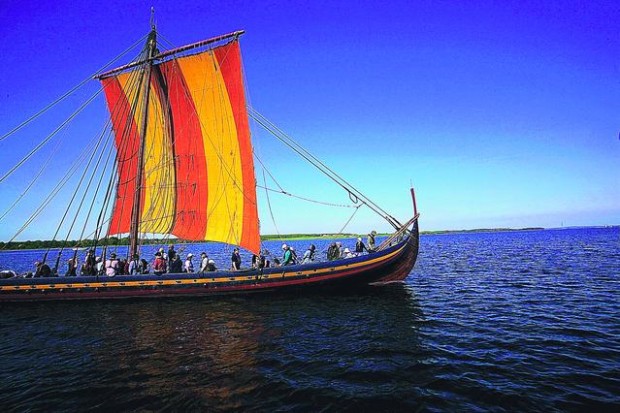
COPENHAGEN, Denmark — The crew of a replica Viking longship scrapped plans to sail across the North Sea on Monday because of unfavorable winds, and the ship was to be towed to a group of islands north of the Scottish mainland.
The Sea Stallion of Glendalough, billed as the biggest Viking ship reconstruction to date, will be towed to the Orkney islands by a support ship before continuing its voyage to Dublin, Ireland, where it is to arrive on Aug. 14.
"We have a timetable we have to stick to, and the winds are not favorable to us," said Mette Busch of the Viking Ship Museum in Roskilde, west of Copenhagen.
The initial plan was to travel nonstop from Roskilde to Dublin using only oars and sails — like Viking warriors did 1,000 years ago — but the weather intervened.
Just days after leaving Roskilde on July 1, the 100-foot-long ship was forced to make stops in Norway to await the right winds to cross the North Sea.
People are also reading…
After sailing along the Norwegian coast for nearly two weeks, the crew decided to start the crossing early Monday, but westerly winds made it impossible, Busch said. The ship would need an easterly wind to push it across the North Sea.
"Vikings didn't have deadlines, so they could sail whenever the winds permitted," Busch said. "They didn't have a reception committee jumping on the harbor in Dublin as we have."
The support ship, Cable One, will tow the Sea Stallion to Kirkwall, the biggest town on Orkney, where it was set to arrive Tuesday, she said.
Busch said the North Sea crossing was not the most important part of the journey for the Sea Stallion, which was modeled after a Viking ship believed to have been built in 1042 in Glendalough, Ireland.
"What is interesting for us is to sail in the waters around Orkney and the Irish Sea because the original was built to sail there," Busch said.
The expedition's goal is to give a better understanding of the challenges Vikings faced on their long journeys.
On the Net
• Viking Ship Museum: http://www.havhingsten.dk


 Vacant Tucson stores could transform into new housing