

TAIJI, Japan - The gala crowd in Los Angeles cheered as "The Cove" won the best documentary Oscar with its grisly portrayal of dolphin hunting. Half a world away, residents of the small Japanese village shown in the film abhorred the attention and said it won't end their centuries-old tradition.
In Taiji on the rocky coast of southwest Japan, residents gathered in whale eateries with names like "Tail" and rolled their eyes Monday when told of Oscar laurels for the film, which they see as yet another biased foreign take on their culture.
The village of 3,500 people has been hunting dolphins and whales since the early 1600s. It calls itself "Whale Town" and has a massive pair of whale statues looming over the main road. "The Cove" refers to Taiji and its dolphin fishing as "a little town with a really big secret," but local councilman Hisato Ryono said there is nothing to hide.
People are also reading…
"Everyone around here knows about it. The water nearby turns red during the hunt. The actual killing is done in a concealed area because it is unpleasant to look at, as is true of killing cows or pigs or any other animal," said Ryono, who says he was tricked into appearing in the film.
"This is a close-knit group of fishermen. The more they feel squeezed, the more they will close off to outsiders. They won't stop this hunt because of such pressure," Ryono said.
The Japanese government allows about 19,000 dolphins to be killed each year. Taiji hunts about 2,000 dolphins every year for meat - less than other places - but is singled out in part because of its "oikomi" method of herding and killing them near shore.
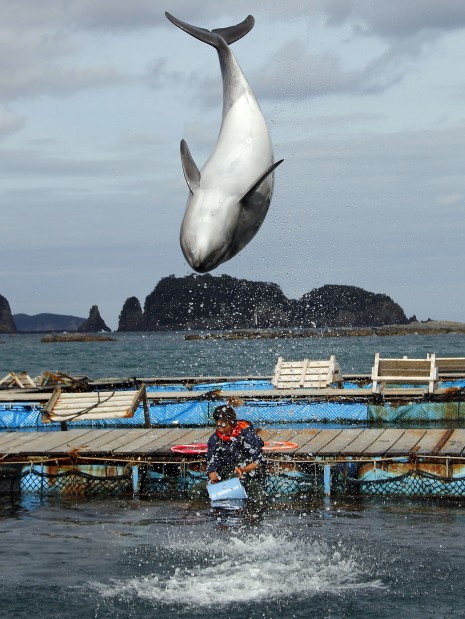
Dolphins, in addition to being food, are also recognized in Taiji as crowd- pleasers with their playful natures, leading to odd contrasts. Taiji fishermen capture some to sell to aquariums, and the area is dotted with ocean cages offering dolphin-bonding sessions. "Dolphin Base" charges 2,000 yen ($22) for a 20-minute session less than half a mile from the cove where hundreds of the animals are killed.
Like most residents of Taiji, the dolphin trainers repeatedly avoided talking to a foreign reporter - one young woman ran away when asked her opinion.
After the movie won, the town government issued a short news release.
"There are different food traditions within Japan and around the world," it read. "It is important to respect and understand regional food cultures, which are based on traditions with long histories."
Government officials defended the fishermen's right to hunt dolphins and called the film unbalanced.
"There are some countries that eat cows, and there are other countries that eat whales or dolphins," said Yutaka Aoki, fisheries division director. "A film about slaughtering cows or pigs might also be unwelcome to workers in that industry."


