

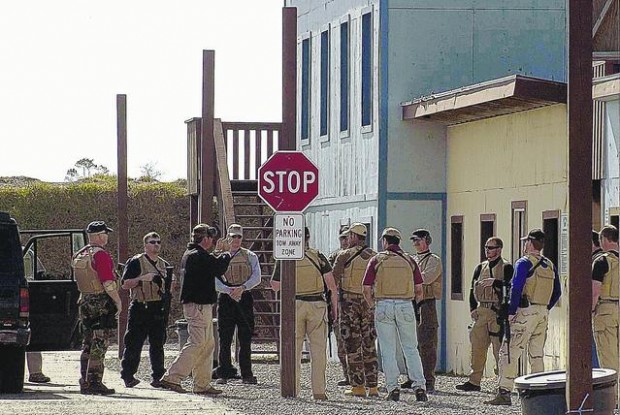
There are now nearly as many private contractors in Iraq as there are U.S. soldiers — and a large percentage of them are private security guards equipped with automatic weapons, body armor, helicopters and bulletproof trucks.
They operate with little or no supervision, accountable only to the firms employing them.
And as the country has plummeted toward anarchy and civil war, this private army has been accused of indiscriminately firing at American and Iraqi troops, and of shooting to death an unknown number of Iraqi citizens who got too close to their heavily armed convoys.
Not one has faced charges or prosecution.
There is great confusion among legal experts and military officials about what laws — if any — apply to Americans in this force of at least 48,000.
People are also reading…
They operate in a decidedly gray legal area. Unlike soldiers, they are not bound by the Uniform Code of Military Justice. Under a special provision secured by American-occupying forces, they are exempt from prosecution by Iraqis for crimes committed there.
The security firms insist their employees are governed by internal conduct rules and by use-of-force protocols established by the Coalition Provisional Authority, the U.S. occupation government that ruled Iraq for 14 months following the invasion.
But many soldiers on the ground — who make in a year what private guards can be paid in just one month — say their private counterparts should answer to a higher authority, just as they do. More than 60 U.S. soldiers in Iraq have been court-martialed on murder-related charges involving Iraqi citizens.
Security firms have more than $4 billion in government contracts, but the government doesn't know how many private soldiers it has hired, or where all of them are, according to the Government Accountability Office. And the companies are not required to report violent incidents involving their employees.
Security guards now constitute nearly 50 percent of all private contractors in Iraq.
The wartime numbers of private guards are unprecedented — as are their duties, many of which have historically been done by soldiers.
They protect U.S. military operations and have guarded high-ranking officials including Gen. David Petraeus, the U.S. commander in Baghdad. They also protect visiting foreign officials and thousands of construction projects.
At times, they are better equipped than military units.
Shootings anger Iraqis
Their presence has also pushed the war's direction. The 2004 battle of Fallujah — an unsuccessful military assault in which an estimated 27 U.S. Marines were killed, along with an unknown number of civilians — was retaliation for the killing, maiming and burning of four Blackwater guards in that city by a mob of insurgents.
"I understand this is war," said Rep. Jan Schakowsky, D-Ill., whose efforts for greater contractor accountability led to an amendment in next year's Pentagon spending bill.
"But that's absolutely no excuse for letting this very large force of armed private employees, dare I say mercenaries, run around without any accountability to anyone."
Blackwater has an estimated 1,000 employees in Iraq, and at least $800 million in government contracts. It is one of the most high-profile security firms in Iraq, with its fleet of "Little Bird" helicopters and armed door gunners swarming Baghdad and beyond.
The secretive company, run by a former Navy SEAL, is based at a massive, swampland complex in North Carolina. Until 9/11, it had few security contracts.
Since then, Blackwater profits have soared. And it has become the focus of numerous contractor controversies in Iraq, including the May 30 shooting death of an Iraqi deemed to be driving too close to a Blackwater security detail.
"The shooting of that Iraqi driver has intensified tensions," Schakowsky said. "The Iraqis are very angry."
Company spokeswoman Anne Tyrrell, in an e-mail to The Associated Press, said the shooting was justified.
"Based on incident reports and witness accounts, the Blackwater professional acted lawfully and appropriately," she wrote. There was no response to AP inquiries seeking further details.
Other alleged shootings involving contractors include:
● An incident in which a supervisor for a Virginia-based security company said he was "going to kill somebody today" and then shot at Iraqi civilians for amusement, possibly killing one, according to two employees.
The two, former Army Ranger Charles L. Sheppard III and former Marine Corps sniper Shane B. Schmidt, were fired by the company, Triple Canopy, and responded with a wrongful-termination lawsuit.
Their suit did not identify the shift leader they said deliberately opened fire on civilians in at least two incidents while their team was driving in Baghdad. He was described only as a former serviceman from Oklahoma.
On its Internet site, the company said all three were fired for failing to immediately report incidents involving gunfire. Triple Canopy, after an initial investigation, reported no one had been hurt and handed its information to the U.S. government.
Patricia Smith, a lawyer representing Sheppard and Schmidt, said the U.S. Justice Department declined to investigate. The Justice Department declined comment on the case.
On Aug. 1, a Fairfax County, Va., jury ruled that Triple Canopy did not wrongly fire the two men. But jury forewoman Lea Overby also issued a scathing note on behalf of the panel, saying the company displayed "poor conduct, lack of standard reporting procedures, bad investigation methods and unfair double standards."
The judge's jury instructions, Overby said, left no choice but ruling against the former employees.
● Disgruntled employees of London-based Aegis Defence Services, holder of one of the biggest U.S. security contracts in Iraq — valued at more than $430 million — posted videos on the Internet in 2005 showing company guards firing automatic weapons at civilians from the back of a moving security vehicle.
In one sequence, a civilian car is fired on, causing the driver to lose control and slam into a taxi. Another clip shows a white car being hit by automatic-weapons fire and then coming slowly to a stop.
In the videos, the security vehicle doesn't stop. It speeds on, leaving the civilians and their shot-up vehicles behind.
After initially denying involvement, Aegis, run by former Scots Guard Lt. Col. Tim Spicer, issued a statement saying the shootings were legal and within rules-of-force protocols of the now-defunct Coalition Provisional Authority.
Those guidelines allow security guards to fire on vehicles that approach too closely or too quickly. U.S. Army auditors, in their own investigation, agreed with Aegis.
● Sixteen American security guards were arrested and jailed by U.S. Marines in battle-scarred Fallujah in 2005 following a day of shooting incidents in which they allegedly fired on a Marine observation post, a combat patrol, and civilians walking and driving in the city, about 40 miles west of Baghdad.
The guards, employed by Zapata Engineering of North Carolina, were jailed for three days.
"They were detained because their actions posed a threat to coalition forces. I would say that constitutes a serious event," Marine spokesman Lt. Col. Dave Lapan said at the time.
The contractors were released and returned to the U.S., where they claimed the Marines humiliated and taunted them in prison, calling them "mercenaries" and intimidating them with dogs. The private guards denied taking part in the shootings.
Last year, the Naval Criminal Investigative Service closed its criminal investigation of the case "for lack of prosecutive merit," a spokesman said. None of the 16 men were charged.
Soldiers, contractors clash
Since American contractors first swarmed into Iraq, animosity has run high between soldiers and private security guards. Many of the latter are highly trained ex-members of elite military groups including Navy SEALS, Green Berets and Army Rangers.
"Most military guys resent them," said former Marine Lt. Col. Mike Zacchea, who spent two years in Iraq training and building the Iraqi army. "There's an attitude that if these guys really wanted to do the right thing, they would have stayed in the military."
In late 2004, the Reconstruction Operations Center opened in Baghdad. Its purpose was to track movement of contractors and military troops around the country and to keep records of violent incidents.
But participation is voluntary.
Military leaders say the government should demand that contractors report their movements and weapons use. Last year, officials of the 3rd Infantry Division in Baghdad told visiting GAO auditors that lack of coordination continued to endanger the lives of soldiers and contractors.


