

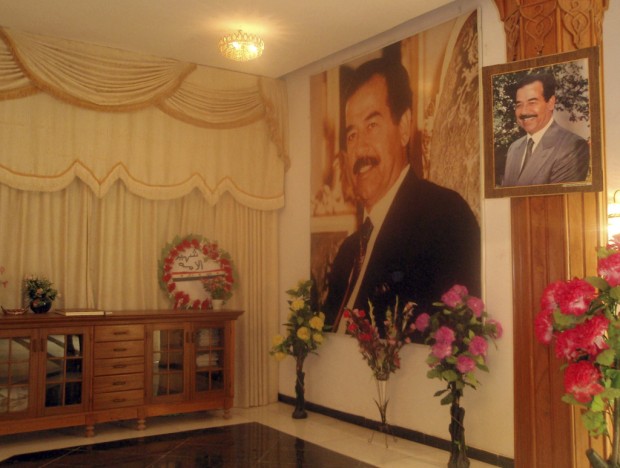
AL-AWJA, Iraq - In what passes for a mausoleum here, the body of Saddam Hussein lies in the middle of a marble octagon, under a giant twinkling chandelier and purple, orange and blue blinking lights. His corpse is covered with Iraqi flags, candies thrown by children, and bundles of plastic flowers.
It has been four years since the former Iraqi leader was executed, and over that period it has been rare to see any more than a trickle of his fellow Iraqis show up to pay tribute in his hometown, just outside Tikrit.
But over the past few months, the crowds have begun to grow.
On some recent weekends, more than 100 people at a time have crowded the mausoleum, somehow compelled to travel to the shrine of the man who once terrorized large parts of the country's population.
Some visitors say they are acting out of nostalgia, not just for a safer Iraq but for a more stable Middle East, like the one that predated the upheaval of the current Arab Spring.
People are also reading…
"He was the lion of the Middle East; he was stronger than all of the other Arab leaders. Look at them, they are falling now like flies," said Abu Hanza al-Khazraji, a Shiite who this week spent a morning driving to Saddam's grave with a carload of elders from the village of Dujail.
"Maybe the only one like him was (Libyan leader Moammar) Gadhafi, and now Americans are targeting him," said his brother, Abu Ali al-Khazraji.
In what was once a community center, the visitors shuffle past dozens of photos of Saddam, many of him posing with rifles or side-by-side with his sons, who were killed by U.S. strikes and whose bodies are buried nearby.
Accurate counts of visitors are not kept. More than 1,100 people have signed a guest book in the last five weeks. But one afternoon this week, only about one visitor in 20 signed the book. Most went straight to Saddam's side or read from a poem dedicated to "the courageous hero, the martyr."
Most visitors said they recalled days under Saddam when their children could go to school without fear of improvised explosives on roadways and when the electricity stayed on far longer than it does today.
"Everything was better," said one Sunni. "He was a dictator, but he was one dictator. Now we have many," said another.
The spectacle is clearly the kind of thing the U.S. government sought to avoid when it chose to bury Osama bin Laden at sea, rather than in a grave that might attract the faithful.
Joost Hiltermann, who has studied the Iraq conflict for the International Crisis Group, said the increase in visitors to Saddam's grave represents only a part of Iraq's population.
"There are many Shiites and Kurds who say the dictator is gone and we live more freely now. But Iraq is still an unhappy place," Hiltermann said. "A significant part of the population is nostalgic for strong leadership, unhappy about the endemic instability, and fear growing influence by Iran and sense that Iraq as a regional power is weakened."
Abu Hamza al-Khazraji, one of the group from Dujail, left no doubt that what he mourned was the loss of a strong Iraqi leader.
"Our nation is gone," he said. "He represented Iraq, and when we lost him, we lost our pride. We were once a proud people."


