
America’s housing crisis is devastating tens of millions of middle- and working-class tenants. They can't afford unfair, excessive rents and face the prospect of homelessness.

Patrick Range McDonald
According to data from Zillow, rents across major U.S. cities have surged 36% since 2020. Miami and Tampa have seen rent increases of more than 50%. It may seem hopeless.
But the Open Market Institute’s Brian Callaci and Sandeep Vaheesan offer sensible solutions in the Harvard Business Review. Rather than push the real estate industry’s flawed trickle-down agenda, Callaci and Vaheesan write that rent regulations are essential to protect hard-working tenants against powerful, predatory landlords.
People are also reading…

New York City Mayor Zohran Mamdani wants to seize the means of production, starting with landlords. He recently pledged to crack down on what he considers bad landlords, saying the city will work to “transfer ownership” to “responsible stewards including community land trusts and nonprofits.”
From New York to Illinois to California, the need for rent control is popular among tenants as they struggle with sky-high rent and the predatory business practices of the real estate industry. Corporate landlords are pushing back with their flawed, decades-old argument that we just need to build more housing, and then rents will come tumbling down. It’s a self-serving, self-enriching stance and hardly sincere. Does anyone really believe that the profit-driven real estate industry wants more affordable rents?
Besides rent control, America needs to preserve existing housing that's affordable, rather than demolishing it to make way for luxury housing. More pre-fabricated housing also can help.
The real estate industry, fearing it will no longer be able to charge exorbitant rents, has stepped up its attack against rent control.

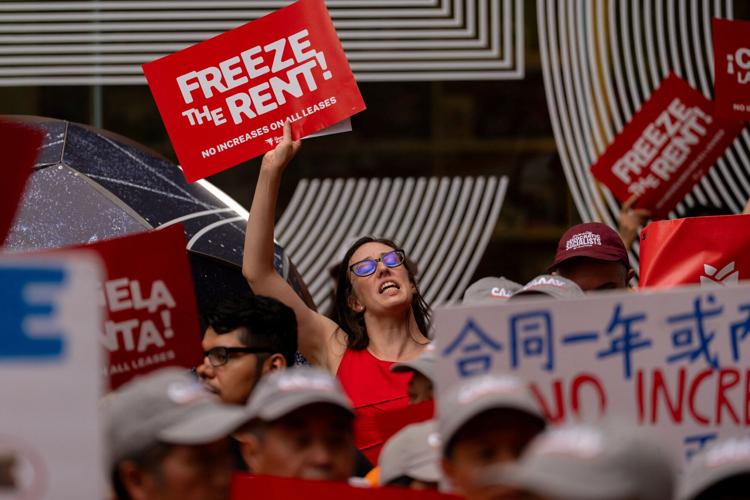
People rally June 25 outside the final public hearing and vote of New York City's Rent Guidelines Board on rent-stabilized apartments. The board froze rent on 1 million apartments for up to two years, fulfilling a campaign pledge by Mayor Zohran Mamdani.
Callaci and Vaheesan rightly highlight that market solutions alone won’t fix the problem. The rental market is seriously broken and needs revamping. Big Real Estate and Big Tech have created software that corporate landlords use to charge wildly excessive rents.
"Any plan to overhaul the housing market needs to, first, confront the power of landlords to raise rents," Callaci and Veheesan write. “Second, it requires rethinking public governance of housing markets behind simplistic prescriptions to just free the housing market from government regulation, assuming lower rents will follow. And third, it needs to provide more muscular government involvement in housing, through price regulation, more robust planning and even direct public provision.”
So we need the government to protect the poor and working-class tenants through rent control. No other tool will rein in Big Real Estate and Big Tech as urgently and effectively.
The “trust the market” argument, as Callaci and Vaheesan point out, hasn’t worked. Rent control is common sense, based on what advocates have seen on the frontlines of the housing crisis year after year. Callaci and Vaheesan explain that “extensive empirical research shows the simplistic story of such rent control leading to less and poorer quality rental housing is false.”
Instead of trusting greedy corporate landlords to do right by tenants, Callaci and Vaheesan write that rent regulations will “restrain the unilateral and collective price-setting power of landlords and can mitigate the long-term effects of the RealPage cartel.”
That refers to the nationwide RealPage scandal, in which the Texas-based technology firm developed software used by many of the largest corporate landlords in the country. It enabled landlords to collude and charge outrageous rents, according to ProPublica. Antitrust lawsuits were filed against RealPage and its clients, including one by the Department of Justice and a group of state attorneys general.
The arguments from Callaci and Vaheesan echo today’s veteran housing activists: Landlords, especially multibillion-dollar corporate landlords, have way too much power over tenants, and rent regulations level the playing field. Despite Big Real Estate’s talking points, activists have the facts on their side, and it’s time for policymakers to pay attention.