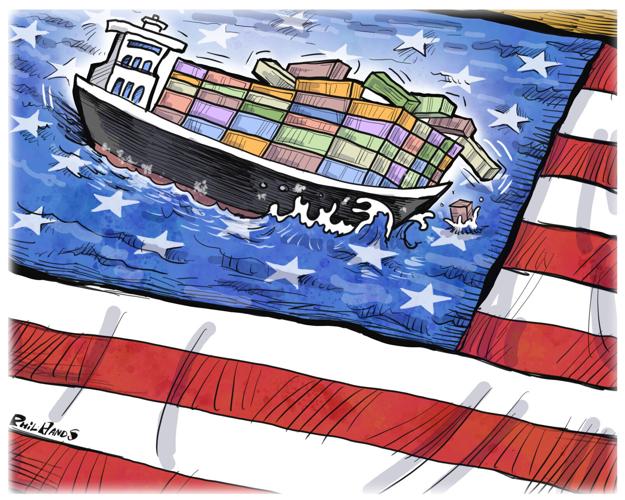
The Trump administration’s recent waiver of the Jones Act during the conflict in the Middle East recognizes that this law restricts the efficient movement of critical resources.

Katelyn Bledsoe
Passed in 1920, the Jones Act requires that all goods transported between U.S. ports be carried on vessels built in the United States, registered under the U.S. flag, and owned and crewed by Americans. On paper, the law was supposed to protect domestic shipbuilding. In reality, it didn't delivered on that goal — all while quietly raising the prices of essentials such as food and fuel.
American families are facing an affordability crisis. In a recent Politico poll, nearly half of Americans say they struggle to afford basic necessities such as groceries, utility bills, healthcare, housing and transportation.
People are also reading…
While many factors contribute to rising costs, the Jones Act is one of the most persistent and overlooked drivers.
The administration’s recent waiver of the Jones Act is to “allow vital resources like oil, natural gas, fertilizer and coal to flow freely to U.S. ports,” according to the White House.
That kind of temporary relief is not enough. High energy costs were a financial burden even before the U.S.-Iran engagement. Trump’s decision to waive the law until August recognizes policies that strengthen American competitiveness. If the U.S. is serious about energy dominance, American energy should be able to move freely to American consumers — not be constrained by outdated shipping restrictions.
Congress should repeal the Jones Act for good.
By limiting the number of vessels allowed to operate between U.S. ports, the Jones Act drives up shipping costs. With so few compliant ships, rates on Jones Act routes can in some cases reach several times those of foreign vessels.
Shipping impacts nearly every good that Americans consume. So higher shipping prices ultimately translate into higher prices at the gas pump and on store shelves. A U.S. International Trade Commission analysis compared the Jones Act’s effects to a significant tariff on domestic shipping.
Supporters of the Jones Act often argue that it is necessary for national security. They say it helps sustain domestic shipbuilding and a merchant fleet. But in practice, the law coincided with a shrinking number of U.S.-flagged vessels and higher costs that limit flexibility in times of crisis.

Nowhere are these costs more visible than in energy markets. The United States has no Jones Act-eligible liquefied natural gas tankers serving U.S. domestic routes. This leaves regions such as New England reliant on imported fuel, including shipments from Trinidad and Tobago -- even though abundant domestic supplies are closer.
An analysis by professors at the University of Chicago and Boston College found that repealing the Jones Act could save consumers $769 million annually in petroleum shipping costs.
The burden is even heavier in noncontiguous states and territories. A study for the World Bank estimates that the Jones Act imposes $1.4 billion in annual welfare costs on Puerto Rico, with consumers bearing about $692 million of that cost.
Hawaii has the highest energy costs in the nation, with electricity prices often more than double the national average. A study from the Grassroot Institute of Hawaii estimates that Hawaiian families pay an extra $1,800 annually for basic goods, including housing, food and gas, because of the Jones Act.
Congress can fix this by repealing the Jones Act and its distortion of the marketplace.
The affordability crisis confronting Americans today is not driven by a single policy. But the Jones Act is a clear and fixable contributor, one that raises costs, reduces efficiency and fails to deliver on its promises.
Repealing or reforming the Jones Act would not solve every challenge with affordability overnight. But it would lower costs, strengthen energy security and make American supply chains more efficient.
In an economy where every dollar matters, that’s a practical step Congress should take.
Bledsoe is the vice president of external affairs at Americans for Prosperity. She wrote this for InsideSources.com.