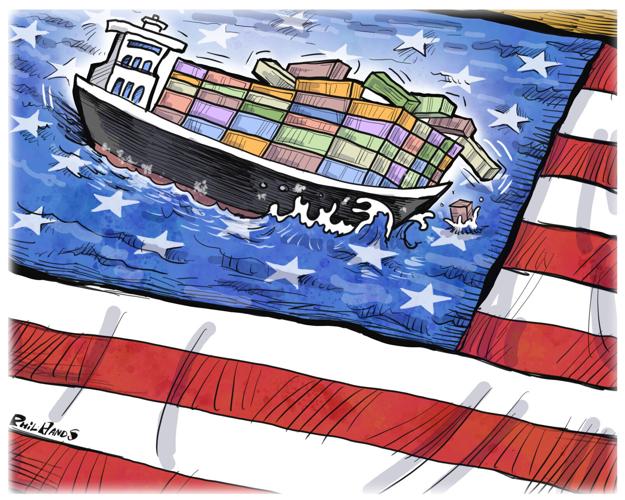
Only American-built, American-crewed and American-flagged vessels can deliver goods between U.S. ports, under the Jones Act.

Jennifer Carpenter
For years, critics demanded repeal. They claimed that allowing foreign vessels into domestic trade would lower prices and strengthen supply chains for American consumers.
A real-world test of that theory is now underway, and it is failing to make a difference.
Even as policymakers of both political parties agree on the need for robust American border security, the Trump administration's broad wavier of the Jones Act has blown a hole in America’s largest border — 95,000 miles of coastline. Those shores are now open to foreign vessels and foreign crews who don’t comply with U.S. immigration, tax, labor or other laws. The result is harm to American homeland security and to a strategically vital American shipping industry, with no real benefit to the American consumer.
People are also reading…
The Jones Act creates a stable market for investment in American vessels and crew dedicated to serving U.S. needs. Some 105 countries — including allies South Korea, Japan, Australia and Canada — have similar laws. More nations have adopted these laws since the COVID-19 pandemic exposed the fragility of global supply chains.

The Trump administration’s recent waiver of the Jones Act during the conflict in the Middle East recognizes that this law restricts the efficient movement of critical resources.
The Trump administration's suspension of the Jones Act is promoted as a way to improve the flow of domestic fuel and ease pressure on prices during the Iran conflict, which has stalled global shipments and limited supplies. The waiver allows foreign ships with foreign crews to transport critical energy cargo along America's coasts, inland waterways and to non-contiguous territories.
The waiver has not accomplished its goals.
Gas prices are driven by forces far larger than shipping rules, including global crude prices, refinery capacity, state fuel standards, taxes and wholesale markets. The cost of U.S.-flag shipping is estimated at only around a penny per gallon.
Supporters of the waiver have focused on getting enough fuel to California. They claimed the waiver would boost fuel shipments from the U.S. Gulf Coast to California. Yet no meaningful increase has occurred.

Why? Because commodities move to where returns are highest. If Gulf Coast refiners and traders earn more by exporting to Europe or Asia, they will. The opportunity to use a foreign-flagged ship that avoids U.S. tax, labor and environmental requirements is not enough to persuade patriotic action out of a globalized industry. According to Reuters, fuel exports have surged as refiners shipped product abroad, where profit margins were stronger. Some fuel cargo meant for the East Coast even reversed direction and moved overseas rather than taking advantage of the waiver.
That is precisely where the importance of American maritime becomes clear. The Jones Act keeps ships, mariners and supporting infrastructure anchored in the domestic market rather than chasing short-term returns abroad. In periods of volatility, that capacity matters. It is why foreign tankers have been charging rates nearly twice as much, while our carriers keep rates steady.
The U.S.-flagged fleet, 45,000 vessels strong, provides reliability, accountability and capacity the nation can lean on. Regardless of the waiver, American carriers are moving fuel, fertilizer and other critical cargo between U.S. ports.
Without the Jones Act, the U.S. would be dependent on outside actors — including our adversaries — to move strategic goods within our own borders. That would weaken supply-chain resilience, undercut American jobs, open immigration loopholes and erode the industrial base our military depends on.
This is why the Jones Act continues to enjoy strong bipartisan support in Congress. Policymakers understand the stakes of “giving up the ship.”
It is time to put America first by supporting the U.S. shipping capacity that keeps our economy and national security resilient.
Carpenter is the president and CEO of the American Waterways Operators. She wrote this for InsideSources.com.