


The most important Missouri Supreme Court decision that’s never been enforced is known by a woman’s name who is no longer a part of the case.
It affects schoolchildren who probably know nothing about it.
It unites school districts in their opposition to justice.
It turns on a simple premise: Do children have the right to transfer to an adjoining school district if the one they live in has failed to provide them an adequate education?
The answer, of course, is yes, they should. That’s what the Missouri Supreme Court ruled in 2010 in the case of Turner v. Clayton School District. The lead plaintiff, St. Louis city resident Jane Turner, sent her children to Clayton district schools because city schools were unaccredited. Then she sued the Clayton schools to recover the tuition she had paid.
People are also reading…
In 2010, the state’s highest court turned the educational establishment upside down by ruling that a state law requires an adjoining district to accept children from an unaccredited district, and that the district where the child resides must pay for the student’s education. The ruling could have had — and should have had — a dramatic effect on public education in the St. Louis region.
It hasn’t, because both the city school district that at the time was unaccredited, and the suburban districts which feared an onslaught of students, continued to tie the issue up in court. Meanwhile, state lawmakers were unable to clarify the law or create an atmosphere that forced the school districts to cooperate.
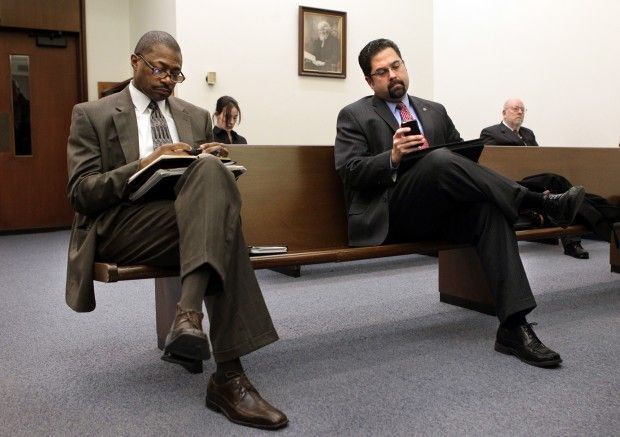
So on Tuesday, the case, now known as Breitenfeld vs. Clayton, was back before the Missouri Supreme Court. This year, the court will rule on a more narrow element of law. When the case was sent back to St. Louis Circuit Court for review, school districts argued that the law violates the state Hancock Amendment’s “unfunded mandate” provision. That means public bodies can’t be forced to assume obligations that aren’t paid for.
There is now less urgency to the case. That’s not because Gina Breitenfeld’s two children are less valuable than Ms. Turner’s, but because the St. Louis Public Schools have since regained provisional accreditation.
Still, the underlying issue is the same. Whose responsibility is it to educate children from failing school districts? Who will step up?
Rather than dividing school districts, the Breitenfeld vs. Clayton case should unite the entire St. Louis region into helping the slowly improving St. Louis Public Schools, and the unaccredited Riverview Gardens and Normandy districts, find a sustained path toward success.
Their failure is all of our failure, both from a purely moral standpoint, and also because as long as the school district in the core of our city can’t make the sort of gains that attract young families and businesses, then our entire region suffers economically.
Once again, lawmakers in the Missouri Legislature are talking about a variety of reform measures. Some of the proposals, like applying a letter grade to each school to give parents more understandable information, have merit. Others, like gutting teacher tenure before a system is in place to better evaluate teachers, are potentially harmful.
None of those ideas gets to the core of the problem: There simply are too many school districts in the St. Louis metropolitan area (49 of them on the Missouri side of the Mississippi River), too many arbitrary lines drawn on a map that protect property values instead of children. There is no built-in incentive for the entire region to take seriously the conditions of public education in our poorer communities. There’s not enough of a commitment to the one idea — early childhood education — that the evidence shows will help our community the most.
The Breitenfeld vs. Clayton case might be decided narrowly, but it’s a big, broad issue.
We hope the court once again reaffirms its commitment to every child in Missouri. The court should rule once and for all that failure is not an option.
