

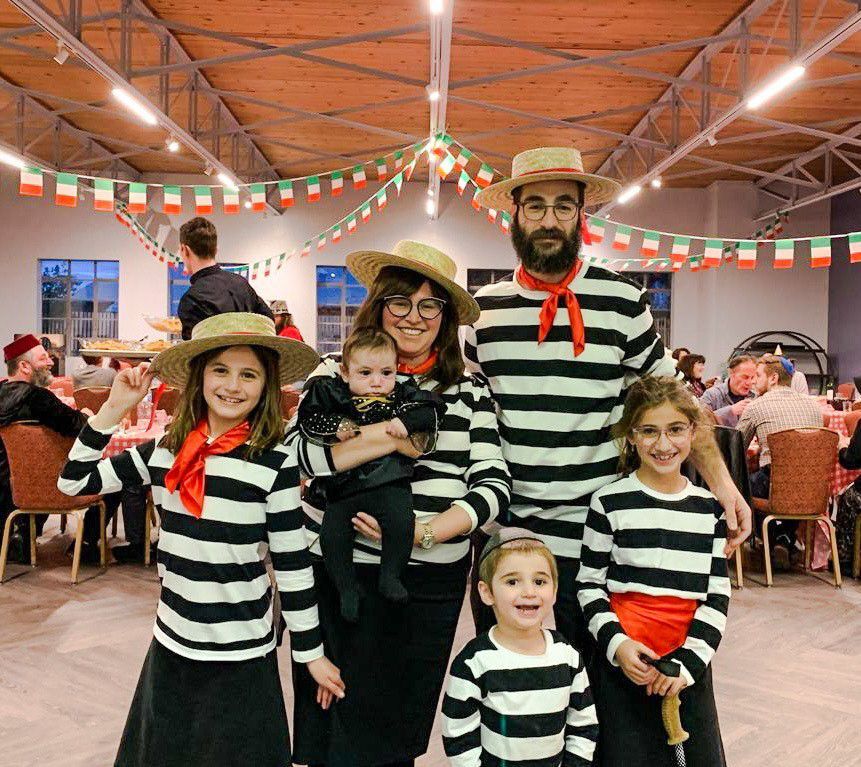
On a typical day, I’m easy to spot on the streets of Tucson. Even on the hottest days, you will notice my white shirt, dark pants and a yarmulke on my head. On Shabbat and holidays, I can be seen wearing a dark jacket and a black fedora.
But once a year, I’m dressed unusually, even for a Chassidic Jew. You might see me dressed as a gondolier, or a mad scientist, or a baseball player or jungle explorer.
That once a year is Purim (which begins this year on the evening of Thursday, Feb. 25, and ends on the evening of Friday, Feb. 26). This Jewish holiday reminds us not to avoid chaos and uncertainty, but to accept and embrace it, and learn to live with it.
Like many Jewish holidays, Purim’s basic theme is — to borrow the well-used aphorism — “they tried to kill us, we won, let’s eat.” As told in the biblical Book of Esther, the holiday commemorates the nullification of an edict in 356 B.C.E. to exterminate the Jewish people throughout the Persian Empire.
People are also reading…
The Jews had been equal citizens in ancient Persia’s society, but due to the machinations of a vindictive court official, a royal decree was issued to exterminate the Jews in the kingdom. Purim celebrates the fact that miraculously, that order of genocide was reversed, and the Jews were saved.
Unlike other Jewish holidays, Purim is not commemorated with intense synagogue services such as on the High Holidays, or lengthy ritualistic meals like on Passover. Instead, we celebrate it with a distinct spirit of unbridled joy, levity, and even silliness.
The holiday observances take on a lighthearted spirit even though ritual is part of the celebration. We read the book of Esther, but we make a ruckus when the name of the key antagonist (Haman) is mentioned. We enjoy a holiday feast, and distribute gifts of food and charity to friends and needy community members to ensure they can partake in the joy as well.
One might legitimately ask, “Why the levity? Shouldn’t such a significant episode in Jewish history — when we were saved from utter annihilation — merit the same stately, even solemn, commemoration we observe during other holidays?”
The difference is that on Purim, we’re not just celebrating in a topsy-turvy way — we’re celebrating that we live in a topsy-turvy world. We are actually celebrating the inherent unpredictability of life. That’s why on Purim, you might find me and my children dressed up in silly costumes, even as we visit local straight-laced businesses and homes.
During this COVID-19 pandemic, we are reminded that life is not normal these days, but history shows us that chaos has been far more common than order. The trick is not to be overwhelmed or devastated by the challenges life throws at us, but to find a way to celebrate life despite the threats and losses we face.
Retired U.S. Navy Adm. William McRaven tells in his bestselling book “Make Your Bed” about his superior — and later, friend — Lt. Philip “Moki” Martin. Martin was a shining example of healthy and fit living. He would ride his bicycle every day, weather permitting. Then one day another cyclist crashed into him. Martin has used a wheelchair ever since.
The crash devastated his routine, broke his body and shattered his way of life. But it didn’t break the man. He found new meaning in his new normal. He became a renowned painter, and he continues to oversee the triathlon in Colorado.
“If you want to change the world, learn to let go and carry on,” McRaven says in the book.
So we celebrate Purim by letting go and both creating and enjoying silly chaos. It is a joyful training for the chaos life throws at us when we keep hoping for normal.


 For sale: Tucson's Park Place mall